Dispute resolutions applied for by 227 affected investors take little time
Problems arise if banks reject settlement proposals
Compensation in lawsuits likely less than half
100% refund with contract cancellation if fraud is proven
[Asia Economy Reporters Koh Hyung-kwang and Park Ji-hwan] Investors in Lime Asset Management’s redemption suspension funds, which are expected to incur losses of up to 1 trillion KRW, are deliberating between lawsuits and dispute mediation. Attention is focused on whether investors can recover 100% of their principal if it is revealed that the funds were sold even after recognizing the insolvency during the sales process of the Lime Trade Finance Fund.
According to the financial investment industry on the 18th, there are two main ways for investors affected by the Lime redemption suspension incident to receive compensation. The first is to use the Financial Supervisory Service’s (FSS) dispute mediation. Dispute mediation has the advantage of taking less time than the prosecutor’s investigation or court rulings, which are expected to take several years.
An investor affected by the Lime redemption suspension said, “The biggest issue in the current Lime incident is the time required,” adding, “Considering that lawsuits take not only costs but also more time, we are pinning our hopes on the FSS dispute mediation.” According to the FSS, 227 dispute mediation applications had been received as of the 16th. In response to the surge in dispute mediation applications, the FSS is also operating a dedicated Lime Fund dispute window at the FSS Financial Consumer Center.
However, dispute mediation becomes problematic if the sales companies such as banks and securities firms reject the mediation proposal. Currently, the sales companies maintain the position that they were also victims who were unaware of the Lime fund’s insolvency. If the sales companies do not accept the dispute mediation proposal, investors have no choice but to pursue civil lawsuits, which can take up to five years or more.
There is also the option of immediately choosing litigation. In fact, some investors believe that although the financial authorities discovered Lime’s illegal activities during an inspection of Lime Asset Management conducted last year, they did not inform the market or issue warning messages, which exacerbated the current situation. Therefore, rather than trusting the financial authorities’ dispute mediation process, they prefer to receive a court judgment as soon as possible.
The key issues in the Lime incident handled by both the financial authorities’ dispute mediation and court lawsuits are “incomplete sales” and “contract fraud.” In both dispute mediation and lawsuits, claims for damages due to incomplete sales are likely to be accepted, but the compensation amount is expected to be less than half of the invested amount. Actual compensation also requires the liquidation or redemption of the fund as a prerequisite, which may take considerable time.
On the other hand, if “fraudulent acts” are proven in the FSS investigation or lawsuits, the contract can be canceled, allowing investors to recover all their invested funds. In this case, investors can expect a resolution 2 to 3 years faster than if it is recognized as incomplete sales.
The financial authorities are reportedly considering a plan to compensate up to 100% of the investment for the “Lime Trade Finance Fund (Pluto TF-1),” one of the three parent funds of Lime Asset Management whose redemptions have been suspended, by applying fraud charges. According to the FSS investigation, Lime Asset Management invested about 600 billion KRW in overseas trade finance funds such as the IIG Fund, BAF Fund, and Barack Fund together with Shinhan Financial Investment in May 2017. Among these, it was discovered that the IIG Fund had not calculated its net asset value since June 2018, and in November of the same year, it was found that the IIG Fund had created fake bonds and had entered liquidation procedures. However, this was not disclosed to investors. The FSS judged that Shinhan Financial Investment continued to sell the fund as if it were normal even after recognizing the fund’s insolvency.
The legal community has judged that if a financial company continued to sell a fund to general investors despite prior knowledge of its insolvency, it could be grounds for contract cancellation. Attorney Kim Kwang-jung of the law firm Hangyul explained, “Cases where fund products have been canceled through lawsuits are rare, but if it is recognized that the sales company proceeded with sales knowing the insolvency in advance, cancellation could be possible.”
It is difficult to predict whether the date the sales company recognized the insolvency was June 2018, when the IIG Fund’s net asset value was not calculated, or November 2018, when they received an email about the IIG Fund entering liquidation procedures, but funds sold after that point are likely to receive 100% compensation.
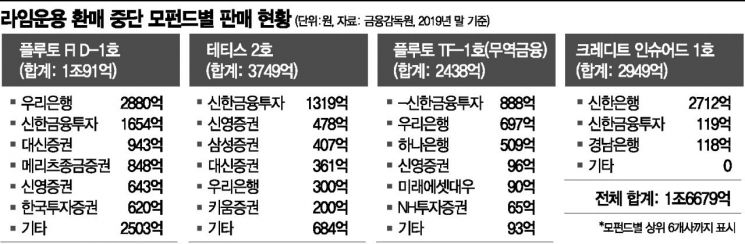
The total amount set up for trade finance funds sold under the Lime name is 243.8 billion KRW, with 38 sub-funds. The financial company that sold the most of this trade finance fund was Shinhan Financial Investment, which sold a total of 88.8 billion KRW. Woori Bank (69.7 billion KRW) and Hana Bank (50.9 billion KRW) also sold more than 50 billion KRW each. The sales amounts of these three financial companies total 209.4 billion KRW, accounting for 86% of the total sales amount.
© The Asia Business Daily(www.asiae.co.kr). All rights reserved.
![User Who Sold Erroneously Deposited Bitcoins to Repay Debt and Fund Entertainment... What Did the Supreme Court Decide in 2021? [Legal Issue Check]](https://cwcontent.asiae.co.kr/asiaresize/183/2026020910431234020_1770601391.png)