Including Measures to Partially Upgrade 'Speculative Overheated Zones'
Loan Regulations for 'Mid-Low Priced Housing' Between 600 Million and 900 Million Won Also Enforced
[Asia Economy Reporters Inho Yoo, Hyunjung Kim, Sehee Jang] The government’s decision to introduce additional real estate measures such as expanding regulated areas and tightening loan restrictions despite opposition from the ruling party reflects its determination to curb the balloon effect early and prevent the spread of rising housing prices. The plan to expand the adjusted target areas to include Suwon, Yongin, Seongnam (collectively known as 'Suyongseong') plus alpha (α) appears to stem from this concern.
The core of this measure is expected to be pinpoint regulations on houses priced between 600 million and 900 million KRW in the Seoul metropolitan area, where housing prices have surged. Since the December 16 real estate measures last year strengthened regulations on high-priced homes exceeding 900 million KRW, a balloon effect has appeared in apartments priced below 900 million KRW in southern Gyeonggi areas such as Suyongseong. However, industry insiders express concerns that regulation-focused real estate policies could deepen market distortions in the long term.
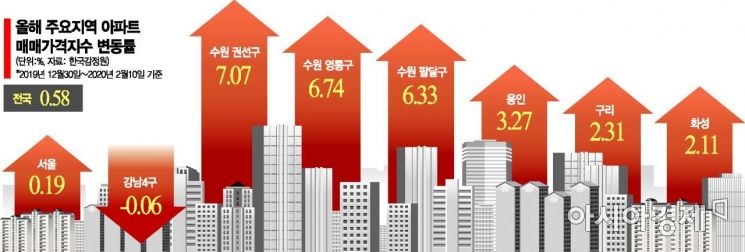
◆Significant Expansion of Adjusted Target Areas Expected= According to multiple government officials, candidates for the alpha region beyond Suyongseong include Guri, Hwaseong, and Namyangju in Gyeonggi Province. The government is considering proactively designating not only areas where prices have already surged but also those showing signs of increase, aiming to preemptively block another balloon effect caused by Suyongseong regulations. This also seems to take into account the ruling party’s resistance due to public opinion concerns about regulating only specific regions ahead of the April general elections. According to the Korea Real Estate Board, since the December 16 measures, apartment prices in the Gangnam area have stabilized with a 0.06% decline, but prices in Suwon have surged over 5%. Yongin, Guri, and Hwaseong have also recorded housing price increases of 2-3%. In fact, in outer areas like Hwaseong Dongtan New Town, prices for medium-sized apartments of 84㎡ have repeatedly surpassed the psychological threshold of 1 billion KRW.
The possibility of including some local metropolitan cities such as Daejeon, where recent housing price increases have been notable, in the adjusted target areas cannot be ruled out.
There is also speculation inside and outside the government that some areas already designated as adjusted target areas may be upgraded to speculative overheating districts. Leading candidates include Suji and Giheung in Yongin, and Sujeong in Seongnam. A government official said, "It is highly likely that all areas in Suwon, Yongin, and Seongnam, including Yeongtong-gu and Gwonseon-gu in Suwon, will be included in the adjusted target areas."
If included in the regulated areas, loan-to-value ratio (LTV) and debt-to-income ratio (DTI) limits will be reduced, and capital gains tax surcharges for multiple homeowners will apply, naturally resulting in regulatory effects through taxation. For adjusted target areas, LTV and DTI are limited to 60% and 50%, respectively, and in speculative overheating districts, both are capped at 40%. For homes exceeding 900 million KRW in speculative overheating districts, LTV drops to 10-20%, and for homes over 1.5 billion KRW, it is 0%.
◆Tightening Loans on Mid-to-Lower Priced Homes= New loan regulations are also expected to be part of this measure. The target is anticipated to be 'mid-to-lower priced homes' priced between 600 million and 900 million KRW. This price range is where the balloon effect is mainly occurring across the Seoul metropolitan area.
Accordingly, reducing LTV and DTI limits for homes in this price range within adjusted target areas or speculative overheating districts is considered a likely option.
There is also discussion about extending the loan regulations applied in speculative overheating districts to adjusted target areas. Currently, LTV for homes priced over 900 million KRW in speculative overheating districts is reduced from 40% to 20%, and applying this to adjusted target areas is being considered. However, to maintain differentiation from speculative overheating districts, the LTV limit for homes over 900 million KRW in adjusted target areas is likely to be set somewhat higher.
Additionally, plans to strengthen investigations into funding plans and sources, crack down on false transactions, false listings, and price collusion are expected to be announced. A Ministry of Economy and Finance official explained, "Until now, due to investigation authority issues, crackdowns were conducted jointly with local governments, but from this month, they will be converted to permanent crackdowns," adding, "With the organization and system in place, the crackdown intensity will be increased."
However, experts consistently predict that since the purpose of this measure is to block the balloon effect caused by the December 16 measures, it will not be a large-scale policy including tax measures beyond designating adjusted target areas and tightening loan regulations. Regarding taxes, the burden of holding taxes has already significantly increased due to the realization of official property prices, so the likelihood of additional regulations is low.
Concerns about suppressive regulations have also been raised. Professor Kyo-eon Shim of Konkuk University’s Department of Real Estate said, "While liquidity is increasing, if balloon effect areas are designated as adjusted target areas, the government will have to consider how to prevent second and third balloon effects," and added, "Regulations without supply will, in the long term, fuel rapid housing price increases and may have adverse effects on the real estate market immediately."
© The Asia Business Daily(www.asiae.co.kr). All rights reserved.
![User Who Sold Erroneously Deposited Bitcoins to Repay Debt and Fund Entertainment... What Did the Supreme Court Decide in 2021? [Legal Issue Check]](https://cwcontent.asiae.co.kr/asiaresize/183/2026020910431234020_1770601391.png)















