Ministry of Employment and Labor-Labor Institute Announce 'Wage Distribution Status by Business Characteristics'
[Asia Economy Reporter Kim Bo-kyung] "How much do workers in the same industry with similar years of experience earn?"
Anyone who receives a monthly salary from their company has probably wondered this at least once. This is because there was no clear way to compare how my wage stands within the same industry. From now on, it will be possible to understand wage levels based on six variables: business size, occupation, experience, gender, and more.
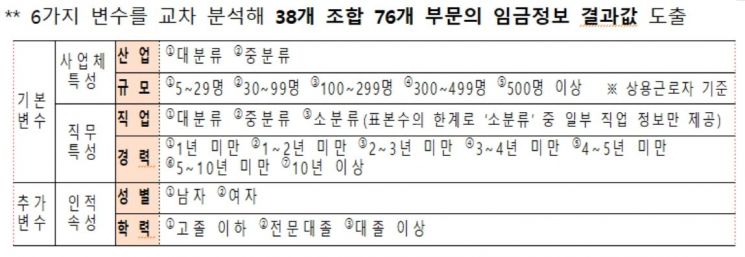
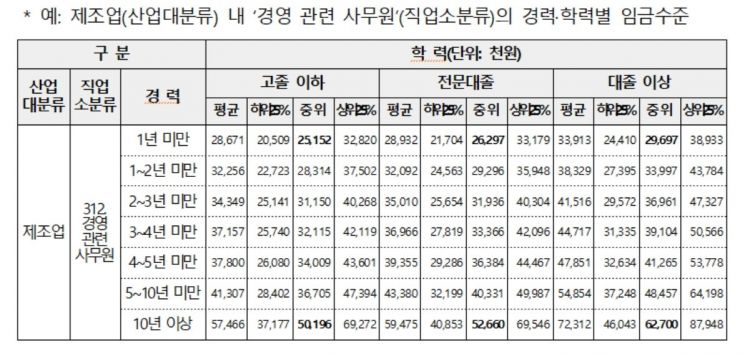
The Ministry of Employment and Labor and the Korea Labor Institute announced on the 18th that they will process, analyze, and disclose the "Wage Distribution Status by Business Characteristics." They used three years of statistics from 2016 to 2018, with a sample size of about 2.3 million workers. The results were derived by cross-analyzing six variables: business characteristics (size, industry), job characteristics (occupation, experience), and personal attributes (gender, education). Based on annual wages combining fixed wages and special wages excluding overtime pay, wage information is provided at four levels: ▲average ▲bottom 25% ▲median ▲top 25%. This information can be found on the Wage and Job Information System website (www.wage.go.kr) under the menu "Wage Information - Wage Distribution Status by Business Characteristics."
By utilizing this data, it is expected that the overall wage distribution status can be understood. You will be able to know the wage level of other workers doing similar jobs in the same industry or companies of similar size. For example, the median annual wage for a second-year college graduate working in the financial industry is 40,648,000 KRW, and the average is 47,802,000 KRW.
In advanced countries such as the United States and Europe, various types of market wage information are provided through government or public-private institutions. Recently, the scope of disclosure has been expanding further to address the gender wage gap.
However, in Korea, wage information has been regarded as a company's "business secret." Because of this, there has been a lack of sufficient market wage information for companies and workers to refer to in practice, causing difficulties. At a corporate field meeting held by the Ministry of Employment and Labor last November, many HR managers expressed the opinion that it would be good to have sufficient wage information for companies to refer to.
Through this data, it is possible to refer to wage levels by business size or occupation within specific industries. It also provides an overall view of annual wage levels by business size, experience, gender, and education across various occupations. Additionally, it allows checking the extent of wage gaps between men and women.
Oh Gye-taek, Director of the Wage and Job Innovation Center at the Korea Labor Institute, said, "Unlike the current wage information provision method where users have to search and compare information one by one, providing more detailed overall statistical data will improve access to wage information in the field."
Director Oh added, "Like in foreign countries, we plan to announce the 'Wage Distribution Status by Business Characteristics' every year in the second half starting this year, so that it can serve as a mechanism to autonomously reduce wage gaps in the labor market in the long term."
Kim Min-seok, Director of Labor-Management Cooperation Policy at the Ministry of Employment and Labor, said, "We plan to continuously expand public infrastructure related to wage distribution and gap information," adding, "The government will continue policy efforts to reduce wage gaps and polarization in the labor market through various means such as tripartite social dialogue."
© The Asia Business Daily(www.asiae.co.kr). All rights reserved.



















