Seodaemun-gu Announces Research Results for Optimal Supply of 생활SOC... Reflecting Resident Demand, Accessibility, Socioeconomic Characteristics to Identify Priority Supply Areas... Survey Reveals Need for Libraries, Senior Classes, Urban Parks for Learning, Care, and Rest
[Asia Economy Reporter Jongil Park] Seodaemun-gu (Mayor Moon Seok-jin) recently conducted a "Living SOC Status Survey and Analysis" to improve residents' quality of life by efficiently supplying facilities in areas with poor access to living SOC.
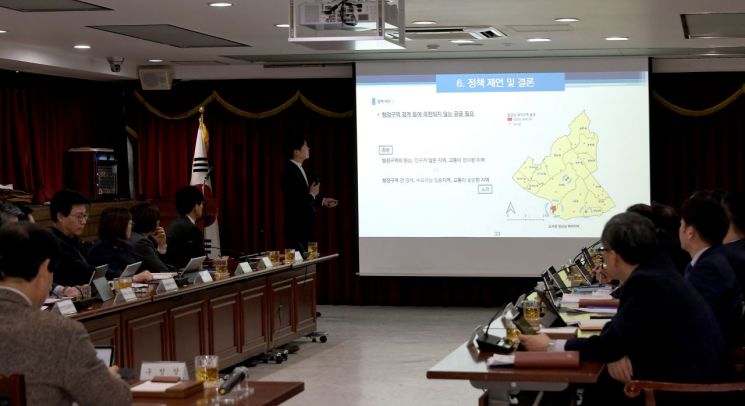
According to the presentation by the Seodaemun-gu Policy Research Team at the policy meeting held on the morning of the 17th in the Planning Situation Room of the district office, the services needed in the area include libraries, senior citizen classrooms, and urban parks for learning, care, and rest.
It was also found that areas vulnerable to access to living SOC are mainly distributed along administrative district boundaries, places with small populations but high demand, and areas with inconvenient transportation.
The presentation highlighted the necessity of ▲ supplying living SOC beyond administrative district boundaries ▲ supporting services in areas where facility supply is difficult ▲ installing complex facilities in areas generally vulnerable to living SOC services.
Furthermore, to secure accessibility, it was found necessary to strengthen the "review of pedestrian routes to living SOC" during the construction review of large-scale housing complexes.
These research results were derived by considering the supply status relative to service demand, residents' opinions, and socio-economic characteristics to identify "priority supply areas" and "service supplementation plans."
Living SOC includes all facilities that enhance residents' convenience in daily life, such as childcare, medical, welfare, transportation, cultural, sports facilities, and parks.
According to the "National Urban Regeneration Basic Policy," which presents standards for local governments' living SOC supply, facilities are classified into "regional hub facilities" and "village hub facilities," with village-level facilities especially encouraged to be installed within walking distance from residential areas to provide living-close services.
So far, the living SOC supply plans conducted by the Ministry of Land, Infrastructure and Transport and Seoul City have been analyzed using straight-line distances, which have limitations when applied at the local government level.
Accordingly, the Seodaemun-gu Policy Research Team analyzed in more detail by using the concept of "network distance," which is similar to actual walking distance, and a "population distribution grid" of 100m by 100m.
With this research, it is expected that living SOC-related departments of local governments can utilize the Seodaemun-gu Policy Research Team's analysis method when reviewing regional priorities for supply facilities and service supplementation plans.
Moon Seok-jin, Mayor of Seodaemun-gu, suggested a direction for improvement, stating, "It is necessary to ensure the effectiveness of this research by reviewing linkage plans with projects being carried out in the district, such as urban redevelopment projects."
He also emphasized, "In the future, the Policy Research Team should aim for research that can present a vision for the overall urban planning of Seodaemun-gu, along with micro-level approaches."
Seodaemun-gu Policy Research Team (330-4313)
© The Asia Business Daily(www.asiae.co.kr). All rights reserved.

















