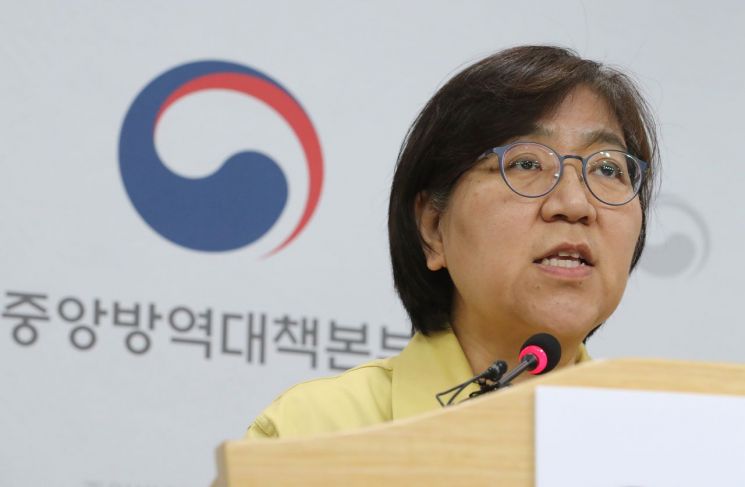
 Jung Eun-kyung, head of the Central Disease Control Headquarters (Director of the Korea Disease Control and Prevention Agency), is holding a regular briefing on the domestic COVID-19 outbreak status and interim investigation results of confirmed cases on the afternoon of the 17th at the Korea Disease Control and Prevention Agency in Cheongju, Chungbuk.
 [Asia Economy Reporter Choi Dae-yeol] The quarantine authorities announced that they will expand the scope of their response to the novel coronavirus infection (COVID-19) to include earlier detection and treatment of patients. While efforts so far have focused on minimizing cases imported from overseas countries, mainly China, and managing contact with existing patients, future measures will take into account the possibility of numerous patients with unclear infection routes emerging throughout the local community. The fact that COVID-19 symptoms are often mild and early detection and treatment lead to a high recovery rate also influenced this decision.
Jung Eun-kyung, head of the Central Disease Control Headquarters, said at a briefing on the 17th, "Since the confirmed case on the 20th of last month, we have mainly pursued a strategy to block importation of the virus for about a month," adding, "Going forward, while continuing this strategy, we judge that early detection, early diagnosis, and treatment of patients are important to prevent infections in medical institutions and to delay the spread in the local community as much as possible."
According to the quarantine headquarters, the 29th and 30th confirmed patients had no history of overseas travel nor contact with existing patients. After identifying the patients, investigations into their infection routes are underway, but so far the source of infection remains unclear. For the previous 28 patients, it was possible to determine or estimate the infection routes, but for these patients, it is difficult based on the currently confirmed movement paths. This is the background for concerns about the spread of infection within the local community.
The government had anticipated this situation. Compared to Middle East Respiratory Syndrome (MERS) or Severe Acute Respiratory Syndrome (SARS), COVID-19 has a lower fatality rate (the proportion of deaths after infection) and severity. However, because symptoms are often mild or absent, many patients did not realize they were infected and transmitted the virus to those around them. Medical professionals currently believe that transmission is possible even in the early stages of infection when symptoms are minimal or absent. This increases the likelihood of widespread transmission throughout the local community.
This background also influenced the quarantine authorities to include COVID-19 as a subject of continuous monitoring in frontline medical institutions. Currently, there is a surveillance system for severe acute respiratory infections centered on 13 tertiary hospitals, and starting from the 18th, COVID-19 will be added to this system to monitor patient occurrences and identify causative pathogens. The number of participating medical institutions will be expanded going forward.
Additionally, COVID-19 will be added to the test items in the influenza and respiratory virus infection pathogen surveillance system, which currently targets eight types of viruses. The quarantine authorities have established and are operating a national surveillance system that collects respiratory specimens from patients suspected of having influenza at 52 medical institutions and sends them to 17 provincial health and environment research institutes for testing influenza and respiratory viruses. Through this system, they check weekly which viruses are currently prevalent and provide this information to the public and medical institutions.
Head Jung said, "It is time to focus on blocking infection cases in the community and medical institutions by establishing a surveillance system for early detection of patients through expanded diagnostic testing, strengthening infection prevention in medical institutions, and enhancing protective measures for vulnerable facilities."
© The Asia Business Daily(www.asiae.co.kr). All rights reserved.

















