Ministry of Economy and Finance, 2020 Work Report
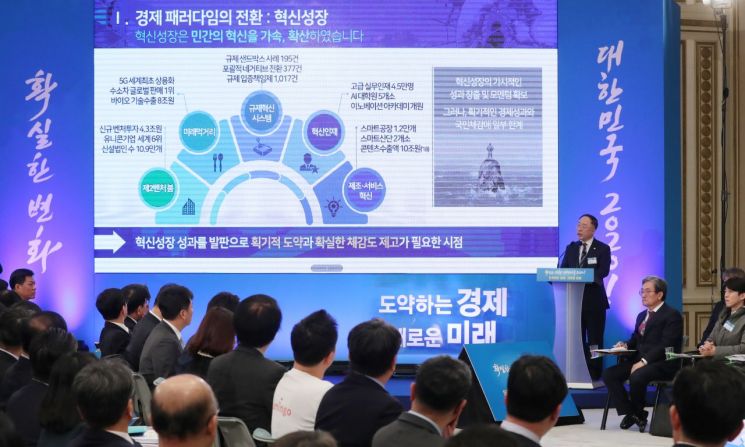
[Asia Economy Reporter Jang Sehee] The Ministry of Economy and Finance announced that this year it will achieve tangible results in innovation growth sectors that the public can feel by preemptively capturing new industries and new markets, and through bold regulatory reforms and infrastructure support. Although the globally spreading COVID-19 is expected to impact the real economy, the ministry also expressed an optimistic outlook that early resolution is possible if the government, businesses, and the public cooperate together.
On the 16th, the Ministry of Economy and Finance held its 2020 work report at the Blue House State Guest House, containing these details. This year, to overcome the psychological economic contraction caused by COVID-19 and promote economic revitalization, a town hall meeting was held where President Moon Jae-in, ministers of economic-related departments, and economic experts from various fields sat down and communicated openly without formality.
At this meeting, the Ministry emphasized that it will promote innovation growth centered on the 4+1 strategic framework: the second venture boom, manufacturing and service innovation, future growth engines, innovative talent, and regulatory innovation. The ministry stated, "Innovation growth has steadily increased economic outcomes by accelerating and spreading private sector innovation," adding, "Building on this foundation, this year we will focus on a breakthrough leap and a clear improvement in public perception." It further emphasized, "We are pushing forward policies with speed by coordinating interdepartmental differences and activating collaboration systems through innovation growth strategy meetings and green room meetings."
◆ Activation of the Data Economy and Fostering the Bio Industry = First, the plan is to strategically nurture new industries. A data economy activation plan will be established by next month, and follow-up work related to the amendment of the three data laws will be carried out without delay. Additionally, the ministry plans to promote the disclosure and use of public data, build transaction infrastructure such as data exchanges, and encourage fusion between heterogeneous data.
Furthermore, the bio industry will be fostered as the next-generation growth industry following semiconductors. The Ministry of Economy and Finance identified ten core tasks for the bio industry, including ▲a strategy for building big data on life research resources ▲innovation strategies for bio research and development (R&D) ▲a master plan for bio industry workforce development ▲and a comprehensive strategy for K-Beauty innovation.
Efforts will also be made to strengthen the competitiveness of key industries and the service industry. The number of smart factories will be significantly expanded to 30,000 by 2022, and smart industrial complexes will increase from 2 to 10. Strategic investments in DNA (Data, Network, AI) and the Big 3 (system semiconductors, future cars, bio-health) will also be reinforced.
◆ Accelerating Innovative Talent Development and Strengthening the Innovation Finance System = Alongside this, the ministry will support 24.2 trillion won in national R&D to secure technological capabilities. AI graduate schools will be increased to cultivate innovative talent, and policy finance for innovation growth sectors will be expanded from the existing 39.6 trillion won to 45.6 trillion won.
Bold regulatory innovation will also be pursued. The ministry plans to select ten key regulatory-focused industrial sectors across five areas (new industries, bio-health, common industries, manufacturing innovation, and service industries) and review them from the ground up.
In the first quarter, a 'One Step Model' plan will be announced to reform regulations in new industry areas, resolve conflicts, and build social consensus. To reach agreements, tailored use of policy menus such as regulatory sandboxes, profit-sharing agreements, and cooperative formation will also be considered.
Additionally, the ministry plans to expand customized job support for each life cycle and vulnerable groups, and to foster the care economy by increasing social service jobs in response to rising welfare demands.
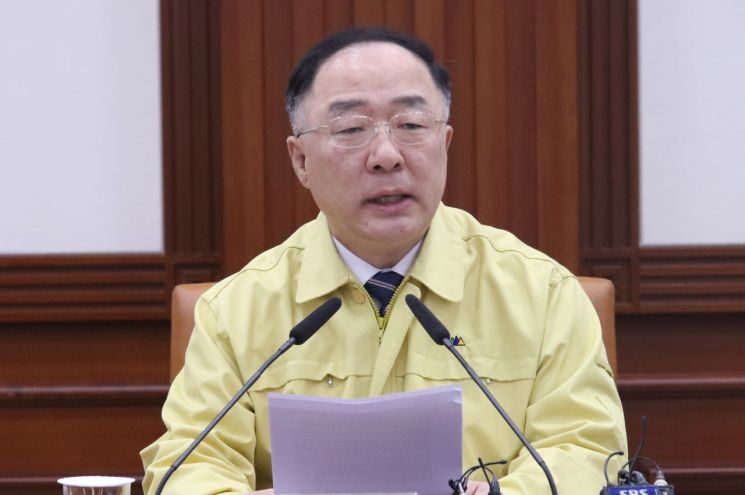
◆ COVID-19 Causes Declines in Exports and Tourists... "Early Resolution Possible Through Cooperation" = At the work report, Deputy Prime Minister and Minister of Economy and Finance Hong Nam-ki said that while quarantine measures are being steadily managed by the government, the impact on the real economy is inevitable. Hong stated, "The COVID-19 situation is expected to lower China's economic growth rate and weaken global supply chains, which will have ripple effects on the global economy," adding, "Under the goal that public safety is the top priority, we will devote all fiscal and budgetary efforts to proactive quarantine measures, even if they seem excessive." He continued, "We will make every effort to minimize the economic ripple effects early and help affected industries and regions overcome the crisis."
Measures to stimulate subdued consumption were also mentioned. Hong explained, "We will prepare a comprehensive package of measures this month to encourage investment, domestic demand, and exports," adding, "We will discover 100 trillion won worth of investment projects in the private, private capital, and public sectors, and will carry out the measures planned earlier this year without delay." Furthermore, he said, "As the International Monetary Fund (IMF) pointed out, COVID-19 is a temporary shock," and explained, "If the public, companies, and government unite and cooperate, we believe we can end COVID-19 early and overcome its economic ripple effects."
However, the ministry drew a line on supplementary budgets (extra budgets), stating that it is not considering them. On the same day, Kim Yong-beom, Vice Minister of Economy and Finance, said, "It is currently February, and sufficient contingency funds have been secured. We will actively respond through support from policy finance institutions and partial changes to fund project plans," adding, "Since there is sufficient capacity, we are not considering supplementary budgets at this time."
© The Asia Business Daily(www.asiae.co.kr). All rights reserved.


















