Announcement of Support Measures at the Economic Ministers' Meeting
Airline, Shipping, Tourism, and Dining Industries Hit Hard by COVID-19
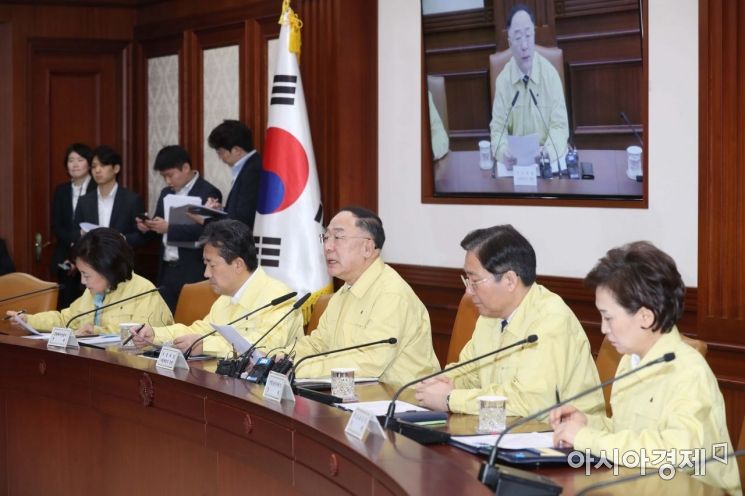 Hong Nam-ki, Deputy Prime Minister and Minister of Economy and Finance, is speaking at the 'Economic Ministers' Meeting on COVID-19 Response and Related Ministers' Meeting on Japan's Export Regulations' held on the 17th at the government Seoul office video conference room. / Photo by Moon Ho-nam munonam@
[Asia Economy Reporters Kwangho Lee and Sehee Jang] The government will inject more than 420 billion won in emergency funds into the aviation, shipping, tourism, and dining industries struggling due to the novel coronavirus infection (COVID-19) crisis.
An emergency loan program will be supported for low-cost carriers (LCCs) within a maximum range of 300 billion won, and 60 billion won and 50 billion won will be invested in the shipping and tourism industries, respectively.
On the 17th, the government held an economic ministers' meeting on COVID-19 response and a related ministers' meeting on Japan export regulations, chaired by Deputy Prime Minister and Minister of Strategy and Finance Hong Nam-ki at the Government Seoul Office, and announced emergency support measures for aviation, shipping, tourism, and dining industries including these details.
First, the government decided to provide an emergency loan program through policy financial institutions within a maximum range of 300 billion won to LCCs temporarily experiencing liquidity shortages. In addition, if flights are suspended or routes are reduced due to this crisis, payment of airport facility usage fees will be deferred for up to three months. The recovery measures for unused transport rights and slots (number of takeoffs and landings per hour) will also be deferred.
To facilitate early recovery of air travel demand and create stable management conditions, the saturated Incheon Airport slots will be expanded to 70 times per hour (from the existing 65), and a public guarantee program for airline operating leases to reduce airline costs will also be introduced.
The government also prepared phased support measures for the shipping industry. A dedicated emergency management fund of 60 billion won will be newly established at the Korea Ocean Business Corporation for the shipping industry, and during the passenger transport suspension period, port facility usage fees and passenger terminal rental fees will be reduced by up to 100%. Furthermore, if ship repairs are delayed due to reduced operation of Chinese repair shipyards, the validity period of ship inspections will be extended by up to three months.
For the tourism industry, a 'special unsecured credit guarantee loan' worth 50 billion won will be introduced to alleviate funding difficulties for small and medium-sized tourism companies, supporting them at a low interest rate of 1%. In particular, general loans with interest rates of 1.5?2.25% will also expand the support targets and provide early support considering industry demand, and repayment of tourism fund loans will be deferred for one year from today upon application. For affected lodging businesses, property tax reductions will be promoted with local council approval, and for duty-free shops facing difficulties due to business suspension, the patent fee payment deadline will be extended by up to one year and up to six installment payments will be allowed.
For dining businesses, the current 10 billion won scale of dining business development funds will be expanded, and interest rates will be lowered by 0.5 percentage points. In addition, to spread dining and consumption sentiment, early hosting of food festivals, early promotion of repair and modernization of major tourist facilities, and other measures to improve conditions for attracting tourists will be pursued. Deputy Prime Minister Hong emphasized, "This (COVID-19) crisis is an opportunity to reassess our economy's response capabilities and to build an economic structure that is not easily shaken by external shocks."
© The Asia Business Daily(www.asiae.co.kr). All rights reserved.
![User Who Sold Erroneously Deposited Bitcoins to Repay Debt and Fund Entertainment... What Did the Supreme Court Decide in 2021? [Legal Issue Check]](https://cwcontent.asiae.co.kr/asiaresize/183/2026020910431234020_1770601391.png)















