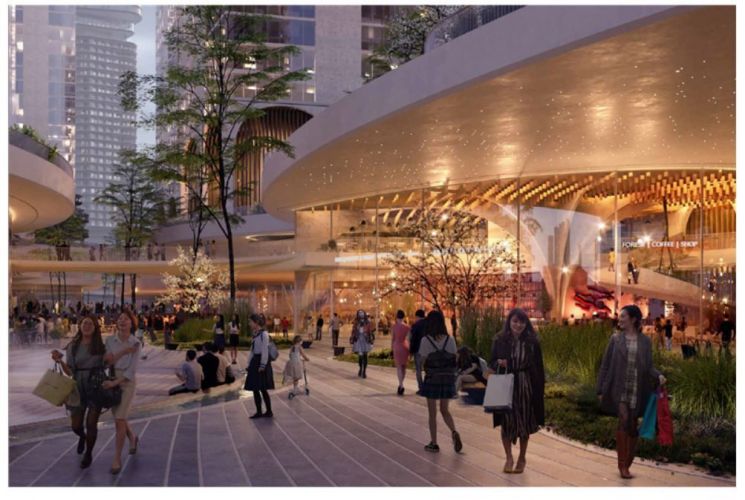
[Asia Economy Reporter Yuri Kim] The 'Gwangwoon University Station Area Development Project,' which aims to transform a logistics site spanning 150,000㎡ within the Gwangwoon University Station area into a new economic hub in the northeastern region with mixed functions such as residential, office, retail, and cultural facilities, is entering its final stage for the confirmation of the development plan.
The Seoul Metropolitan Government and the landowner, Korea Railroad Corporation (KORAIL), announced that they will hold the first 'Negotiation Coordination Council' on the 17th to discuss and finalize the logistics site development plan, which is the core of the Gwangwoon University Station area development.
Since May of last year, Seoul and KORAIL have been conducting preliminary negotiations to build consensus on various issues arising from large-scale development, including public contributions and traffic improvement measures, leading to the convening of the first Negotiation Coordination Council. This council is a negotiation body that oversees and coordinates the entire preliminary negotiation process. It is responsible for selecting negotiation topics, exchanging and mediating understanding between public and private sectors, objectively reviewing matters, and deriving feasible alternatives. The council consists of a total of 10 members, including public officials, private sector representatives, and external experts.
The preliminary negotiation system is a framework where public and private developers establish detailed development plans and change urban plans through negotiations for large-scale development sites of 5,000㎡ or more. Its purpose is to promote efficient land use and strengthen the public nature of urban development projects. Seoul expects to complete the preliminary negotiations by the first half of the year and proceed with related administrative procedures such as drafting and deciding urban management plans in the second half, aiming to start construction as early as 2021.
The Negotiation Coordination Council will review the appropriateness and alternatives of issues discussed during the preliminary negotiations, including traffic improvement measures for large-scale development, integration and linkage plans with surrounding areas, and district specialization plans. Public contribution facilities will also be decided considering public interest and policy feasibility.
The Gwangwoon University Station area development project involves constructing a mixed-use complex building up to 46 stories high, including office, retail, convention, and cinema facilities, as well as a residential-commercial apartment complex with 2,466 households on the logistics site around Gwangwoon University Station (land area 150,320㎡). Through the preliminary negotiation process, Seoul and KORAIL adjusted the originally proposed maximum height by KORAIL from 49 floors to 46 floors.
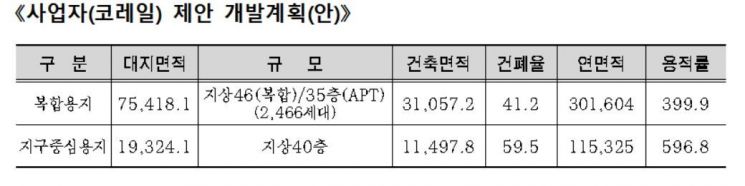
Seoul plans to use the public contributions from the development to build a new road connecting Gwangwoon University Station and Wolgye-dong, which were previously separated by the railway and logistics site, and to expand living SOC such as cultural and sports facilities and startup support centers.
Although the logistics facilities led regional economic revitalization in the 1980s, they have become a nuisance facility due to aging infrastructure, dust, and noise. The plan is to attract office and commercial functions to the site to create jobs and strengthen the region's self-sufficiency.
Meanwhile, the logistics facility site in the Gwangwoon University Station area was selected as a negotiation target when the city introduced the 'Urban Planning Change Preliminary Negotiation System' in 2009, but the project faced difficulties for a long time due to repeated failures in private developer bidding. However, with active cooperation among the city, landowner KORAIL, Nowon District, and local assembly members, the project got on track in June 2017. KORAIL selected HDC Hyundai Development Company as the developer through a private developer bidding process. Since then, Seoul and KORAIL have entered preliminary negotiations. Based on KORAIL's business proposal and the winning ideas from a public contest, they jointly established a 'Business Development Plan (draft)' and supplemented the plan through consultations with related departments and expert advisory meetings after several rounds of opinion gathering.
Lee Sung-chang, head of the Seoul Public Development Planning Division, said, "The logistics facility site at Gwangwoon University Station, which once led regional economic revitalization but has faced demands for relocation due to aging facilities, will be reborn as a new economic hub in the northeastern region combining office, commercial, and residential functions. We will accelerate progress through active cooperation with KORAIL, the landowner, to enhance the region's self-sufficiency and develop it as a central area that grows together with its surroundings."
© The Asia Business Daily(www.asiae.co.kr). All rights reserved.


















