[Asia Economy Reporters: Ko Hyung-kwang, Kim Hyo-jin, Park Ji-hwan] As Lime Asset Management's funds, which have suspended redemptions, are expected to incur losses in the trillion-won range, some financial firms are being criticized for exacerbating the situation. In the case of Shinhan Financial Investment, evidence has emerged that they colluded with Lime Asset Management, while Daishin Securities reportedly prevented victims from redeeming their investments, thereby increasing the scale of losses. Financial authorities have launched investigations into financial firms related to Lime.
According to financial authorities and the financial investment industry on the 17th, Lime Asset Management invested in overseas trade finance funds such as the IIG Fund and BAF Fund under the name of Shinhan Financial Investment in May 2017. The trade finance fund size reached 600 billion KRW, combining 250 billion KRW of customer money from Lime Asset Management and 350 billion KRW borrowed from Shinhan Financial Investment through a total return swap (TRS) contract with Lime. TRS is a type of loan arrangement where a securities firm purchases assets on behalf of the asset manager and receives fees in return. Because the fund size doubled through TRS, profits increased proportionally for investors, but losses also magnified significantly.
In June 2018, Lime Asset Management and Shinhan Financial Investment first became aware that the net asset value (NAV) of the IIG Fund within the trade finance funds was not being calculated. This indicated a problem. In November of the same year, they received an email stating that the IIG Fund had created fake bonds and that U.S. financial authorities had detected this, initiating liquidation procedures. However, neither Lime Asset Management nor Shinhan Financial Investment informed their clients of these facts. Instead, they arbitrarily manipulated the fund's NAV to show a monthly increase of 0.45%. Even after recognizing the fund's insolvency, Shinhan Financial Investment continued to sell it as if it were a normal fund. Despite losses due to the poor quality of investment targets, they concealed this and manipulated returns, further increasing investors' losses.
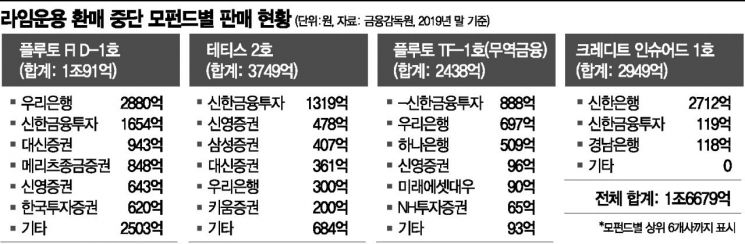
Daishin Securities also exacerbated investors' damages. As of the end of July last year, when the Lime scandal broke out, Daishin Securities had sold 1.176 trillion KRW, accounting for over 20% of the total 5.7 trillion KRW in Lime fund sales. This was the largest amount among financial companies selling Lime funds. When suspicions arose in July last year that Lime Asset Management was engaging in a Ponzi-like scheme, Daishin Securities immediately gathered investors the following month and held multiple seminars. At these meetings, they reassured investors and prevented redemptions. However, shortly thereafter, Lime Asset Management announced a large-scale suspension of redemptions, and investors who trusted Daishin Securities' explanations and did not redeem suffered snowballing losses. One client who invested through Daishin Securities expressed frustration, saying, "If I had withdrawn money in July or August last year, the damage wouldn't have been this severe."
The Financial Supervisory Service (FSS) has launched investigations into financial firms related to Lime Asset Management, including fund distributors. This marks the start of dispute resolution procedures concerning allegations of incomplete sales. Currently, the FSS has received 214 dispute resolution requests related to Lime funds. Based on written investigations, the FSS plans to deploy a 'Joint On-site Investigation Team' next month to conduct on-site inspections of the distributors.
From today, as loss rates for Lime funds with suspended redemptions are notified to investors, the phase of fund recovery has also begun. Lime Asset Management will adjust the NAVs of Pluto FI D-1 (Pluto) and Thetis No. 2 (Thetis), two of the four master funds that have completed audits, by the 21st. Lime Asset Management announced that as of the 18th, the valuation amounts for Pluto and Thetis will be adjusted (written down) to 460.6 billion KRW and 165.5 billion KRW, respectively. Compared to the end of September last year, the loss rates are 49% and 30%, resulting in a decrease in asset value of about 510 billion KRW from just these two funds. Including other funds such as the trade finance funds that have not yet completed audits, the total loss across the four master funds is expected to reach 1 trillion KRW.
Currently, investors are pursuing legal action through law firms, claiming fraud or incomplete sales against the distributors. They argue that they were deceived by sales staff without sufficient explanation of the fund's structure or risks. Future recovery amounts for individual investors are expected to vary significantly depending on whether TRS contracts were involved and whether the distributors engaged in illegal activities. Differences in recovery rates will arise depending on whether the sub-funds only invested in master funds and whether securities firms used TRS. An FSS official stated, "The principle of minimizing consumer damage is clear," but added, "The process is expected to be arduous due to the complex procedural variables involved."
© The Asia Business Daily(www.asiae.co.kr). All rights reserved.
![User Who Sold Erroneously Deposited Bitcoins to Repay Debt and Fund Entertainment... What Did the Supreme Court Decide in 2021? [Legal Issue Check]](https://cwcontent.asiae.co.kr/asiaresize/183/2026020910431234020_1770601391.png)















