Even with 1-person 1-room isolation, dormitories are severely insufficient... Difficulties in identifying locations
Leave of absence and remote classes are also 'half-measures' with questionable effectiveness
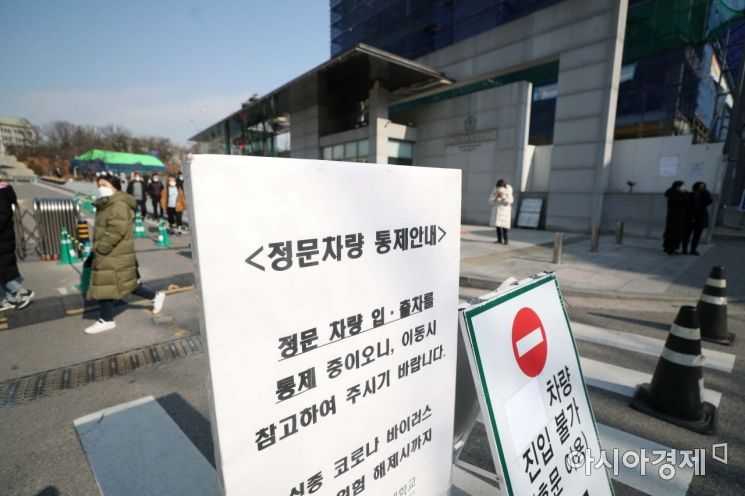 On the 4th, as concerns over the spread of the novel coronavirus infection grow, a notice prohibiting tourist entry was installed in front of the main gate of Ewha Womans University in Seodaemun-gu, Seoul. Photo by Mun Ho-nam munonam@
[Asia Economy Reporter Jo In-kyung] Although the government has prepared and announced various measures regarding the entry of Chinese international students, universities themselves are voicing complaints that the measures lack practicality.
According to universities on the 17th, the most urgent issue identified by the universities is quarantine space for Chinese international students. According to the Ministry of Education guidelines announced the previous day, each student should be assigned a single room in the dormitory, but since many university dormitories have shared rooms for 2 to 6 people, space is absolutely insufficient.
A representative from a private university in Seoul said, "Even if we use an entire dormitory building, we can only accommodate one-fifth of the Chinese international students," adding, "To follow the guidelines, it is inevitable to postpone or cancel the admission of domestic students."
According to another university, about 10% of Chinese international students lived in dormitories, while the rest lived in boarding houses or rented rooms nearby. Dormitory students are managed by the school through quarantine measures, but students living off-campus may fall into a blind spot in management.
In fact, some schools are struggling to locate international students who are unreachable. A student affairs official from a metropolitan area university said, "Students who have no departure records at all have effectively stayed in the country during the vacation period, so they are actually safer," but added, "However, there are cases where students went to China or re-entered the country but are still unreachable, so local communities (local governments) are also getting involved and concerned."
The Ministry of Education’s measures such as allowing first-year students to take a leave of absence for the first semester and remote classes are also criticized as "half-measures." The leave of absence allowance for new Chinese students is already underway, and there are doubts about the effectiveness of remote classes. According to universities, there are numerous issues to confirm and prepare in advance, such as whether students staying in China can attend classes, whether they are properly participating in lectures, and how evaluations will be conducted.
A representative from a private university in Seoul said, "The Ministry of Education said it would consider support for purchasing quarantine supplies and management personnel, but no concrete plans have been announced, causing many difficulties in preparation," adding, "Guidelines from the Ministry of Education on step-by-step management plans for international student entry and dormitory management principles are still nowhere to be found."
© The Asia Business Daily(www.asiae.co.kr). All rights reserved.

















