[Asia Economy Reporter Kim Daeseop] The Ministry of SMEs and Startups announced its 2020 work plan titled "Great Transition to the Digital Economy, Smart Korea" at the Blue House State Guest House on the 17th.
This work plan is broadly divided into three major areas: ▲Smart Korea ▲Innovation Company Scale-up ▲Coexistence and Win-win.
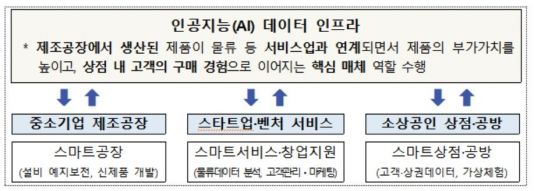
First, the Smart Korea sector is divided into policy tasks such as ▲data sharing and utilization necessary for advancing smart factories (SMEs) ▲management innovation and smart services using big data, etc. (startups and venture companies) ▲connecting 4th Industrial Revolution technologies with small merchants and smart stores (small merchants) ▲introducing digital technology into manufacturing processes and smart workshops (small manufacturers).
They will promote the advancement of smart factories, including expanding smart factories for manufacturing process smartization and realizing an optimal production system using manufacturing data. The plan is to distribute 30,000 smart factories by 2022. As of last year, 12,660 smart factories have been distributed.
Additionally, by supporting the introduction of advanced information and communication technology (ICT) solutions, they will foster the discovery of services such as pre-diagnosis and demand forecasting using big data and artificial intelligence (AI), thereby building smart services.
To strengthen the competitiveness of small merchants, smart store technologies utilizing 4th Industrial Revolution technologies such as smart order, smart mirror, and smart map will be specialized and distributed by industry. Furthermore, digital technology will be introduced into the manual manufacturing processes of small manufacturers to improve productivity through smartization of the manufacturing environment.
The innovation company scale-up policy tasks include ▲promoting the K-Unicorn project to nurture global startup companies ▲fostering the global 'Brand K' such as K-Beauty, K-Food, and K-Pop ▲and bold regulatory innovation through the world's first regulatory free zones. These are tasks central to the digital economy.
The K-Unicorn project will be carried out jointly by the public and private sectors. It focuses on discovering and nurturing potential unicorn companies and promoting their leap forward through a systematic scale-up system. A system to attract large-scale investments will be established through the creation of leap-stage funds, special guarantees for prospective unicorns, and differential voting rights. A unicorn company refers to an unlisted startup with a corporate value of over 1 trillion won.
Also, excellent SME products will be carefully selected as 'Brand K' and supported to enter the global market through Hallyu-linked events and special exhibitions on overseas online malls. Regarding regulatory free zone innovation, support for research and development (R&D) and commercialization will be provided to produce results, and cooperative models linking with other national projects will be promoted to create synergy.
Lastly, the coexistence and win-win sector is a policy foundation for the digital economy. It includes ▲expanding win-win cooperation through voluntary connections such as considerate companies ▲promoting 'Value Buy' together with small merchants through online support ▲and fostering local commercial districts and traditional markets integrated with culture using local creators.
They plan to discover and support considerate companies that expand the horizon of coexistence, implement public procurement win-win cooperation systems, and improve systems for fair trade. To strengthen the competitiveness of small merchants, support for online market entry will be expanded in line with the changing distribution environment. The number of century-old stores and century-old small manufacturers with long experience and know-how will be increased, and financial support for low-credit and small-scale merchants will be expanded.
They will also create traditional markets where people gather, such as local commercial districts fused with culture, content, and design, and tourism resources. New local creators who start businesses by combining innovative ideas based on local culture, heritage, and characteristics will be discovered and nurtured.
This work plan reflects the determination that a new innovation growth strategy centered on SMEs and venture companies is necessary to leap forward in the era of the 4th Industrial Revolution, unlike in the past. As the world competes to establish itself as a leading country in the 4th Industrial Revolution amid the great transition to digitalization and smartization, the ministry plans to focus its capabilities on policies to respond to this.
Kim Daehee, Director of SME Policy at the Ministry of SMEs and Startups, said, "To turn crisis into opportunity and leap forward in the era of the 4th Industrial Revolution, a new innovation growth strategy centered on SMEs and venture companies is necessary. The Ministry of SMEs and Startups has set the goal of a great transition to the digital economy and Smart Korea this year and will focus its capabilities on policies to achieve this."
© The Asia Business Daily(www.asiae.co.kr). All rights reserved.
![User Who Sold Erroneously Deposited Bitcoins to Repay Debt and Fund Entertainment... What Did the Supreme Court Decide in 2021? [Legal Issue Check]](https://cwcontent.asiae.co.kr/asiaresize/183/2026020910431234020_1770601391.png)