"Government Funding Support Means the Situation Is That Serious"
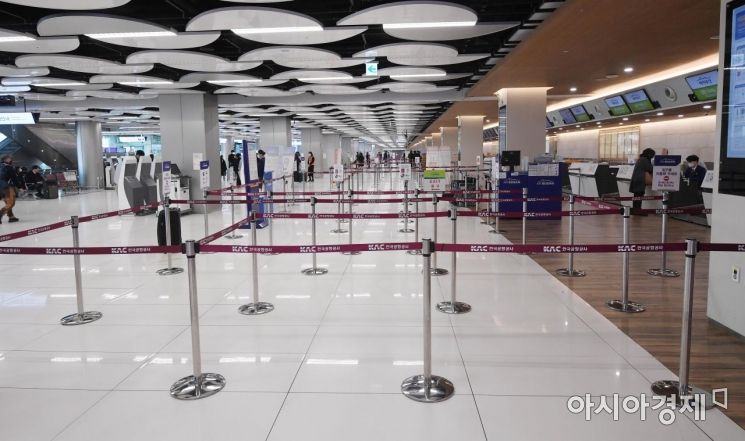 On the 10th, amid ongoing concerns about the spread of the novel coronavirus infection, the domestic terminal at Gimpo Airport in Seoul showed a quiet scene. Photo by Hyunmin Kim kimhyun81@
[Asia Economy Reporter Yoo Je-hoon] As the government decided to inject emergency funds into low-cost carriers (LCCs) pushed into an unprecedented crisis by the COVID-19 pandemic, the industry is calling it a "rain in a drought." This move allows the industry to catch its breath amid last year's massive losses, a sharp decline in air travel demand, and a surge in ticket refund cases that have driven cash flow to its worst level. Industry insiders advise that the government should additionally work on resolving external risks and easing regulations that have constrained the aviation sector.
According to the industry on the 17th, the government's LCC support plan announced at the Economic Ministers' Meeting on COVID-19 response includes ▲an emergency loan program (up to 300 billion KRW) ▲deferral of airport facility usage fees ▲introduction of a public guarantee program for aircraft operating leases ▲and expansion of Incheon International Airport slots (from 65 to 70 per hour).
The government’s decision to use the "capital injection" card reflects the unprecedented level of shock the industry is facing due to COVID-19. Previously, the government injected 250 billion KRW into the two major national carriers after the September 11, 2001 terrorist attacks, but no separate financial support was provided during the 2003 Middle East Respiratory Syndrome (MERS) or the 2015 MERS outbreaks.
Unlike past one-off issues, this COVID-19 crisis is intertwined with last year's Korea-Japan tensions leading to a boycott of travel to Japan, political instability in Hong Kong, and an overall "supply-demand imbalance" in the industry. A representative from a national airline said, "In some flights, the load factor (L/F) does not even reach 10%, resulting in losses of over a billion KRW per flight," adding, "The intangible losses from reduced aircraft utilization are even greater."
Especially, LCCs focusing on short-haul routes have faced severe financial pressure with losses amounting to hundreds of billions of KRW last year. Last year's deficits for LCCs were 32.9 billion KRW for Jeju Air, 49.1 billion KRW for Jin Air, 19.2 billion KRW for T'way Air, and 50.5 billion KRW for Air Busan. Some airlines are even facing the possibility of partial capital erosion.
To make matters worse, the surge in ticket refund requests due to COVID-19 is tightening LCCs' cash flow. According to the Ministry of Land, Infrastructure and Transport, from the 23rd of last month to the 4th of this month, refund amounts for national airlines reached 25 billion KRW for Eastar Jet, 17.9 billion KRW for Jin Air, 14 billion KRW for Jeju Air, and 4.2 billion KRW for Air Seoul.
Public guarantees for aircraft operating leases are also expected to provide considerable help to the LCC industry. Most LCCs operate their fleets through operating leases. With the new accounting standard (IFRS-16) applied this year, these operating lease costs are recognized as liabilities, causing each airline's debt ratio to surge.
Experts say this support will be a much-needed relief for LCCs but advise that various support measures should be prepared to minimize future risks. Professor Hwang Yong-sik of Sejong University said, "The government's move to provide 'liquidity support' means it is taking this situation very seriously," adding, "At the same time, efforts at the government level to reduce uncertain external risks should be intensified."
Professor Heo Hee-young of Korea Aerospace University also said, "Since LCCs' business conditions are rapidly deteriorating, this support will be like rain in a drought," but added, "Issues for the medium- to long-term development of the aviation industry, such as exemptions from aircraft acquisition registration taxes and waivers of tariffs on aircraft parts, should also be discussed during this opportunity."
© The Asia Business Daily(www.asiae.co.kr). All rights reserved.
![User Who Sold Erroneously Deposited Bitcoins to Repay Debt and Fund Entertainment... What Did the Supreme Court Decide in 2021? [Legal Issue Check]](https://cwcontent.asiae.co.kr/asiaresize/183/2026020910431234020_1770601391.png)















