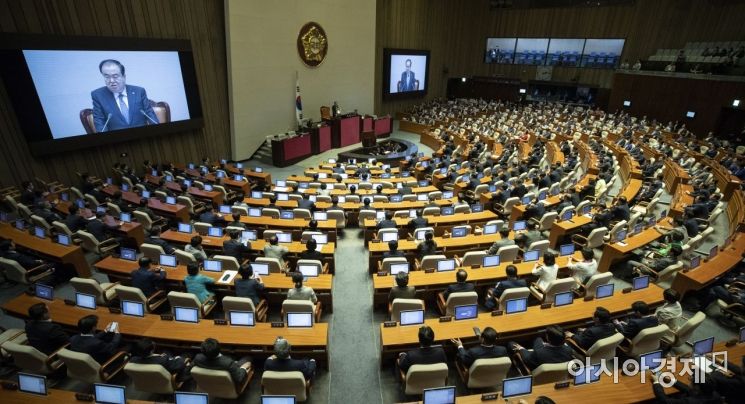
 The ball has moved to the National Assembly. The "ratification of the ILO core conventions and the passage of related bills in the National Assembly" is a key issue in the controversy over violations of labor-related provisions in the Free Trade Agreement (FTA) between our government and the European Union (EU).
Photo by Dongju Yoon, taken on September 2 last year, showing Moon Hee-sang, Speaker of the National Assembly, delivering the opening address at the regular session opening ceremony held in the National Assembly plenary hall.
[Asia Economy Reporter Moon Chaeseok] The government has submitted a statement to the relevant body asserting that South Korea has not violated labor-related provisions in the Free Trade Agreement (FTA) with the European Union (EU).
According to the Ministry of Employment and Labor on the 16th, the government submitted its position in a statement to the expert panel formed under the dispute resolution procedure of the "Trade and Sustainable Development" chapter (Chapter 13) of the Korea-EU FTA, which includes labor-related provisions, on the 14th.
The Trade and Sustainable Development chapter states that both Korea and the EU must respect, promote, and realize the fundamental labor rights principles of the International Labour Organization (ILO) and strive to ratify the ILO core conventions, including freedom of association.
The EU initiated the dispute resolution procedure in December 2018, claiming that Korea was not properly complying with these provisions. Consequently, since December last year, an expert panel composed of members from Korea, the EU, and a third country has been reviewing whether Korea has violated the FTA.
Although the government has not disclosed the statement submitted to the expert panel, it is known to have emphasized that Korea is making efforts to ratify the ILO core conventions.
The Moon Jae-in administration made ratification of the ILO core conventions a national agenda. Accordingly, the Economic, Social and Labor Council (ESLC), a social dialogue body under the president, discussed amendments to domestic labor laws for ratification of the ILO core conventions.
Although the ESLC failed to reach a social consensus, it issued a public interest committee recommendation, including allowing unemployed and dismissed workers to join labor unions. Based on this, the Ministry of Employment and Labor drafted amendments to labor laws and submitted them to the National Assembly along with the ratification bill for the ILO core conventions in October last year.
The government maintains that it continues efforts to pass the ILO core conventions ratification bill and related legislation through the National Assembly.
The EU holds a different view. In a statement submitted to the expert panel on the 20th of last month, the EU argued that the ratification bill’s passage in the National Assembly is uncertain and that it has not been properly discussed, claiming Korea’s efforts to ratify the ILO core conventions are insufficient.
The EU pointed out issues such as special employment workers in Korea not being recognized as workers under the Labor Union Act, which restricts freedom of association. It criticized Korea for not realizing the ILO’s fundamental labor rights principles.
Major domestic labor unions and employer organizations have also submitted statements to the expert panel. The expert panel is currently coordinating the hearing schedule to formally examine whether Korea has violated the Korea-EU FTA with participation from both Korea and the EU.
Based on the statements from Korea, the EU, and related organizations, as well as the hearing results, the expert panel will adopt a report by the end of next month.
If it is concluded that Korea violated the Korea-EU FTA, Korea would become the first case in FTA history to be found in violation of labor-related provisions.
Some fear that the EU might use this as a pretext to impose trade disadvantages on Korea.
© The Asia Business Daily(www.asiae.co.kr). All rights reserved.
![User Who Sold Erroneously Deposited Bitcoins to Repay Debt and Fund Entertainment... What Did the Supreme Court Decide in 2021? [Legal Issue Check]](https://cwcontent.asiae.co.kr/asiaresize/183/2026020910431234020_1770601391.png)















