Central Disaster and Safety Countermeasures Headquarters, Expanded Meeting Chaired by Prime Minister on 16th
Authorities "Concern Over Community Spread, Early Detection of Patients Crucial"
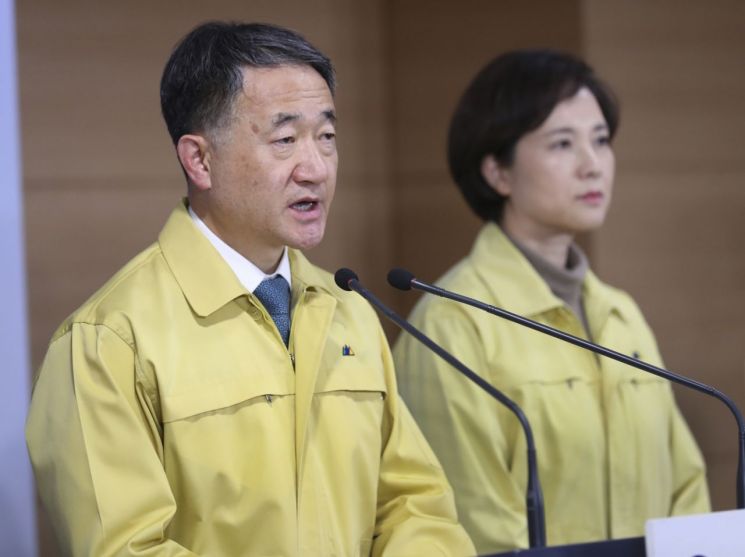 Park Neung-hoo, Head of the Central Disaster and Safety Countermeasures Headquarters (Minister of Health and Welfare), is announcing additional measures related to COVID-19 at a briefing held at the Government Seoul Office Building on the 16th.
 [Asia Economy Reporter Choi Dae-yeol] To detect patients infected with the novel coronavirus disease (COVID-19) early, diagnostic tests will be conducted on patients hospitalized with pneumonia of unknown cause. Considering the expected large influx of Chinese international students coinciding with the university semester start, the government has established protection and management measures and informed each university.
Park Neung-hoo, head of the Central Disaster and Safety Countermeasure Headquarters (Minister of Health and Welfare), stated at a briefing after the meeting on the 16th, "We will establish a continuous surveillance system to detect COVID-19 patients in the community at an early stage," and announced the expansion of testing criteria. Until now, testing was available for those who had traveled to China within the past two weeks and showed fever or respiratory symptoms, or for those who had traveled to countries where COVID-19 was prevalent and were tested based on a physician's opinion.
Going forward, even without overseas travel, individuals with symptoms can receive diagnostic testing based on a physician's judgment. Park explained, "Except for cases where pneumonia has been definitively caused by other diseases, we will conduct examinations on patients with pneumonia of unknown cause," adding, "Although physicians could already broadly request tests at their discretion, the guidelines have been clarified more explicitly."
Additionally, COVID-19 testing will be added to the hospital-based Severe Acute Respiratory Infection (SARI) surveillance system (currently 13 hospitals) and the influenza laboratory sentinel surveillance system (currently 52 clinics). The number of medical institutions participating in the surveillance system will also increase. This is a preemptive measure to detect potential community spread. On the same day, the 29th domestic patient was confirmed positive without a history of overseas travel or contact with existing patients, raising concerns about community transmission.
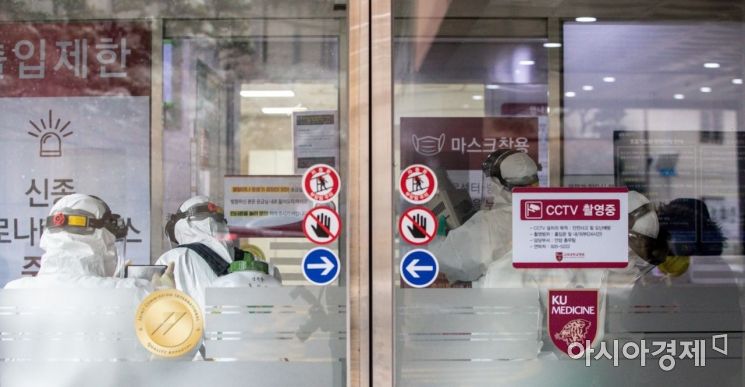 On the 16th, after closing the emergency room of Korea University Hospital in Seongbuk-gu, Seoul, where the 29th COVID-19 patient had visited, disinfection measures were initiated. Photo by Jinhyung Kang aymsdream@
Currently, about 800 to 1,200 tests are conducted daily, and the roles of frontline screening clinics, public health centers, and private medical institutions will be adjusted. According to health authorities, the number of specimen collection and testing institutions will be increased to raise daily testing capacity to 10,000 by the end of this month. Furthermore, considering the workload concentrated at screening clinics, a supplementary budget of 23.3 billion KRW has been requested to support air tents and mobile negative pressure devices. When confirmed cases are identified, designated national inpatient treatment beds will be prioritized, and starting from the 17th, operational plans for each province will be reviewed to flexibly utilize regional base hospitals and hospitals with negative pressure rooms in preparation for a potential increase in patients.
As previously announced by the government, the rapid response teams dispatched upon patient detection will be increased from the current 10 to 30, with training for new personnel beginning on the 24th. Epidemiological investigation teams at the provincial level will increase from 18 teams with 114 members to 40 teams with 249 members, and at the city/county/district level from 325 teams with 1,928 members to 562 teams with 3,299 members.
Meanwhile, at the meeting, a plan was finalized to assess the intentions of Korean nationals aboard the Japanese cruise ship Diamond Princess and to transport them back to Korea. Earlier, the Japanese government announced that after testing all cruise ship passengers and confirming negative results, disembarkation would begin sequentially from the 19th. The Korean government decided to transport Korean passengers who wish to return even before that. Cho Se-young, First Vice Minister of Foreign Affairs, said, "Although not specified in detail, some of our nationals want to be transported," and added, "We are contacting them to accurately ascertain their intentions."
© The Asia Business Daily(www.asiae.co.kr). All rights reserved.
![User Who Sold Erroneously Deposited Bitcoins to Repay Debt and Fund Entertainment... What Did the Supreme Court Decide in 2021? [Legal Issue Check]](https://cwcontent.asiae.co.kr/asiaresize/183/2026020910431234020_1770601391.png)
















