Seoul Tightens Regulations, Causing Prices in Suyongseong to Rise
Attempt to Strengthen Suyongseong Regulations Makes Namsangwang Flinch
[Asia Economy Reporter Onyu Lim] "Press here, and there rises; press there, and here rises."
Although the government has declared a 'war on real estate speculation,' market funds are chasing regulatory loopholes, causing balloon effects in various places. Instead of Seoul housing prices, the so-called 'Su-Yong-Seong' (Suwon, Yongin, Seongnam) are rising. The government is again considering regulatory measures to calm housing prices in these areas, but there are concerns that the same results will repeat under the ongoing low-interest rate environment.
According to the Korea Real Estate Board on the 16th, apartment prices in Gyeonggi Province rose by 0.39% in the second week of February (as of the 10th), increasing from 0.22% the previous week. Meanwhile, apartment prices in the four Gangnam districts of Seoul fell by 0.05%, widening the decline, and Yangcheon-gu (-0.01%) turned to a decline for the first time in 37 weeks since the fourth week of May last year.
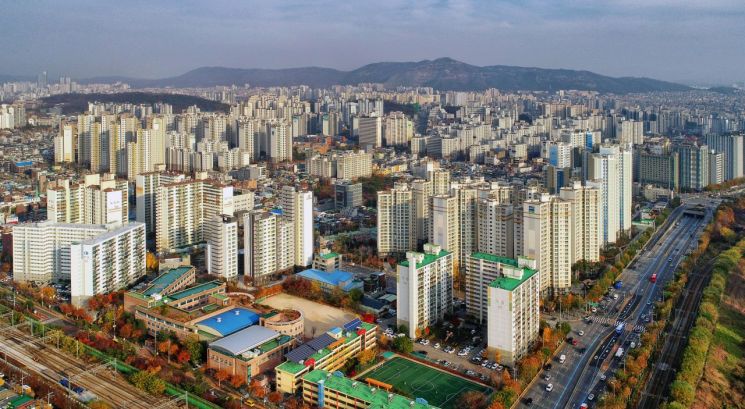
Suwon led the rise in housing prices in Gyeonggi Province. Suwon more than doubled its rate of increase from the previous week, leading the rise in the metropolitan area housing prices. Specifically, in Suwon’s Gwonseon-gu (1.23%→2.54%), the increase was centered around Geumgok and Homaesil-dong, which benefit from transportation improvements such as the extension of the Shinbundang Line. In Yeongtong-gu (0.95%→2.24%), the rise was focused around the Gwanggyo Central and Mangpo Station areas, and in Paldal-gu (0.96%→2.15%), housing prices increased mainly near Maegyo Station (Paldal 8 District), which has redevelopment issues, and Hwaseo Station. It is the first time in eight years since May 2012, when the Korea Real Estate Board began compiling statistics, that Suwon’s housing prices have risen more than 2% in a single week.
The rise in Suwon housing prices became more pronounced after the December 16 measures. Prices increased by an average of more than 5%. As the government strengthened regulations to curb Seoul housing prices, market funds moved to Suwon, where regulations were less strict. Along with Suwon, housing prices in Yongin and Seongnam also surged sharply, giving rise to the new term Su-Yong-Seong.
In fact, according to the Ministry of Land, Infrastructure and Transport’s real transaction price disclosure system, the number of reported apartment transactions in Seoul was only 7,990 in the two months following the December 16 real estate measures announcement. This is a significant decrease from 22,614 transactions in the two months prior to the measures. On the other hand, apartment transactions in Gyeonggi Province increased from 20,802 in November last year to 20,857 in December, and contracts signed in January this year have already reached 16,658, suggesting the total will exceed 20,000.
In response, the government reportedly held a Green Room meeting chaired by Deputy Prime Minister and Minister of Strategy and Finance Hong Nam-ki on the 13th to consider adding some metropolitan areas, including Su-Yong-Seong, to the list of regulated areas.
Contrary to the government’s hopes for market stabilization, news of regulations targeting Su-Yong-Seong has shown signs of the balloon effect spreading to other areas within the metropolitan area. Market funds appear to be moving to regions with fewer regulations or where housing prices still have room to rise. New terms like 'Nam-San-Gwang' (Namyangju, Sanbon, Gwangmyeong) have already been coined. This has even led to arguments that to stabilize the metropolitan real estate market, it might be better to remove regulations entirely from all areas.
A real estate industry official predicted, "Even if Su-Yong-Seong is designated as a regulated area amid abundant market liquidity, speculative demand will simply move to other parts of the metropolitan area, so the effect on stabilizing housing prices will be limited."
© The Asia Business Daily(www.asiae.co.kr). All rights reserved.
![User Who Sold Erroneously Deposited Bitcoins to Repay Debt and Fund Entertainment... What Did the Supreme Court Decide in 2021? [Legal Issue Check]](https://cwcontent.asiae.co.kr/asiaresize/183/2026020910431234020_1770601391.png)
















