National Institute of Environmental Research Wildlife Infectious Disease Research Team
Basis for SARS and MERS Infection Routes
"Transmission to Humans Possible via Intermediate Hosts like Cheonsangap"

[Asia Economy Reporter Kim Heung-soon] "Although it was somewhat surprising to hear the announcement that the pangolin is an intermediate host, considering the transmission cases of SARS (Severe Acute Respiratory Syndrome) and MERS (Middle East Respiratory Syndrome), I think it is possible that it played a role as a vector for human infection."
On the 16th, Kim Yong-kwan, a researcher from the Biosafety Research Team at the National Institute of Environmental Research under the Ministry of Environment, expressed this opinion while referring to recent analyses of the human transmission routes of the novel coronavirus infection (COVID-19). He said, "Since pangolins are not animals that are easily accessible and there are no opportunities to test them domestically, it is difficult to make a definitive conclusion," adding, "It is possible to speculate that the coronavirus originating from bats infected pangolins through a specific route, which then caused genetic mutations and transmitted to humans."
The claim that the COVID-19 virus was transmitted to humans via the endangered species pangolin first emerged on the 7th from Huazhong Agricultural University in China. The research team stated that the strain isolated from pangolins showed 99% homology with this virus. Homology refers to how similar genes are between individuals of the same or different species.
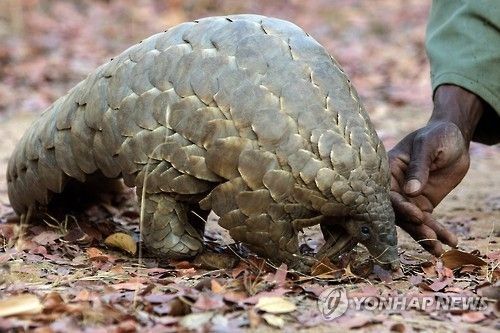 Chinese research team suspects the endangered wild animal pangolin as the intermediate host for COVID-19 human infection
 [Image source=Yonhap News]
◆ Cause of COVID-19 outbreak... Bat or Pangolin?= Until now, the virus originating from bats has been considered the cause of the COVID-19 outbreak, but domestic and international experts have speculated that the virus likely passed through an intermediate host such as other wild animals rather than being transmitted directly to humans.
Researcher Kim explained, "The coronavirus has spike proteins in the form of protrusions on its surface, and human cells have receptors that can attach to these spike proteins," adding, "For a high probability of infection in the human body, the key regions of these spikes with high infectivity must bind together." He further explained, "Analysis of the SARS virus genes showed low homology between the SARS-like coronavirus detected in bats and the SARS virus found in humans," adding, "This means that the grooves and ridges of the lock and key do not exactly match, so the lock does not open, indicating a low possibility of infection."
Therefore, experts studied intermediate hosts with protein structures similar to humans instead of bats. Through this, it was understood that SARS was transmitted from bats to civet cats and then to humans, and MERS was defined as transmitted from bats to camels and then to humans. Researcher Kim pointed out, "Based on the cases of SARS and MERS, the possibility of airborne transmission of coronaviruses is low," emphasizing, "It is highly likely that the virus originating from bats was transmitted to humans through an intermediate host."
Even when wild animals are used for food, infection by viruses can occur, but in such cases, the probability of the virus penetrating the human body is higher after consuming or contacting the intermediate host rather than bats, according to Researcher Kim. Pangolins are known to be actively trafficked in some countries such as China and Southeast Asia due to the belief that they are good for stamina and vitality. In China, where coronavirus research is active, animals such as badgers, bamboo rats, and minks have also been suggested as intermediate hosts for COVID-19.
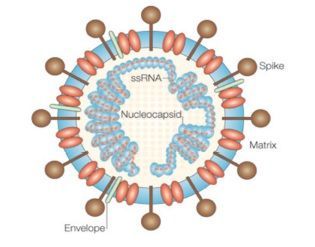
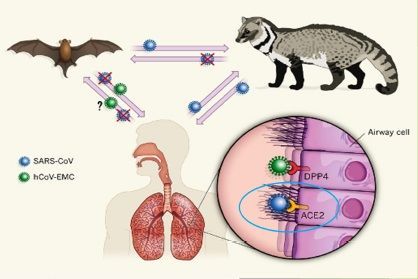 Suspected Transmission Routes of SARS to Humans [Captured from the Report by the Biosafety Research Team, National Institute of Environmental Research]
◆ "We are not a clean country from infectious diseases either... Active management is necessary"= The Biosafety Research Team at the National Institute of Environmental Research, consisting of 15 experts including Researcher Kim, studies infectious diseases originating from wild animals such as bats, African swine fever, and avian influenza. According to data they reported at the Korean Society for Zoonoses Spring Conference last year, 23 species of bats are known to inhabit Korea. Investigation of oral swabs, excrement, carcasses, and urine of these bats revealed that out of a total of 672 samples, 13 tested positive for SARS-like coronaviruses and 3 for MERS-like coronaviruses.
This means that Korea is not a safe zone from coronaviruses. Researcher Kim emphasized, "Currently, Korea is only focusing on quarantine of infectious diseases occurring abroad," and added, "We need to expand research and management systems that continuously monitor domestic wild animals and identify in advance which regions have a high probability of infectious disease outbreaks."
Additionally, Researcher Kim warned, "There are quite a few diseases transmitted by mosquitoes, but bats play beneficial roles such as eating these pests or transferring pollen of plants," cautioning, "It would be problematic if the perception spreads that bats are the cause of human infectious diseases and that they must be indiscriminately captured or exterminated."
© The Asia Business Daily(www.asiae.co.kr). All rights reserved.
![User Who Sold Erroneously Deposited Bitcoins to Repay Debt and Fund Entertainment... What Did the Supreme Court Decide in 2021? [Legal Issue Check]](https://cwcontent.asiae.co.kr/asiaresize/183/2026020910431234020_1770601391.png)


















