9 out of 10 Self-Employed Experience Sales Decline... 4 See Sales Halved 'Distress'
Surge in Part-Time Layoffs Due to No Customers from COVID-19... Labor Cost Burden
Concerns Over Prolonged Crisis... Self-Employment Impact Proven During MERS
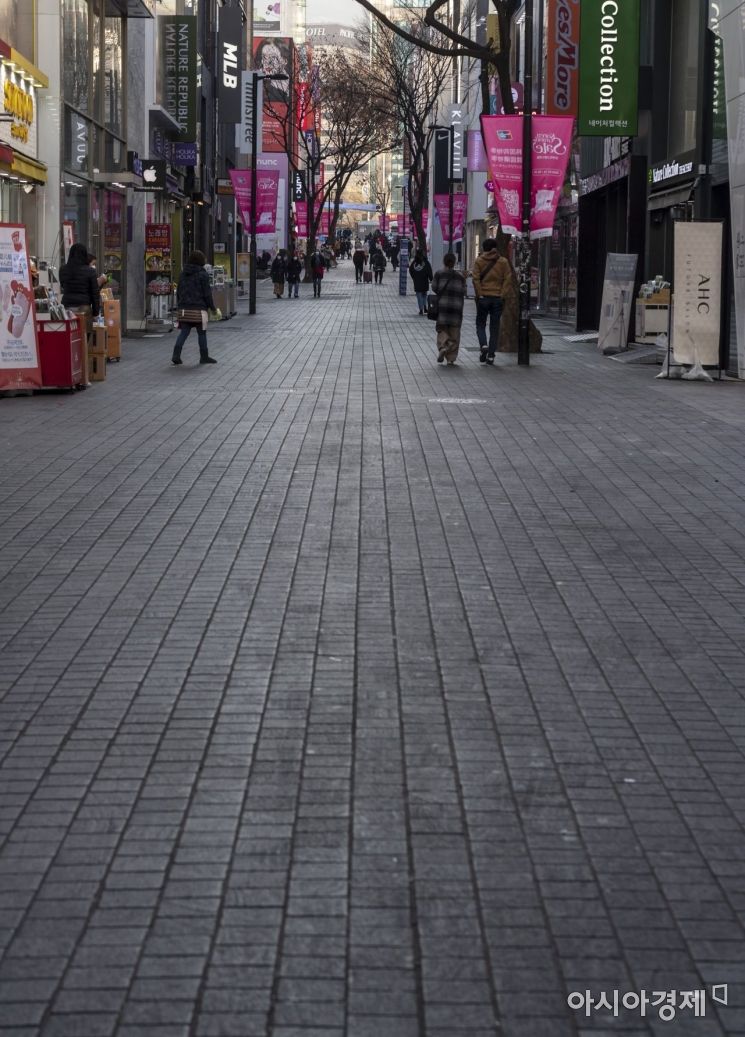 Due to the impact of the novel coronavirus infection, the Myeongdong shopping street in Seoul is showing a quiet appearance despite it being the weekend. Photo by Yoon Dong-joo doso7@
[Asia Economy Reporter Lee Seon-ae] "Sales have dropped exactly 50%. It's halved. There's no way to resolve this situation. People are afraid of getting infected, so they avoid coming to the restaurant, and we can't just beg them to come. Even though we prepared hand sanitizers and put up signs saying we disinfect and sanitize, customer visits have completely stopped. If we don't reduce labor costs, we're facing closure, so recently I had to let go of my part-time worker." - Mr. Kim, owner of a snack bar in Gasan Digital Complex.
As fear and anxiety over the novel coronavirus infection (COVID-19) spread, self-employed business owners are taking a direct hit. Nine out of ten self-employed people have experienced a decline in sales, and among them, four have seen sales plummet by 50%, pushing them to the brink of closure.
According to a survey conducted by the Korea Federation of Small and Medium Business (KOSME) earlier this month on 1,096 small business owners, 97.9% of respondents reported a decrease in sales after the COVID-19 outbreak. Among them, 44% said their sales dropped by more than 50% compared to the previous year.
The Korea Foodservice Industry Research Institute under the Korea Foodservice Association announced on the 14th that an emergency survey on the impact of COVID-19 on the foodservice industry found that 85.7% of surveyed businesses reported a decrease in customers due to the outbreak.
The survey targeted 600 member establishments of the Foodservice Association, comparing customer numbers during the two weeks around the first confirmed domestic COVID-19 case on the 20th of last month. The average customer decrease rate among affected businesses was 29.1%. By service type, 87.3% of businesses saw a decline in dine-in customers, 57.8% experienced fewer takeout orders, and 37.5% had a drop in delivery orders.
Since the first confirmed COVID-19 case in Korea on the 20th of last month, the impact on self-employed businesses has become apparent in less than a month.
Self-employed individuals hit hard by the sales decline are trying to endure by reducing labor costs, such as laying off part-time workers or cutting their working hours. Kim, a part-time worker at a cafe in Ilsan, said, "My working hours were cut from 5 hours to 2 hours, so my pay was halved. Before, with the weekly holiday allowance, my hourly wage was over 10,000 won, but now I don't even get that allowance," she lamented.
Mr. Park, owner of a clothing store in Dongdaemun, said, "Customer visits have stopped as if by magic, and with current sales, it's hard to even cover the rent. Recently, I talked to my part-time worker about reducing their working hours," he confessed.
Mr. Lee, who runs a Korean restaurant in Jongno, said, "Compared to this time last year, sales have dropped about 55%, and since COVID-19 seems to be prolonged, I'm thinking of cutting labor costs. I was originally considering hiring a serving staff, but now I think I need to adjust the working hours of current employees instead," he complained.
Mr. Kim, owner of an umbrella shop in Namdaemun, said, "There are no people walking around, and even fewer entering the store, so sales have halved. I hope the government quickly ends this situation and does its best to revive the economy," he raised his voice.
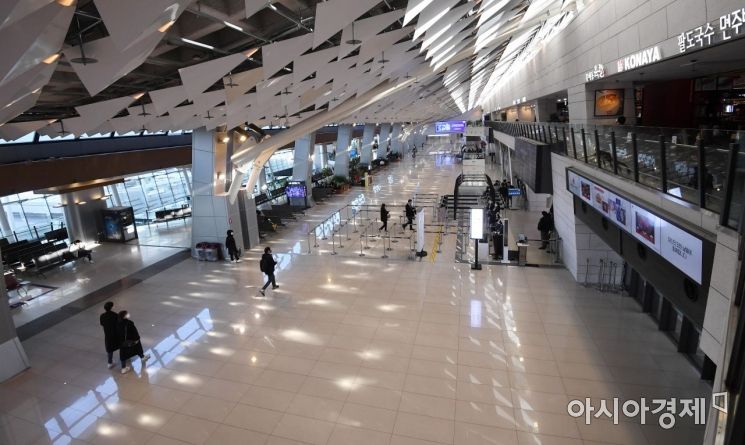 On the 10th, amid ongoing concerns about the spread of the novel coronavirus infection, the domestic departure floor at Gimpo Airport in Seoul appeared quiet. Photo by Hyunmin Kim kimhyun81@
The cries of those running foodservice businesses in Incheon are also loud. With visitors to tourist spots down by nearly 80%, it's hard to even see shadows of customers in restaurants. According to Incheon City, sales in the foodservice self-employed sector are estimated to have dropped by about 50% recently.
Office worker Lee Hyun-hee (41) said, "With talk of aerosol infection, how can I go to restaurants or shopping? I especially avoid places like Euljiro, Gwanghwamun, Jamsil, Myeongdong, and Dongdaemun, where Chinese tourists flock, and I don't even want to go near Incheon or Gimpo Airport," she emphasized.
As the situation unfolds this way, anxiety is spreading among self-employed business owners that the domestic economy will inevitably be hit. They particularly recall the 2015 Middle East Respiratory Syndrome (MERS) outbreak. At that time, the damage to self-employed businesses was clearly proven. In 2015, the number of self-employed people decreased by 98,000 compared to the previous year, the largest drop since the global financial crisis years of 2009 (-256,000) and 2010 (-107,000). The consumer price inflation rate in 2015 was 0.7%, the lowest since 1998 (0.8%) after the Asian financial crisis. A low consumer price inflation rate indicates a contraction in consumption.
© The Asia Business Daily(www.asiae.co.kr). All rights reserved.