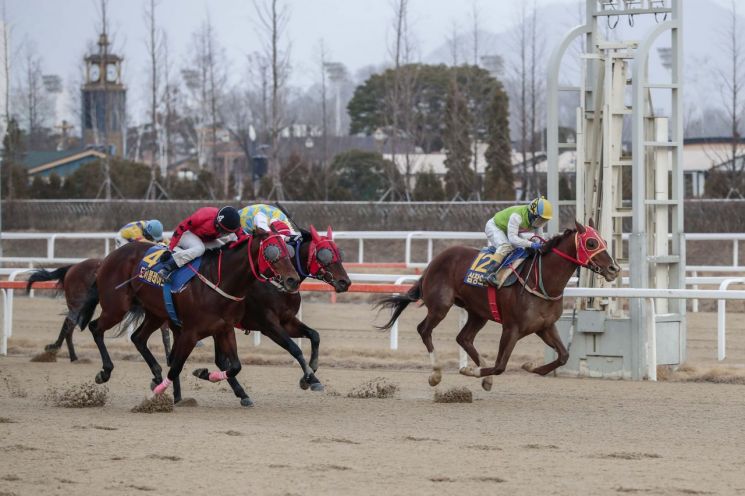
[Asia Economy Reporter Kim Hyunjung] The Korea Racing Authority's improvement of the horse racing system for coexistence and cooperation among horse racing stakeholders, implemented from this year, has shown positive results after one month of enforcement. Compared to January last year, the average daily number of rides per jockey active at the Busan-Gyeongnam Racing Park increased from 5.7 to 6.35, and the minimum income also jumped from 3.58 million KRW to 5.82 million KRW.
According to the Korea Racing Authority on the 15th, the Authority began improving the horse racing system in December last year to realize competitive principles on a more stable foundation. The goal was to guarantee riding opportunities for mid- and lower-tier jockeys and to alleviate the prize money concentration among top-tier jockeys. To restructure the prize money and riding structure centered on top jockeys, the proportion of first-place prize money was adjusted from 57% to 55%, and the daily number of rides was limited to seven.
To ensure stable livelihoods for mid- and lower-tier jockeys, non-competitive income was increased. The general race riding fee paid to jockeys participating in races was raised from 120,000 KRW to 130,000 KRW, and the basic training fee for racehorse training was increased from 45,000 KRW to 76,000 KRW.
The Korea Racing Authority immediately implemented this system from the 1st of last month, resulting in a reduction in the gap of riding opportunities between top and lower-tier jockeys. Compared to January last year, the average daily number of rides per jockey active at Busan-Gyeongnam Racing Park increased (5.7 → 6.35). Notably, the weekly rides of the top 20% of jockeys decreased from 12.6 to 11.9, while the rides of the bottom 20% increased from 2.1 to 3.9, which is encouraging. This translates to an increase of about seven rides per month. With an increase of seven rides per month, riding fee income rises by 910,000 KRW.
The income gap among jockeys also narrowed. Despite two fewer racing days in January this year compared to last year due to the Lunar New Year holiday closure, the monthly income of the lowest-earning jockey at Busan-Gyeongnam Racing Park increased from 3.58 million KRW to 5.82 million KRW. Meanwhile, the income of the highest-earning jockey decreased from 36.73 million KRW to 21.62 million KRW.
Results from the increase in non-competitive income were also observed. The proportion of prize money, which is highly competitive income among jockey earnings, decreased by 7.5 percentage points from 48.6% to 41.1%, while the proportion of non-competitive income such as riding fees and training fees increased accordingly.
At the same time, the evaluation system for trainer licensing, which has recently been controversial, will also be improved. To ensure transparency and fairness, the participation rate of external committee members will be expanded (from 20% to over 50%), and an observer system will be operated. Simultaneously, the evaluation weight for experience and license acquisition period will be increased (from 10% to 40%) to give preference to experienced individuals.
Kim Naksoon, Chairman of the Korea Racing Authority, said about this system improvement, "We focused on establishing a foundation that guarantees the sustainable growth of the horse racing industry through the cooperation of all stakeholders," and added, "We hope this system improvement will be an opportunity for horse racing fans, racehorse stakeholders, and the Authority to cooperate and take a leap forward."
© The Asia Business Daily(www.asiae.co.kr). All rights reserved.
![Clutching a Stolen Dior Bag, Saying "I Hate Being Poor but Real"... The Grotesque Con of a "Human Knockoff" [Slate]](https://cwcontent.asiae.co.kr/asiaresize/183/2026021902243444107_1771435474.jpg)
















