Directly Linked to CEO Position and Incentives
Concerns Over Deterioration of Institutional Finance and Government Fiscal Health
[Asia Economy Reporters Minyoung Kim, Sehee Jang, Chaeseok Moon] There is growing concern that public institutions, by excessively increasing their workforce, may not only worsen their management performance but also undermine the government's fiscal soundness. The reason behind public institutions expanding unplanned hiring is linked to the public institution management evaluations, highlighting the urgent need for reform in this system. Since the Moon Jae-in administration strengthened evaluations on the regularization of non-regular workers and safety management in public institution management assessments, each public institution has been increasing recruitment in related fields to achieve high scores.
According to the government on the 14th, public institutions must submit their performance reports for last year to the Ministry of Economy and Finance by the 5th of next month for the public institution management evaluation. The government has significantly increased the evaluation weight for social values such as safety, ethical management, and job coexistence cooperation by more than 50% compared to before.
Along with new hiring, the area that public institutions are most focused on this year is safety. This is especially because, following the death of the late Kim Yong-gyun, the government announced measures to strengthen safety in public institutions and raised the safety indicator score in management evaluations from 2 points to 6 points.
Public institutions that received low grades in the 2018 management evaluation established safety-related organizations or hired personnel last year to comply with the strengthened evaluation guidelines. The Korea Racing Authority, which received a D grade (insufficient) in the 2018 evaluation, created a dedicated safety department and recruited two experts from external safety organizations. The Korea Coal Corporation, which received an E grade (very insufficient), hired 19 new safety personnel last year and established a basic safety management plan, while Korea Electric Power KPS, rated D, set up dedicated safety teams at 45 business sites and increased its safety-related budget by 4.5 billion KRW compared to the previous year.
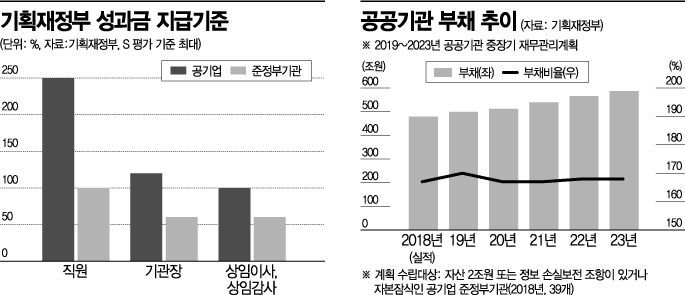
The reason public institutions are so focused on management evaluations is that the results directly affect the position of the public institution CEO, the institution’s image, and employee incentives. According to the Ministry of Economy and Finance, based on evaluation scores, public enterprises with an S grade can receive incentives up to 250%, and quasi-governmental institutions up to 100%. Because the difference in incentives can amount to tens of millions of won depending on the evaluation results, it also impacts employee morale. A representative from a quasi-governmental institution explained, "The difference in performance bonuses is so large depending on the type of institution and rank. While the bonuses matter, once you receive an A or B grade, you are evaluated at that level, which limits the scope of work."
The problem is that the rapid increase in public institution personnel can raise labor costs, worsening the institution’s financial situation. While efforts such as regularization may earn good evaluations in the social value category, increased labor costs can reduce net income, ironically leading to lower scores in the performance category.
A Korea Gas Corporation official said, "Many public enterprises were established for public interest, but they face the dilemma of needing to pursue profitability. In management evaluations, while social values and public policies should be strengthened, attention must also be paid to net income and sales."
If the deterioration of management performance continues, the burden will inevitably be passed on to the public through service fee increases or increased government fiscal burdens. According to the Ministry of Economy and Finance’s '2019?2023 Mid- to Long-Term Financial Management Plan for Public Institutions (2018, 39 institutions)' submitted to the National Assembly, the scale of public institution debt is expected to increase from 498.9 trillion KRW in 2019 to 586.3 trillion KRW in 2023.
Professor Taegi Kim of Dankook University’s Department of Economics pointed out, "Public institutions in Korea are 'dead organizations' that have no interest in business performance and operate by receiving budgets from the government and following government directives. Since the Moon Jae-in administration, with the strengthening of the Industrial Safety and Health Act and social values, the atmosphere has intensified where productivity and innovation cannot even be mentioned."
© The Asia Business Daily(www.asiae.co.kr). All rights reserved.
![User Who Sold Erroneously Deposited Bitcoins to Repay Debt and Fund Entertainment... What Did the Supreme Court Decide in 2021? [Legal Issue Check]](https://cwcontent.asiae.co.kr/asiaresize/183/2026020910431234020_1770601391.png)
















