The Bank of Korea Reviews Utilization Plans for Financial Intermediation Support Loans
[Asia Economy Reporter Kim Eunbyeol] The Bank of Korea is preparing a plan to supply low-interest funds to companies affected by the novel coronavirus infection (COVID-19). This plan involves utilizing the Financial Intermediation Support Loan (FISL), which falls under the credit policy of the Bank of Korea's monetary and credit policies. Unlike broad interest rate cuts that supply funds widely to the market, this approach has the advantage of targeting and supporting specific companies that have been affected. The FISL is a system where the Bank of Korea lends funds to commercial banks at an interest rate of 0.5~0.75% to promote loans to small and medium-sized enterprises (SMEs). By lowering the banks' funding costs, the Bank of Korea supports the flow of funds to SMEs with weak credit ratings or financing capabilities.
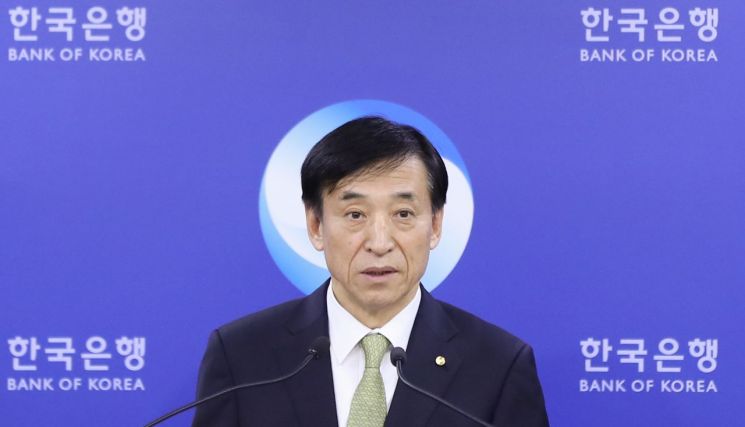
Lee Ju-yeol, Governor of the Bank of Korea, said at the 'Macroeconomic and Financial Meeting' held on the 14th at the Bankers' Hall in Jung-gu, Seoul, "After holding meetings with industry stakeholders and hearing their stories on the ground, it was found that related companies are facing considerable difficulties," adding, "Considering the high correlation with the Chinese economy and the psychological contraction of domestic economic agents, the negative impact on our economy is inevitable."
Governor Lee continued, "Damage caused by COVID-19 is materializing mainly in the service sector and some manufacturing industries," and said, "The Bank of Korea is preparing specific financial support measures for the service sector, which is experiencing damage due to economic activity contraction caused by anxiety and a decrease in travelers, and for manufacturing industries facing difficulties in production due to challenges in procuring raw materials and parts from China." This indicates the intention to support companies with funds by utilizing the FISL.
Currently, the FISL consists of trade finance, new growth job support, SME loan stabilization, and regional SME programs. It is highly likely that a portion of the already allocated quota will be separately set aside to support companies hit by COVID-19. The specific support scale and duration must be finalized and approved through the Monetary Policy Committee meeting. The Bank of Korea also allocated 650 billion won to support companies affected by the Middle East Respiratory Syndrome (MERS) outbreak in 2015.
A Bank of Korea official explained, "In the case of monetary policies such as interest rate cuts, the effects are broad and the views among Monetary Policy Committee members vary, so it is difficult to guarantee outcomes," adding, "On the other hand, there is relatively little difference in opinion among committee members regarding the FISL, and it is meaningful in that it can definitely support affected companies." This means that funds can be directed to companies severely impacted by COVID-19, such as movie theaters, tourism, and distribution industries.
Meanwhile, the 'Macroeconomic and Financial Meeting' attended by Governor Lee also included Hong Nam-ki, Deputy Prime Minister and Minister of Economy and Finance, Eun Sung-soo, Chairman of the Financial Services Commission, and Yoon Seok-heon, Governor of the Financial Supervisory Service. The meeting between Deputy Prime Minister Hong and Governor Lee was the first in six months since they met last August to respond to Japan's export restrictions and the U.S. designation of China as a currency manipulator.
Although some view the meeting as the government pressuring the Bank of Korea to cut interest rates, the government explained that the meeting was held to discuss the real economy impact of COVID-19. Although somewhat subsided, market expectations for a Bank of Korea interest rate cut remain. JP Morgan and Morgan Stanley have forecasted that the Monetary Policy Committee will further cut the base rate by 0.25 percentage points from the current 1.25% this month.
Governor Lee added, "We plan to continue managing market liquidity generously so that companies can smoothly raise the funds they need in the financial market, and so that temporary increases in funding demand do not lead to higher funding costs during this process."
© The Asia Business Daily(www.asiae.co.kr). All rights reserved.
![User Who Sold Erroneously Deposited Bitcoins to Repay Debt and Fund Entertainment... What Did the Supreme Court Decide in 2021? [Legal Issue Check]](https://cwcontent.asiae.co.kr/asiaresize/183/2026020910431234020_1770601391.png)















