No Additional Domestic COVID-19 Cases
Prospects of Entering 'Green Zone' with No Disaster Risk
[Asia Economy Reporters Choi Dae-yeol, Kim Heung-soon] As no new confirmed cases of the novel coronavirus infection (COVID-19) have been reported domestically for four consecutive days, there are expectations that this situation may be entering a 'Green Zone' (an area with no disaster risk). Among the previously confirmed patients, 21 are currently undergoing treatment, most of whom remain in stable condition, creating an atmosphere that the COVID-19 crisis, which has driven our society into fear since the first patient was identified on January 20, is entering a calming phase.
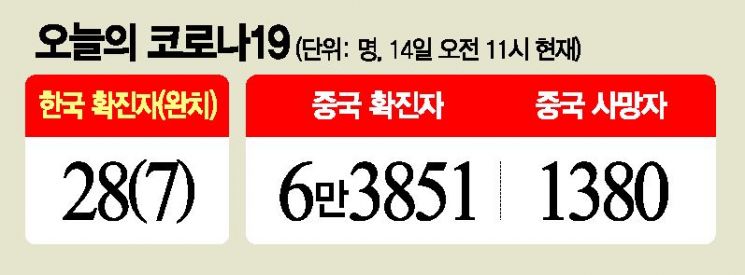
The Central Disease Control Headquarters of the Korea Centers for Disease Control and Prevention announced on the 14th at 9 a.m. that there were no additional confirmed COVID-19 cases domestically. Since the 28th patient was confirmed on the 10th, no new cases have emerged for four days. This is the second time since the first domestic patient was identified on the 20th of last month and the second patient was confirmed four days later. Considering that up to five new cases were reported in a single day at the peak, this suggests the situation is entering a calming phase.
The total number of confirmed cases identified to date is 28, of which 7 have been discharged. So far, a total of 6,826 people have been tested for COVID-19, with 6,134 testing negative and being released from isolation, and 692 currently undergoing testing. Currently, 500 to 800 COVID-19 tests are conducted daily.
Seven Patients Discharged After Recovery... More Discharges Expected Next Week
Authorities Say "No Need to Cancel or Postpone Events or Exams if Quarantine Measures Are Followed"
The number of patients discharged after recovery is expected to increase from next week. Professor Kim Nam-jung, an infectious disease specialist at Seoul National University Hospital, currently treating three patients, said, "The remaining patients under treatment have almost all lost their symptoms and are waiting as it takes some time to conduct virus tests." COVID-19 patients are released from isolation after symptoms disappear and they test negative twice on virus tests conducted one day apart, 48 hours after symptoms have ceased. Most previously discharged patients were released immediately after being cleared from isolation.
Accordingly, the government is taking measures with the aim of 'returning to daily life.' Guidelines have been established and implemented since the 12th, instructing that government events proceed as planned if sufficient quarantine measures are taken, such as excluding activities involving close contact among participants. At a briefing that day, Kim Kang-lip, Deputy Head of the Central Disaster and Safety Countermeasure Headquarters, said, "All patients are occurring or being managed within the quarantine management system," and "There are no patients whose infection routes cannot be explained, so it does not appear to be a pattern of community transmission."
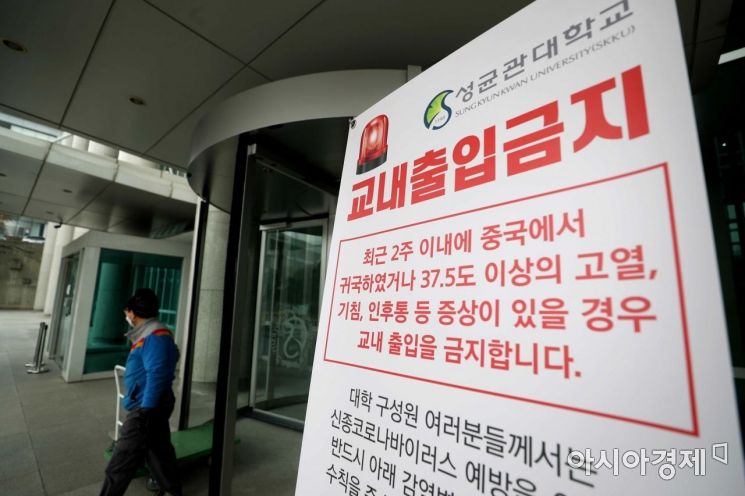 On the 13th, a notice prohibiting entry related to the novel coronavirus infection (COVID-19) was installed at Sungkyunkwan University in Seoul. Photo by Mun Ho-nam munonam@
Health authorities remain vigilant. Jeong Eun-kyeong, Director of the Korea Centers for Disease Control and Prevention, said at a briefing the previous day, "While the risk of widespread community infection is not considered high, there are still many new cases in China and frequent exchanges with China, so we must continue to monitor the situation carefully," adding, "This is not a phase of decline, and it is not the time to judge it as such."
An official from the National Institute of Environmental Research stated, "Currently, the safety guidelines and discharge criteria set by the quarantine authorities are based on MERS, which had a high fatality rate. While this approach may be somewhat inconvenient for patients and the general public, given that this is an infectious disease not yet clearly understood, an excessive response is considered appropriate."
Meanwhile, the National Health Commission of China announced that as of 0:00 a.m. today, 1,380 people have died and 63,851 have been confirmed infected with COVID-19. The number of confirmed cases increased by 5,090 compared to the previous day, of which 3,095 are clinically diagnosed confirmed patients in Hubei Province. The death toll increased by 121 in one day.
© The Asia Business Daily(www.asiae.co.kr). All rights reserved.