Pluto Fund Confirms 46% Loss
Investors in TRS-Contracted Fund
High Likelihood of Losing Most Principal
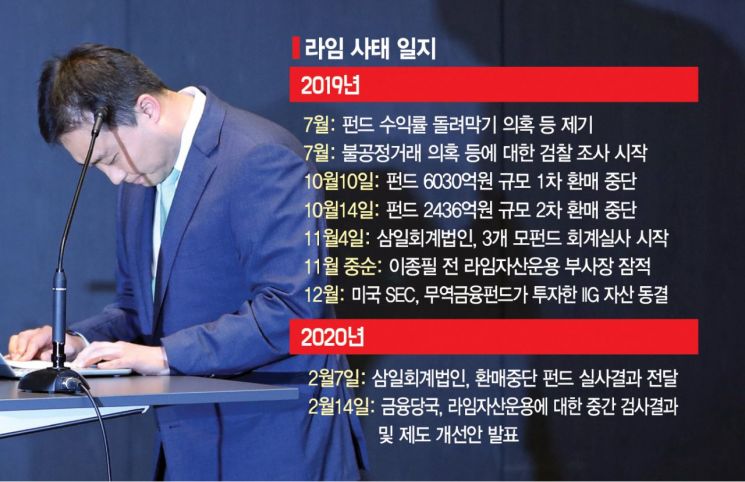
[Asia Economy Reporter Park Jihwan] It has been revealed that most of the losses from the Lime Asset Management incident, which caused a massive redemption suspension worth about 1.6 trillion won, have fallen on individual investors.
On the 14th, Lime Asset Management announced that it had finalized the loss rates of the two master funds that suspended redemptions, 'Pluto FI D-1' and 'Tethys 2,' at -46% and -17%, respectively. The day before, Lime held a collective investment asset evaluation committee meeting and decided to reflect the losses of the Pluto and Tethys funds in the net asset value. Based on the due diligence results conducted by Samil Accounting Corporation, the write-down (loss recognition) ratio for the assets invested in the redemption-suspended funds was determined.
The loss rate for the Pluto fund was decided within the estimated range of 35-50% by Samil Accounting Corporation. The 250 billion won invested in the unlisted company Metropolitan was written down by 90%, and the approximately 120 billion won invested in the Cambodia resort project was written down by 80%. The loss rate for the Tethys fund, which has more than 240 billion won suspended from redemption, was determined to be lower than the estimated 23-42% by Samil Accounting Corporation.
If Lime Asset Management reflects these losses all at once in the current net asset value of the master funds on the 17th, the loss rates for Pluto and Tethys are expected to reach approximately 46% and 37%, respectively. This is because the net asset values of these funds after their establishment currently stand at around 0% and -20%, and the recent losses will be additionally reflected.
However, the loss rates for individual investors are expected to vary significantly depending on the fund structure and other factors. In particular, investors who subscribed to funds where Lime entered into total return swap (TRS) contracts with securities firms may end up recovering nothing at all. It is known that among Lime’s sub-fund investors, 80-95% utilized 100% leverage. When a second write-down occurs, some investors may lose most of their principal.
A TRS contract is a type of loan where a securities firm receives collateral as margin and purchases assets on behalf of the fund manager in exchange for fees. When fund assets are liquidated, the securities firm can recover funds ahead of general investors. If the fund makes a profit, investors can earn higher returns, but if it incurs losses, the TRS funds must be repaid first, which increases the losses for individual investors.
Currently, the outstanding TRS balances in Lime funds are 500 billion won at Shinhan Financial Investment, 100 billion won at KB Securities, and 70 billion won at Korea Investment & Securities. Accordingly, from October to December last year, Shinhan Financial Investment received 2.5 billion won, KB Securities 1.7 billion won, and Korea Investment & Securities 1.3 billion won in fees. An industry insider commented, "Securities firms earned over 20 billion won annually in fees through TRS contracts. While customers are on the verge of losing almost all their investments, securities firms are collecting all related profits, which seems somewhat unfair."
Individual investors have entered litigation, claiming that they were not properly informed about TRS contracts or product risk levels when subscribing to the products through distributors. On the 12th, Daishin Securities sent certified letters regarding TRS contracts to the three securities firms?Shinhan Financial Investment, KB Securities, and Korea Investment & Securities?as well as Lime Asset Management, requesting that these securities firms refrain from claiming settlement distributions from Lime funds ahead of general customers. The letter stated that if these securities firms receive settlement distributions from Lime funds first, causing additional losses to Daishin Securities’ customers, legal responsibility could be pursued against those securities firms. Consequently, legal disputes among stakeholders over fund recovery are expected to intensify further.
© The Asia Business Daily(www.asiae.co.kr). All rights reserved.
![User Who Sold Erroneously Deposited Bitcoins to Repay Debt and Fund Entertainment... What Did the Supreme Court Decide in 2021? [Legal Issue Check]](https://cwcontent.asiae.co.kr/asiaresize/183/2026020910431234020_1770601391.png)















