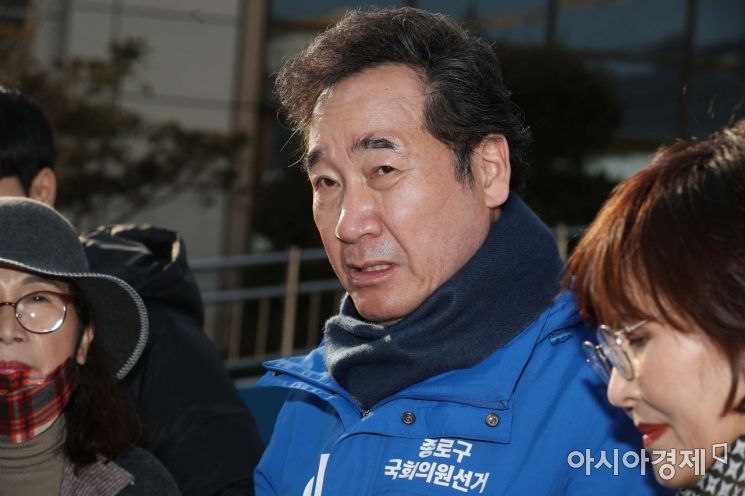
 Former Prime Minister Lee Nak-yeon, who declared his candidacy for Jongno as a Democratic Party candidate, is having a conversation with residents at Pyeongchang Cultural Space in Jongno-gu, Seoul on the 11th. Photo by Moon Honam munonam@
[Asia Economy Reporter Kang Nahum] About two months before the April 15 general election, a public opinion poll showed for the first time that the 'opposition party judgment theory' has surpassed the 'government judgment' sentiment amid a rapid increase in calls for 'government judgment.'
Korea Gallup announced on the 14th that in a survey conducted from the 11th to the 13th regarding the National Assembly election, 43% responded that "many ruling party candidates should be elected to support the current government," while 45% responded that "many opposition party candidates should be elected to check the current government."
In four surveys conducted from April to June last year and until January this year, support for the government was ahead of the check theory by about 10 percentage points, but this time it reversed for the first time.
By age group, in their 30s and 40s, the majority supported "ruling party victory (opposition party judgment theory)," while those aged 60 and over mostly supported "opposition party victory (government judgment theory)." In their 20s and 50s, the difference between support and check was not significant.
By political inclination, 74% of conservatives expected an opposition party victory, and 78% of progressives expected a ruling party victory, similar to a month ago. Among centrists, more expected an opposition party victory (50%) than a ruling party victory (39%), which is a reversal from last month. Among the non-affiliated group with no current party support, 18% expected a ruling party victory and 49% an opposition party victory, placing more weight on the opposition party victory than last month.
In the approval rating survey of President Moon Jae-in's administration, 44% responded that he is "doing well," while 49% said he is "doing poorly." Both positive and negative rates remained unchanged from last week.
Party support ratings were 37% for the Democratic Party of Korea, 21% for the Liberty Korea Party, 5% for the Justice Party, and 3% each for the Bareunmirae Party, the New Conservative Party, and the (tentative) Ahn Cheol-soo New Party. Other parties and organizations were all below 1%. Compared to last week, the Democratic Party, Liberty Korea Party, Bareunmirae Party, and New Conservative Party each rose by 1 percentage point.
In the next political leader preference survey, former Prime Minister Lee Nak-yeon ranked first with 25%, followed by Liberty Korea Party leader Hwang Kyo-ahn at 10%, Prosecutor General Yoon Seok-youl at 5%, and former lawmaker Ahn Cheol-soo and Gyeonggi Province Governor Lee Jae-myung at 3% each. The results were obtained through open-ended responses without providing candidate names.
This survey contacted 7,052 men and women aged 18 and over nationwide, with a final 1,001 respondents completing the survey, recording a 14% response rate. The sampling error is ±3.1 percentage points at a 95% confidence level. For more details, refer to the Central Election Poll Deliberation Commission website.
© The Asia Business Daily(www.asiae.co.kr). All rights reserved.
![User Who Sold Erroneously Deposited Bitcoins to Repay Debt and Fund Entertainment... What Did the Supreme Court Decide in 2021? [Legal Issue Check]](https://cwcontent.asiae.co.kr/asiaresize/183/2026020910431234020_1770601391.png)

















