Over 30,000 Employees Leave for 2 Consecutive Years Amid Government Pressure, Record High
"40% of Staff Have Less Than 5 Years of Service" "Lack of Accommodation Space" Complaints
Distorted Workforce Structure Leads to Decline in Efficiency and Productivity... Concerns Over Workforce Bottleneck
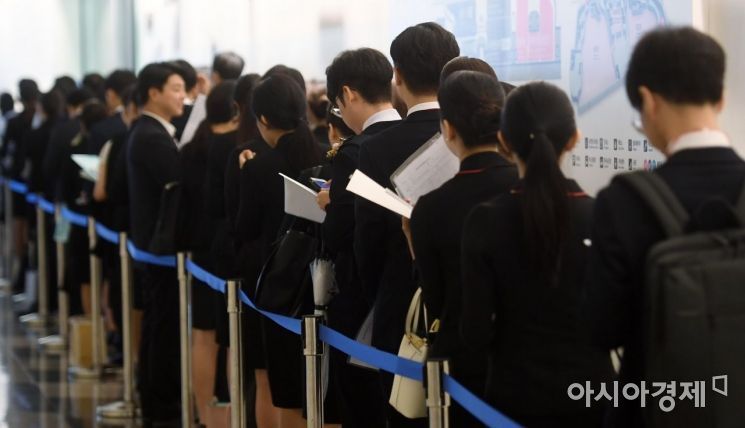
[Asia Economy Reporter Kim Bo-kyung] "In the past two years, we increased new hires so much that we are running out of space to accommodate them." "40% of employees have less than five years of tenure." "Hiring policies have changed with each administration, resulting in an hourglass-shaped workforce structure."
The Moon Jae-in administration, which put its life on job creation, increased new hires at public institutions to an all-time high, causing side effects in the field. A typical issue is that the distorted workforce structure is lowering work efficiency and productivity. This is the result of hiring personnel according to government preferences rather than a long-term workforce supply plan.
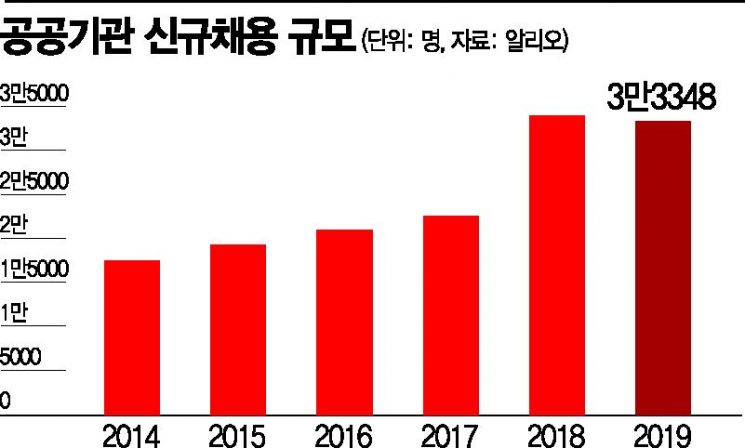
According to the Public Institution Management Information Disclosure System (Alio) on the 14th, the number of employees at public institutions reached 411,908 at the end of last year, surpassing 400,000 for the first time ever. Compared to 2017 (346,412), it increased by nearly 20%. Since the launch of the Moon Jae-in administration, new hires at public institutions were 33,900 in 2018 and 33,348 in 2019, marking the highest levels for two consecutive years. Last year, the number of hires exceeded the initial target (25,000) by about 8,000.
Public institutions competed to expand new hires to align with the government’s policy focus on job creation. The government encouraged new hiring by reflecting ▲employment performance of unemployed youth ▲performance of time-selective jobs ▲conversion of non-regular workers to regular workers in the public institution management evaluation criteria.
Ignoring management efficiency and increasing personnel has led to complaints in the field. Korea Trade Insurance Corporation hired 43 people in 2018 and 31 in 2019. This means they hired 10% of their total 700 employees in two years. This year, they plan to expand hiring to 57 people. They are running out of space to accommodate the increased staff. Internally, there are reactions that it is "excessive."
The scale of new hires at Korea Electric Power Corporation (KEPCO), which was 738 in 2014, more than doubled to 1,786 in 2018. They hired 1,773 last year and plan to hire 1,500 this year. A KEPCO official said, "Currently, 40% of employees have less than five years of tenure," adding, "The workforce structure is pyramid-shaped, so there is concern that personnel congestion may worsen in the future."
Korea Gas Corporation significantly increased new hires compared to previous years, with 369 in 2018 and 293 in 2019. In the past, in 1995 and 1996, they hired more than 500 people annually to strengthen gas safety management, but after the 1997 financial crisis, the scale was reduced to fewer than 50. Recently, new hires have increased again, resulting in an hourglass-shaped workforce structure. Promotion opportunities vary greatly depending on the time of joining. A Gas Corporation official said, "Increasing personnel is not always good. Hiring a certain number of people every year is best," adding, "In the next five to six years, a large number of experienced and specialized baby boomer generation employees are expected to retire, so there are many internal concerns."
A professor with experience participating in the public institution management evaluation team said, "Considering new hires and the conversion of non-regular workers to regular workers, supply has increased, so there is a high possibility of surplus personnel in the future." He added, "The workforce at public institutions increased by 30% over the past five years, but productivity decreased by 10%. Overall productivity has dropped by 20%," pointing out, "Now is a time when tightening the belt is still not enough."
© The Asia Business Daily(www.asiae.co.kr). All rights reserved.
![User Who Sold Erroneously Deposited Bitcoins to Repay Debt and Fund Entertainment... What Did the Supreme Court Decide in 2021? [Legal Issue Check]](https://cwcontent.asiae.co.kr/asiaresize/183/2026020910431234020_1770601391.png)

















