[Asia Economy Reporters Koh Hyung-kwang and Koo Eun-mo] The financial authorities mandated liquidity stress tests, also known as soundness inspections, for open-end funds because some funds, including Lime Asset Management, caused large-scale redemption suspension incidents due to liquidity shortages. As the rapid increase in illiquid assets, which are difficult to liquidate immediately, emerged as a risk that weakens the private equity fund operation structure, the authorities decided to block the setting of open-end funds if the proportion of investment in illiquid assets exceeds 50%. However, despite the financial supervisory authorities presenting institutional improvement plans, it seems difficult to avoid criticism that they have consistently responded belatedly without resolving the problem even seven months after the issue first surfaced.
◆ Private equity funds’ illiquid investment ratio exceeds 50% = According to the Korea Financial Investment Association and the Korea Capital Market Institute on the 14th, as of the end of last year, the proportion of private equity fund assets invested in illiquid assets exceeded half for the first time, accounting for 53.7% of the total domestic private equity fund assets. The share of illiquid assets such as real estate, tangible assets, special assets, and mixed assets in total private equity fund assets was only 13% at the end of 2008. This ratio stagnated for several years after surpassing 30% in 2012 but sharply increased after regulations began to be eased in 2015. It rose from 37.6% at the end of 2016 to 43.3% at the end of 2017, 49.2% at the end of 2018, and exceeded 50% at the end of last year.
The total private equity fund assets increased more than threefold from KRW 126.5564 trillion at the end of 2008 to KRW 412.409 trillion at the end of last year. Among these, real estate fund assets grew about 13 times from KRW 7.3506 trillion to KRW 95.1146 trillion during the same period, leading the growth of private equity funds.
However, open-end funds investing in illiquid assets, which are difficult to liquidate, inevitably face challenges in responding quickly if unexpected situations occur, such as many investors attempting redemptions simultaneously. The large-scale redemption suspension incident of Lime Asset Management’s private equity funds was also triggered by liquidity deterioration. The problem was that many funds were sold as open-end funds allowing mid-term redemptions while investing in illiquid assets like mezzanine, which are difficult to dispose of.
As alternative investments have become popular, concerns about fund liquidity risks have increased worldwide, prompting some advanced countries to strengthen related regulations. In the U.S., liquidity management measures for mutual funds were established in 2016, and Europe announced liquidity risk guidelines last year. The U.K. also prepared private equity fund liquidity regulations last year. In particular, in the U.K., when illiquid open-end funds are sold to individuals, liquidity risks must be disclosed, and risk management methods must be specified in the prospectus. The U.K. Financial Conduct Authority (FCA) immediately suspends sales if an open-end fund fails a liquidity stress test.
Song Hong-seon, head of the Fund and Pension Division at the Korea Capital Market Institute, advised, "Due to failures in managing liquidity risks in some private equity funds, regulations need to be reorganized. We should prepare liquidity risk management measures that align with domestic regulatory objectives by referring to global discussions."
◆ Asset managers ignoring risks, financial authorities responding belatedly = The direct cause of this incident was, of course, the reckless investments and illegal activities by Lime Asset Management’s executives and employees. However, there is criticism that the financial authorities’ complacent and belated response, which overlooked the issue, contributed to the escalation of the Lime incident.
Lime’s fund assets, which were only KRW 244.6 billion at the end of 2016, surged nearly 15 times to about KRW 3.6 trillion by the end of 2018. Compared to Timefolio Asset Management, currently the second-largest hedge fund company, which increased from KRW 589 billion at the end of 2016 to KRW 1.324 trillion at the end of last year, Lime’s growth was remarkably steep.
Despite the massive inflow of funds into Lime, the financial authorities remained passive. It is known that when Lime applied to convert to a public offering fund operator in 2018, the authorities did not find any particular problems with the funds Lime was managing.
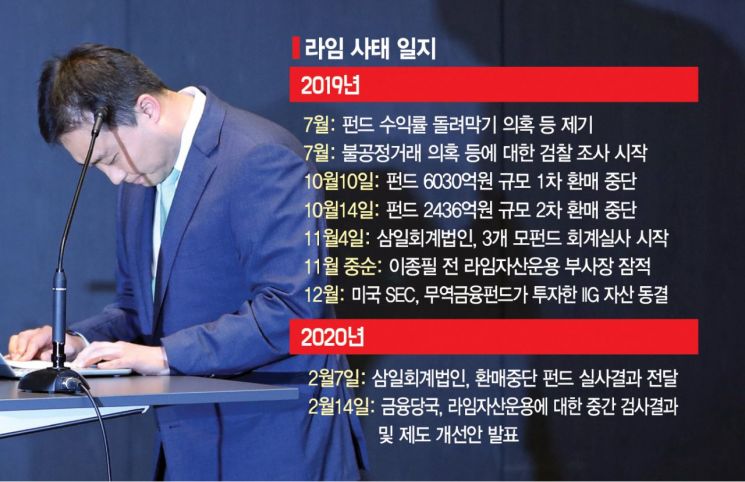
When allegations of Lime’s performance manipulation surfaced in July last year, the Financial Supervisory Service (FSS) showed a passive stance, stating, "We will conduct inspections if necessary in the future." Even when a KRW 620 billion fund redemption suspension occurred in October of the same year, the FSS did not detect suspicions of illegal activities such as performance manipulation by Lime and viewed it simply as a liquidity problem of the company. FSS Chairman Yoon Seok-heon said at the National Assembly audit that month, "We understand that Lime made mistakes in liquidity risk management."
However, in November, the vice president of Lime Asset Management, who was under prosecution investigation, disappeared, and by the end of the year, it was revealed that a U.S. hedge fund invested in by Lime was involved in a Ponzi scheme, freezing assets and escalating the incident.
The authorities’ initial response was not only delayed but also showed no will to resolve the issue. The Lime incident involves not only the capital market but also banks that sold the funds. Banks sold 35% of all Lime funds. Investors point out the banks’ incomplete sales practices, but the FSS, which should inspect this, remained inactive.
Professor Jung Soon-seop of Seoul National University, a member of the Government Innovation Finance Review Committee, pointed out, "While private equity fund regulations were eased, supervision of asset managers and sellers was neglected. The direction of regulatory easing is correct, but supervisory systems should be reorganized accordingly to proactively prepare for anticipated problems."
© The Asia Business Daily(www.asiae.co.kr). All rights reserved.
![User Who Sold Erroneously Deposited Bitcoins to Repay Debt and Fund Entertainment... What Did the Supreme Court Decide in 2021? [Legal Issue Check]](https://cwcontent.asiae.co.kr/asiaresize/183/2026020910431234020_1770601391.png)















