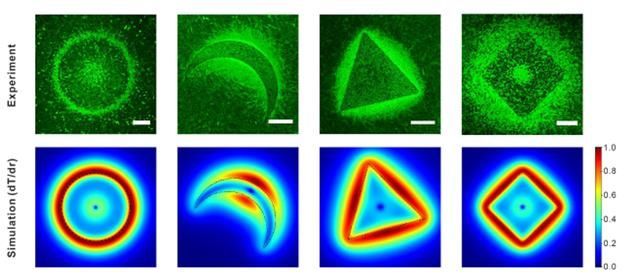
 This is the result of real-time observation of microbial collective behavior using light and heat. The image above shows microscopic observations of biofilms formed near microplates of various shapes, and the temperature distribution change rate near the microplates obtained through heat transfer simulation for the same structure.
[Asia Economy Reporter Junho Hwang] Domestic researchers have developed a technology that can monitor the signaling system between microorganisms in real time. This allows for real-time observation of why microorganisms engage in collective behavior, enabling accurate understanding of microorganisms' environmental adaptability.
The National Research Foundation of Korea announced on the 14th that an international joint research team, including Professor Kyungho Kim of Chungbuk National University, Professor Hongkyu Park of Korea University, and researcher Bochi Tian of the University of Chicago, developed a method to observe the collective behavior of microorganisms in real time using light and heat.
Communication via Bacterial Calcium Ions
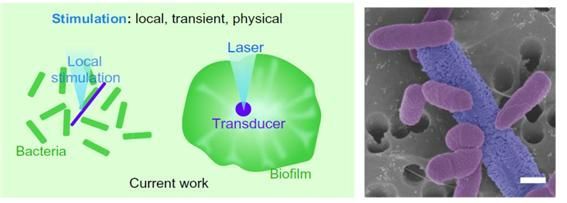 A schematic diagram (left) showing the process in which bacteria gather near the heat source by applying strong laser light to a part of the fabricated silicon nanowire to generate heat instantaneously, and a microscopic image of bacteria gathered near the actual nanowire.
The research team developed a nanostructure using silicon that can generate instantaneous heat through laser light. This allows precise thermal stimulation to be applied only to specific parts of certain microorganisms. Additionally, the light emitted from the structure enables real-time observation of the microorganisms' movements.
Previously, mechanical stimulation or chemical reactions were applied to entire microbial communities rather than specific microorganisms to infer microbial activity.
Using this technology to experiment on bacteria, the research team confirmed that bacteria aggregate through calcium ion waves. They discovered that concentric calcium ion waves occur centered on bacteria receiving thermal stimulation, and these waves propagate to neighboring bacteria up to a distance of 25 micrometers.
The team also conducted the same experiment using a disk-shaped silicon structure and observed bacteria exchanging calcium ion waves. They confirmed that rapid spatial temperature changes are the cause of calcium ion wave generation within bacterial communities.
Accurate Understanding of Microorganisms' Environmental Adaptability

Through this technology, the research team can quickly and precisely observe the activities of microbial communities, which is expected to be utilized in enhancing understanding of microorganisms' environmental adaptability in the future.
Bacterial communities behave like a single adaptive multicellular organism through mutual signal transmission and cooperation. Signal transmission within the community helps them respond more flexibly to various environmental changes such as nutrient deficiency. By observing this phenomenon, the research team explains that it is possible to understand bacterial community responses to environmental changes and their stable survival.
This research was introduced on the 14th in the international academic journal Science Advances.
© The Asia Business Daily(www.asiae.co.kr). All rights reserved.
![User Who Sold Erroneously Deposited Bitcoins to Repay Debt and Fund Entertainment... What Did the Supreme Court Decide in 2021? [Legal Issue Check]](https://cwcontent.asiae.co.kr/asiaresize/183/2026020910431234020_1770601391.png)

















