Recent Economic Trends in February
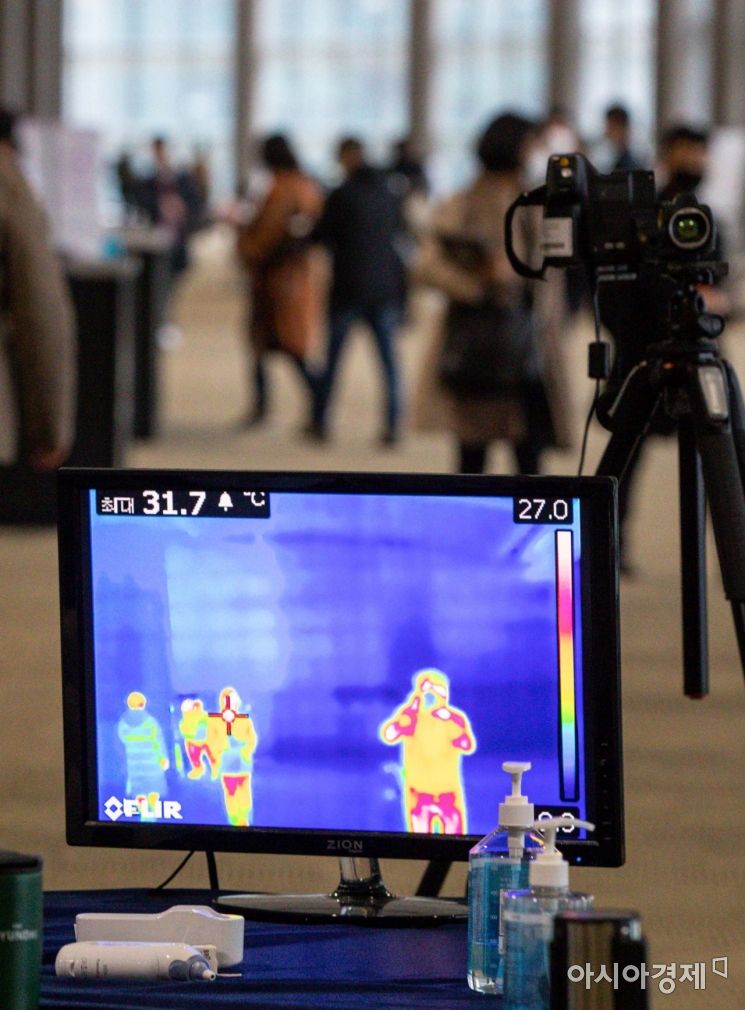 On the 12th, at COEX in Gangnam-gu, Seoul, visitors underwent temperature checks to prevent the spread of the novel coronavirus during the '2020 Hotel Fair'. Photo by Jinhyung Kang aymsdream@
[Sejong=Asia Economy Reporters Kim Hyunjung and Joo Sangdon] The government has judged that COVID-19 could restrict the recovery momentum of our economy. Although an improvement in the economy was confirmed in key indicators such as production, consumption, and facility investment, damage is inevitable depending on the extent and duration of the COVID-19 spread. No specific damage scale or forecast was provided.
On the 14th, the Ministry of Economy and Finance stated in the 'Recent Economic Trends February Issue (Green Book)' that "In the fourth quarter of last year, our economy showed a continued increase in production, consumption, and facility investment, and in December, both the economic trend and leading index (cyclical component) rose together, indicating an improvement in the economic trend."
In particular, it noted, "Externally, in January this year, the fixed price of DRAM semiconductors slightly turned upward, and expectations for a global economic recovery are forming," but also forecasted that "depending on the extent and duration of the recent COVID-19 outbreak, the growth of the world economy, including China, and the recovery momentum of our economy may be constrained."
Regarding the economic situation as of the end of January, the government gave a more positive evaluation than the previous month. After excluding the term 'sluggish' for four consecutive months following seven months of its use from the April to October issues last year, the diagnosis of an 'adjustment phase' that was mentioned only for exports and construction investment was changed to an overall level of 'improvement' and 'recovery.' Although total export value last month decreased by 6.1% compared to the same period last year, the average daily export excluding working days increased by 4.8%. This is the first increase in average daily export value in 14 months.
However, the market expects that private consumption, production, and investment indicators will worsen due to the negative impact of COVID-19. The Ministry of Economy and Finance also mentioned private consumption in the Green Book, citing the increase in the number of Chinese tourists visiting Korea in January as a key positive factor. The number of Chinese tourists visiting Korea, which was about 238,000 in January, is expected to sharply decline due to physical entry restrictions following the COVID-19 outbreak. On the 10th, the Korea Development Institute (KDI) also predicted that "the negative impact of COVID-19 will first appear in some tourism-related sectors."
Investment indicators also showed a limited improvement trend. Facility investment (GDP preliminary estimate) in the fourth quarter of last year decreased by 4.2% compared to the same period last year, but construction investment increased by 0.5%. Construction investment in the third quarter had decreased by 3.7%.
Employment increased mainly among those aged 60 and over, with the number of employed persons expanding from 516,000 in December last year to 568,000 in January this year. The unemployment rate also fell by 0.4 percentage points compared to the same month last year, reaching 4.1%.
Inflation accelerated. In January, the consumer price index rose by 1.5% year-on-year due to a turnaround in agricultural, livestock, and fishery product prices and an increase in petroleum prices, and the core inflation, which shows the underlying trend of prices, also rose by 0.9%.
The domestic financial market showed a decline in stock prices and government bond yields and a rise in the exchange rate (weakening of the won) since late January. The housing market saw a decrease in the sales price increase rate to 0.28% in January from 0.38% in the previous month.
A Ministry of Economy and Finance official said, "The government will do its utmost to secure momentum for economic recovery by thoroughly minimizing the ripple effects on the economy while supporting areas of concern due to infectious disease damage and swiftly promoting tasks to boost investment, consumption, and export vitality reflected in the 2020 economic policy direction."
© The Asia Business Daily(www.asiae.co.kr). All rights reserved.
![User Who Sold Erroneously Deposited Bitcoins to Repay Debt and Fund Entertainment... What Did the Supreme Court Decide in 2021? [Legal Issue Check]](https://cwcontent.asiae.co.kr/asiaresize/183/2026020910431234020_1770601391.png)















