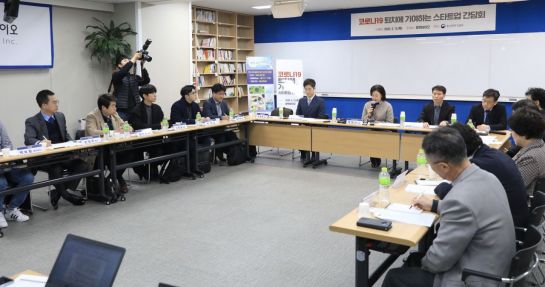
 Park Young-sun, Minister of SMEs and Startups (center), is attending the 'COVID-19 Related Startup Meeting' held on the 13th at Hubet Bio located in Munjeong-dong, Songpa-gu, Seoul, discussing government support policies.
[Asia Economy Reporter Kim Daeseop] An average of 1 million daily visitors and over 13 million cumulative views. These are the figures for the COVID-19-related status map service called 'CoronaMap.'
Lee Donghoon, CEO of Modak, who developed this service, attended the 'COVID-19 Startup Roundtable' held on the 13th at Hubet Bio in Munjeong-dong, Songpa-gu, Seoul, and emphasized, "The biggest challenge and entry barrier for data analysis startups is data," adding, "Because good data was continuously supplied, good services could emerge."
CEO Lee Donghoon is a university student in his twenties and a startup entrepreneur. He stated, "Many services emerged after CoronaMap, but the reason university or high school students could create these services overnight or within a day or two was because the Korea Centers for Disease Control and Prevention provided the data. (Through this) the CoronaMap service was able to become known to the world."
He continued, "I believe that if we have good data when national disaster situations like this COVID-19 occur in the future, not only I but also others can create better services."
The roundtable was organized by the Ministry of SMEs and Startups to hear the on-site voices of startups working to combat infectious diseases. About 10 people, including Minister Park Young-sun and startup CEOs, attended. Minister Park emphasized while listening to CEO Lee Donghoon's story, "It seemed like a statement that truly conveyed the importance of open data."
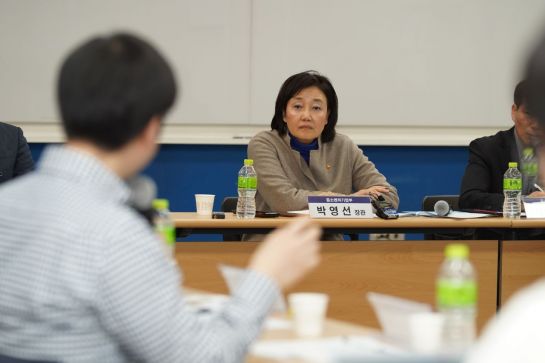 Park Young-sun, Minister of SMEs and Startups, is attending the 'COVID-19 Related Startup Meeting' held on the 13th at Hubet Bio located in Munjeong-dong, Songpa-gu, Seoul, listening to on-site difficulties and other issues.
Park Han, CEO of Viva Innovation, also repeatedly emphasized the importance of open data services. CEO Park operates a mobile service called 'Good Doctor.' The Good Doctor service has over 50,000 monthly users on average. Through providing COVID-19-related content, the monthly average users increased by more than 20,000.
CEO Park said, "When the coronavirus outbreak occurred, I thought a lot about how people could avoid immediately visiting hospitals and instead suspect their symptoms and move to screening clinics," adding, "Based on continuously collected papers from China, we provide content that checks symptoms and advises moving to hospitals or screening clinics if COVID-19 is suspected."
He continued, "While analyzing medical data, I realized that besides the Health Insurance Review & Assessment Service, a lot of hospital data was needed. Now that the Data 3 Act has passed, I hope there will be ways to receive more hospital data."
At this roundtable, startup CEOs proposed ▲ developing and utilizing platforms capable of producing vaccines ▲ significantly increasing short-term policy funds for rapid vaccine development during infectious disease outbreaks ▲ joint procurement of raw materials for vaccine patch development ▲ establishing national-level virus diagnostic kit (clinical) testing plans.
Minister Park Young-sun introduced past efforts through public-private cooperation, such as mask supply from China and domestically, as well as policy financial support plans to respond to the COVID-19 spread. She also emphasized that to prepare more fundamentally for the future, fostering startups that prevent and treat infectious diseases through a shift in perspective is necessary.
Minister Park stated, "For companies with growth potential in pharmaceuticals, medical devices, digital healthcare, and bio-materials, we will provide linked support including 600 million KRW in startup and commercialization funds over three years, up to 600 million KRW in R&D over two years, up to 10 billion KRW in policy funds, and 3 billion KRW in technology guarantees."
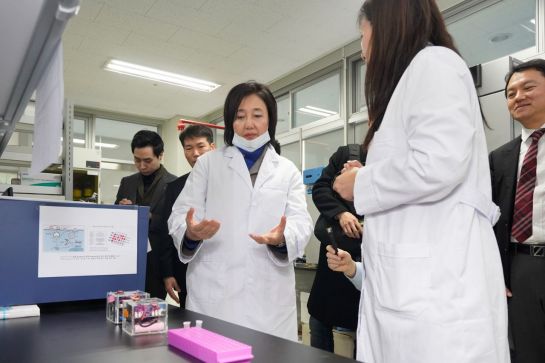 Minister Park Young-sun of the Ministry of SMEs and Startups (left) visited the Hubet Bio laboratory located in Munjeong-dong, Songpa-gu, Seoul on the 13th and received an explanation from a researcher about the development of virus diagnostic kits and vaccine adjuvants using nanoparticles.
Voices regarding difficulties in developing products and vaccines for diagnosing and treating new viruses were also raised at the roundtable.
Kim Subok, Executive Director of CoGen Biotech, which develops COVID-19 diagnostic reagents, emphasized, "We received funding for development, but like during the SARS (Severe Acute Respiratory Syndrome) period, after the project ends, it becomes impossible to report on commercial achievements. This can result in a negative record, making it impossible to apply for the next project. There is a stigma, so parts that can resolve this are needed."
In response, Minister Park said, "We believe that recognizing efforts regardless of commercial success is something we should fully consider."
Meanwhile, on the same day, Minister Park also visited the laboratory and corporate research institute of Hubet Bio, the venue of the roundtable, to review virus screening and diagnostic research and development status.
Jung Hyunghwa, CEO of Hubet Bio, explained, "By introducing a nanoparticle method and utilizing it like cells, we can shorten the time of diagnostic kits and improve accuracy."
© The Asia Business Daily(www.asiae.co.kr). All rights reserved.
![User Who Sold Erroneously Deposited Bitcoins to Repay Debt and Fund Entertainment... What Did the Supreme Court Decide in 2021? [Legal Issue Check]](https://cwcontent.asiae.co.kr/asiaresize/183/2026020910431234020_1770601391.png)

















