Supreme Court Upholds Acquittal of Conscientious Objectors
Veterans Boil Over Saying "Do We Have No Conscience?"
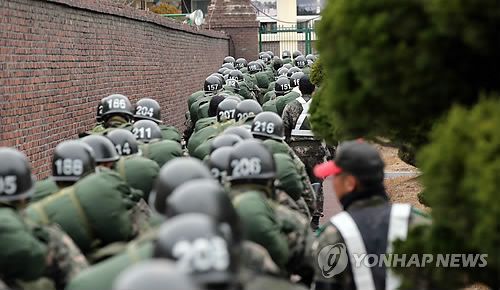 [Image source=Yonhap News]
[Asia Economy Reporter Han Seung-gon] Controversy is erupting as the Supreme Court confirmed the acquittal of Jehovah's Witnesses who refused active military enlistment.
They accept military service itself based on personal faith or beliefs but refuse to handle firearms, practicing what is known as 'conscientious objection to bearing arms.'
The problem lies in the unfavorable perception of this stance. Among men who are about to enlist or have completed military service, there are complaints like "Do we have no conscience?"
On the 13th, the Supreme Court upheld the acquittal verdict from the lower court in the appeal trial of 111 people, including Park Mo, who were charged with violating the Military Service Act.
Previously, in 2018, the Supreme Court's full bench ruled that refusing enlistment based on the religious belief of 'conscientious objection to bearing arms' constitutes a 'justifiable reason for military service refusal' and thus cannot be criminally punished, overturning and remanding the Military Service Act violation case with a not guilty verdict.
Since then, lower courts have consecutively acquitted Jehovah's Witnesses charged with violating the Military Service Act.
However, some express that they cannot understand such court decisions.
A man in his 40s, identified as office worker A, who has served in the military, said, "Before 'conscientious objection to military service,' one of the four major duties of citizens is 'the duty of national defense,' but refusing military service like this means not fulfilling a citizen's duty," and added, "I hope the government clarifies this issue."
Another office worker B in his 30s also expressed incomprehension. He said, "Allowing refusal of military service based on conscience means anyone can refuse military service for this reason," and lamented, "As a result, people inevitably ask, 'Who will protect the country?'"
Meanwhile, according to a survey, 7 out of 10 citizens think they cannot understand conscientious objection to military service.
In May 2018, the Korea Church Media Association commissioned the public opinion research firm Gallup Korea to conduct a survey on 'Perceptions of Conscientious Objection to Military Service and Homosexuality.' The results showed that 66.8% responded that they "cannot understand conscientious objection to military service."
Those who responded "can understand" accounted for 26.6%, and "don't know/no response" was 6.6%. The survey was conducted over two days targeting 1,017 adult men and women nationwide aged 19 and older. The sampling error was ±3.1 percentage points at a 95% confidence level.
Meanwhile, starting this year, an alternative service system for conscientious and religious objectors to military service will be implemented.
On December 30, the Ministry of National Defense announced in relation to "Changes in National Defense Work in 2020" that "Those who refuse military service due to religious beliefs, etc., will be incorporated as alternative service personnel after review and approval by a screening committee according to the law, and will serve 36 months of collective service in correctional facilities. After completing service, they will perform reserve force alternative service in correctional facilities instead of reserve training until the 8th year."
© The Asia Business Daily(www.asiae.co.kr). All rights reserved.
![User Who Sold Erroneously Deposited Bitcoins to Repay Debt and Fund Entertainment... What Did the Supreme Court Decide in 2021? [Legal Issue Check]](https://cwcontent.asiae.co.kr/asiaresize/183/2026020910431234020_1770601391.png)