This Year, Nationwide Prices Rise 6.33% with Slowed Pace
Seoul Up 7.89%... Half of Last Year's Level
Official Land Prices Steadily Increase... Holding Tax Burden Rises
[Asia Economy Reporters Moon Jiwon, Lee Chunhee] The standard land price, which serves as the benchmark for nationwide land prices, rose by only 6.33% this year, leading to analyses that the government has entered a 'speed control' phase. However, concerns are also being raised that the overall property tax burden will inevitably increase, as the official land price has been steadily rising every year and many cases of property taxes that were not reflected last year due to the cap have been carried over to this year.
According to the Ministry of Land, Infrastructure and Transport on the 13th, the standard land price nationwide rose by 6.33% this year, with Seoul increasing by 7.89%. Considering that Seoul's price rose by 13.87% last year, the rate of increase has been reduced to about half. By district, only Seongdong-gu and Gangnam-gu, where buying sentiment was concentrated due to development prospects, saw increases exceeding 10%, while most other areas showed a slowdown in growth. Last year, 12 out of the 25 autonomous districts in Seoul, half of them, had official land price increases exceeding 10%.
Experts predict that individual official land prices and apartment official prices, which are calculated based on the standard land price, will not see as large an increase as last year. Ham Youngjin, head of the Zigbang Big Data Lab, said, "With the official prices rising significantly last year, various issues and fairness controversies emerged," adding, "The rate of increase in official prices is not expected to be that high."
However, since the official land price has been steadily rising for several years, the burden of property taxes such as property tax and comprehensive real estate tax is also expected to increase significantly this year. While housing uses a separate official price as the basis for taxation, buildings and commercial properties use the official land price as the basis for calculating property taxes. Therefore, the tax burden is expected to be particularly heavy in districts where the official land price rose relatively sharply this year, such as Seongdong-gu (11.16%), Gangnam-gu (10.54%), Dongjak-gu (9.22%), Songpa-gu (8.87%), and Seocho-gu (8.73%).
Park Won-gap, senior real estate expert at KB Kookmin Bank, said, "In the Seoul area, the Gangnam area and adjacent districts such as Seongdong and Dongjak had relatively high growth rates," adding, "Especially, districts with active new towns and redevelopment such as Dongdaemun, Nowon, Seodaemun, and Geumcheon had higher growth rates than the previous year."
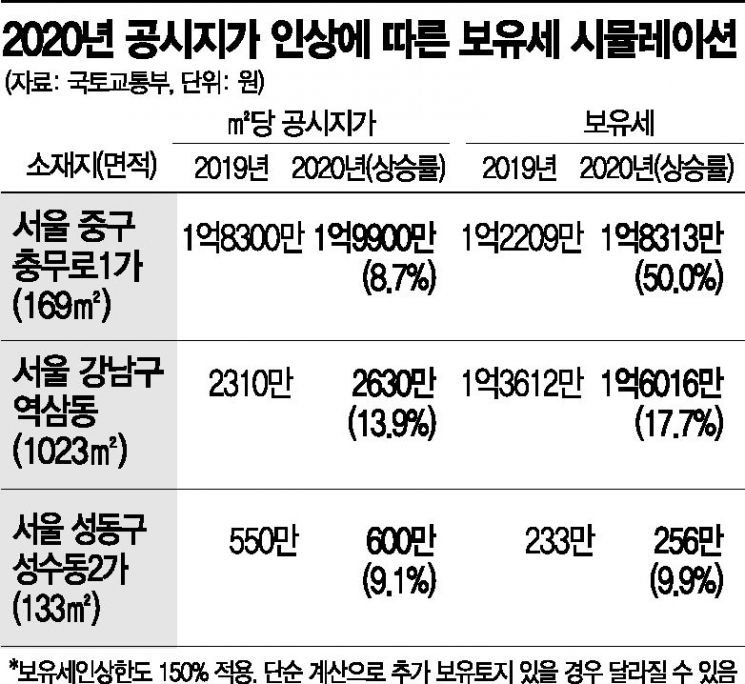
According to a simulation by the Ministry of Land, Infrastructure and Transport reflecting this year's official land price increase, the property tax burden for the top five parcels nationwide has all reached the upper limit.
Assuming the owner of the Nature Republic site in Chungmuro 1-ga, Jung-gu, Seoul, which is the most expensive at 199 million KRW per square meter nationwide, owns only that land, they must pay 183.13 million KRW in property tax this year. Considering the increase in official land price, they should pay 209.56 million KRW, but due to the 150% cap, the tax increases by 61.04 million KRW compared to the previous year.
The owner of the Woori Bank Myeongdong Financial Center site in Myeongdong, Jung-gu, must also pay 467.27 million KRW in taxes this year. This amount is 155.76 million KRW more than last year, reaching the tax burden cap (50% increase compared to the previous year).
In particular, many landowners this year are expected to see their property tax burden increase at a rate far exceeding the official land price increase. This is because the rapid rise in official land prices last year triggered the tax burden cap of 150% of the previous year's tax amount, and the excess property tax is reflected this year.
The increase in the fair market value ratio from 85% to 95% this year is also a factor contributing to the rise in property tax burden. The fair market value ratio, which is a discount rate concept for the comprehensive real estate tax, increases by 5% annually and will reach 100% in 2022. Ham explained, "In areas where the official land price increase or realization rate is locally high, the tax burden will not be insignificant."
© The Asia Business Daily(www.asiae.co.kr). All rights reserved.
![User Who Sold Erroneously Deposited Bitcoins to Repay Debt and Fund Entertainment... What Did the Supreme Court Decide in 2021? [Legal Issue Check]](https://cwcontent.asiae.co.kr/asiaresize/183/2026020910431234020_1770601391.png)















