Japan's Ministry of Economy, Trade and Industry Proposes Ocean Discharge of Contaminated Water... "Due to Site Securing and Costs"
"Total Radioactive Nuclide Amount Remains Despite Dilution... Cannot Avoid Permanent Marine Pollution
Violates International Consensus Principles, Ignores Long-Term Storage Alternatives"
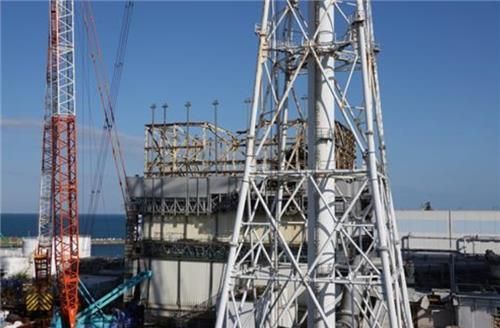 Fukushima Daiichi Nuclear Power Plant Unit 1. (Photo by Japan Nuclear Safety Research Association (NSRA)·Yonhap News)
[Asia Economy Reporter Moon Chaeseok] The possibility of Japan releasing 1.2 million tons of contaminated water from the Fukushima nuclear power plant into the ocean has ultimately increased.
On the 12th, Greenpeace announced that the final report submitted on the 10th by the Expert Subcommittee on Contaminated Water Treatment under Japan's Ministry of Economy, Trade and Industry (METI) recommended discharging approximately 1.2 million tons of contaminated water stored at the Fukushima Daiichi Nuclear Power Plant into the sea.
Greenpeace stated that METI proposed the ocean discharge plan as a final option despite opposition from domestic experts and civil society in Japan, citing reasons such as securing site space and cost reduction. The final decision will be made by the Japanese government, with no specific timeline indicated.
The METI subcommittee and Tokyo Electric Power Company (TEPCO) repeatedly emphasized at subcommittee meetings held on the 31st of last month and the 3rd, as well as at briefings for overseas embassies and foreign media, that ocean discharge is a more reasonable method.
They also cited the burden of storage sites reaching saturation in 2022. Additionally, they mentioned that utilizing ocean discharge technology and establishing a radiation monitoring system would be easier.
Although the report includes technical and cost limitation analyses for both ocean discharge and atmospheric release methods, the METI subcommittee and TEPCO pushed forward with the ocean discharge option.
According to Greenpeace, the Japanese government must obtain the consent of fishermen along the Fukushima coast before releasing the contaminated water into the ocean. Afterward, if the government approves the final disposal plan it has prepared, TEPCO will implement it.
Greenpeace believes that since the Japanese government has accepted all proposals from METI, the main agency responsible for responding to the Fukushima accident, and the Nuclear Regulation Authority, this recommendation makes the government's plan to discharge contaminated water into the ocean more certain.
Jean-Marie, a climate and energy campaigner at Greenpeace Seoul Office, said, "The discharge decision, which both Japanese and Korean citizens opposed and were concerned about, has ultimately been made. Although the procedure to obtain consent from Fukushima citizens remains, it is not sufficient to stop the Japanese government's contaminated water discharge plan, so the Korean government must promptly decide on an international legal response."
Kazue Suzuki, a climate and energy campaigner at Greenpeace Japan Office, stated, "Although the discharge standards are met when the contaminated water is diluted, the total amount of lethal substances such as strontium-90 remains unchanged, so permanent marine pollution cannot be avoided. Given the clear risks of contaminated water discharge and the alternative of long-term storage, the Japanese government's plan violates internationally agreed precautionary principles."
© The Asia Business Daily(www.asiae.co.kr). All rights reserved.

















