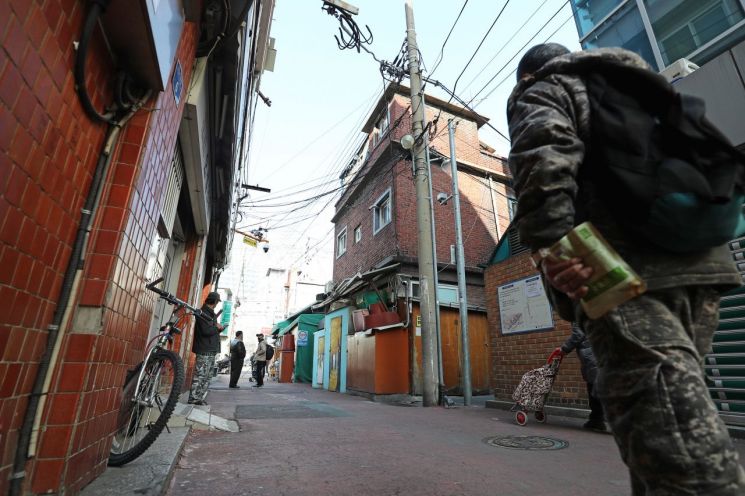
[Asia Economy Reporter Jeong Dong-hoon] When a crisis hits, the poor are the first to be exposed to danger. The novel coronavirus infection (Wuhan pneumonia) situation is no different. Masks, whose prices have skyrocketed, are hard to find, and they cannot avoid outdoor work to make a living.
On the 11th, Mr. Lim Mo (77), an elderly man collecting scrap paper near the shantytown in Bukahyeon-dong, Seodaemun-gu, Seoul, said, "I live day to day, so where would I use a mask?" and complained, "If masks cost 3,000 won each, that's money for a meal, so if I spend it there, how can I eat?"
Many residents of the shantytown make a living by collecting scrap paper or doing daily wage jobs. For them, masks and hand sanitizers that can prevent novel coronavirus infection seemed like a 'luxury.' Among the 17 residents encountered in the shantytown that day, only two were wearing masks.
Masks are not only hard to find but have also become expensive items for them to purchase. According to a survey by the Consumer Citizens' Organization on the 4th, adult KF94 masks are traded at 3,148 won, and adult KF80 masks at 2,663 won. Compared to the 2018 survey prices, KF94 masks have increased 2.7 times, and KF80 masks 2.4 times. Shim Ji-hyun (25), who works at a convenience store near the shantytown, said, "Among the neighborhood residents, there are more elderly people than young people, but most of the people buying masks are young customers," adding, "People over 70 don't seem to look for masks much and find them cumbersome."
Some local governments have stepped in to provide masks, but due to budget issues, support is often one-time only. Many residents were unaware that mask support even existed. Mr. Park Mo (83), a resident of the shantytown, said, "Since the news keeps saying it's a 'deadly disease,' I wear the masks given by the community center when the fine dust is severe," and questioned, "Young people can find out about distribution through computers or phones, but how would elderly people like us know?"
Professor Song Jae-ryong of the Department of Sociology at Kyung Hee University stated, "Looking at places where low-income groups tend to live, medical and quarantine infrastructure facilities appear to be vulnerable," and added, "The government and related agencies need to ensure that there are no quarantine gaps caused by disparities between classes and regions."
© The Asia Business Daily(www.asiae.co.kr). All rights reserved.
![User Who Sold Erroneously Deposited Bitcoins to Repay Debt and Fund Entertainment... What Did the Supreme Court Decide in 2021? [Legal Issue Check]](https://cwcontent.asiae.co.kr/asiaresize/183/2026020910431234020_1770601391.png)