November 11 (local time) Mutual Cooperation Agreement Signed in the US for Next-Generation Electric Vehicle Development
"Expecting to Secure Basis for Electric Vehicle Price Reduction through Simplified Development Process"
 On the 11th (local time), at the Canoo headquarters building located in LA, USA, Payez Raman, Executive Vice President of Hyundai Kia Motors Vehicle Architecture Development Center (left), and Ulrich Kranz, CEO of Canoo, shook hands after signing a cooperation agreement for the development of the next-generation electric vehicle platform. (Photo by Hyundai Kia Motors)
[Asia Economy Reporter Jihee Kim] Hyundai Kia Motors is jointly developing a next-generation electric vehicle platform with the U.S. electric vehicle specialist company 'Canoo.'
Hyundai Kia Motors and Canoo signed a mutual cooperation agreement for next-generation electric vehicle development on the 11th (local time) at Canoo's headquarters in Los Angeles, USA. Through this agreement, Canoo will provide technical support for the development of a modular electric vehicle platform optimized for Hyundai Kia Motors. Hyundai Kia Motors plans to use this platform to develop competitively priced compact and mid-sized passenger electric vehicles as well as purpose-built mobility (PBV) that meets various customer demands.
Albert Biermann, Head of Research and Development at Hyundai Kia Motors, said, “Canoo, which possesses advanced technology in innovative electric vehicle architecture, will be the perfect partner for us to transform into a pioneer of the future mobility industry,” adding, “Through this cooperation, we will develop an electric vehicle platform concept optimized for autonomous driving and mass production with price competitiveness.”
Based in Los Angeles, USA, Canoo specializes in skateboard platform technology that standardizes core electric vehicle components such as motors and batteries into modular forms. In particular, they focus on advancing electric vehicle platform technology that reduces the size, weight, and number of parts of the skateboard platform to secure interior space and enable cost reduction.
Hyundai Kia Motors expects to establish a foundation to lower electric vehicle prices by simplifying and standardizing the electric vehicle development process using Canoo’s skateboard platform technology. Additionally, the ability to produce various vehicle types on a single platform is expected to enable quicker responses to changes in customer demand.
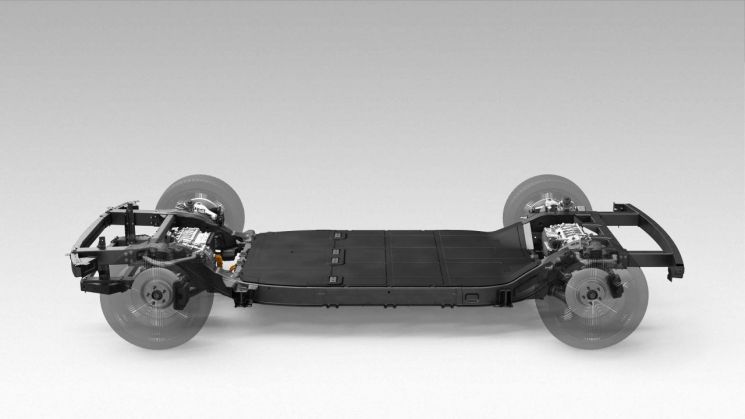
This collaboration is expected to accelerate Hyundai Kia Motors' electrification strategy. According to the '2025 Strategy' announced at the end of last year, Hyundai plans to invest 9.7 trillion KRW in vehicle electrification over the next six years. Kia aims to have a full lineup of electric vehicles by 2025 and sell 500,000 electric vehicles globally in 2026 when sales are expected to ramp up.
Furthermore, the electric vehicle-based PBVs recently announced by Hyundai Kia Motors will be developed into various customized concepts depending on vehicle usage.
Hyundai Kia Motors has also established a dual electric vehicle development strategy: collaborating with Canoo in the passenger electric vehicle sector and with Arrival in the commercial electric vehicle sector. Last month, Hyundai Kia Motors invested 130 billion KRW in Arrival, a UK-based commercial electric vehicle specialist, and agreed to jointly develop urban vans, small buses, and other commercial electric vehicles.
Meanwhile, Canoo, established in December 2017, unveiled its first electric vehicle using skateboard platform technology and is conducting demonstration tests just 19 months after starting full-scale research last September. Currently, more than 300 engineers are concretizing Canoo’s architecture system concept. The first electric vehicle is planned to be launched in 2021.
© The Asia Business Daily(www.asiae.co.kr). All rights reserved.


















