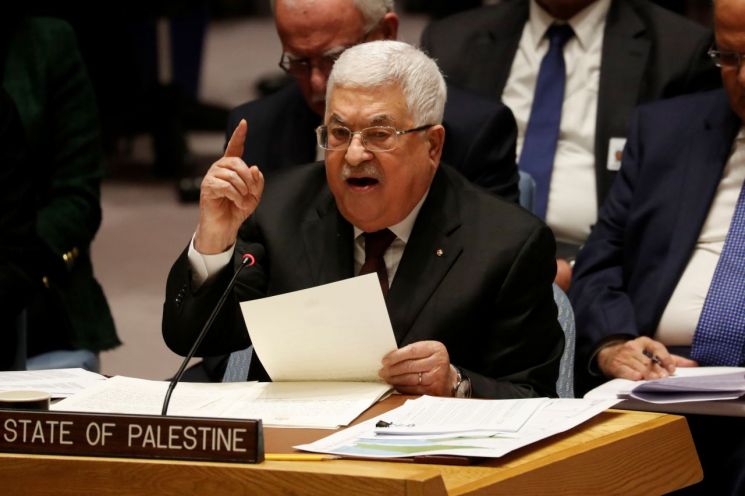
 On the 11th (local time), Mahmoud Abbas, head of the Palestinian Authority, speaking at the United Nations Security Council meeting [Image source=Reuters Yonhap News]
[Asia Economy Reporter Hyunwoo Lee] The Palestinian Authority has once again strongly expressed its rejection of the "Middle East Peace Plan" proposed by U.S. President Donald Trump at the end of last month at the United Nations. The plan, which is unilaterally favorable to Israel, has been criticized for effectively legalizing Israel's illegal settlements within Palestinian territory. With the international community, excluding Israel and the U.S., showing no intention to accept the plan, there are concerns that it will only exacerbate the conflict between Israel and Palestine.
According to foreign media including the Associated Press, on the 11th (local time), Mahmoud Abbas, the head of the Palestinian Authority attending the United Nations Security Council, declared his rejection of the U.S. Middle East Peace Plan, fiercely criticizing it as "legalizing Israel's illegal settlements and annexations on Palestinian land." He further argued, "This plan should not be considered an international standard for negotiations, and since the U.S. is not the sole mediator, an international conference involving not only the U.S. but also Russia, the European Union (EU), and the UN Security Council is necessary."
The Middle East Peace Plan criticized by Abbas was proposed by President Trump at the end of last month. It recognizes all of Jerusalem as Israeli territory and acknowledges Israel's sovereignty over Jewish settlements in the West Bank, while allowing Palestine to establish and be recognized as a separate state, receiving over $50 billion in economic support. The plan is structured with conditions unilaterally favorable to Israel and has not been accepted by the international community except for the U.S. and Israel. The international community opposes Israel's territorial claims over East Jerusalem and the annexation of the West Bank.
On the same day at the UN Security Council, a heated exchange took place between Abbas and the Israeli ambassador to the UN. Danny Danon, Israel's ambassador to the UN, criticized Abbas, saying, "If Abbas truly wants peace, he should be in Jerusalem negotiating with Israeli Prime Minister Benjamin Netanyahu, not at the UN," and added, "A leader (Abbas) who chooses rejectionism and the glorification of terrorism can never be a genuine partner for peace." The U.S. took a mediator stance. Kelly Craft, the U.S. ambassador to the UN, explained, "What we really want to support is for both parties to sit together at the table and discuss how to advance this plan," adding, "This is a vision, not an agreement."
Meanwhile, in opposition to the U.S. Middle East Peace Plan, Tunisia and Indonesia, as non-permanent members of the Security Council, are leading efforts to adopt a resolution condemning Israel's plan to annex Jewish settlements in the West Bank.
© The Asia Business Daily(www.asiae.co.kr). All rights reserved.
![User Who Sold Erroneously Deposited Bitcoins to Repay Debt and Fund Entertainment... What Did the Supreme Court Decide in 2021? [Legal Issue Check]](https://cwcontent.asiae.co.kr/asiaresize/183/2026020910431234020_1770601391.png)