Improving Awareness of Discrimination Against Women, Race, and Foreigners... Voices for Change Linked to Anti-Trump Sentiment
Bong Joon-ho Expresses Support in Acceptance Speech... Predicting Changes in Dynamics Between Mainstream and Independent Film Industries
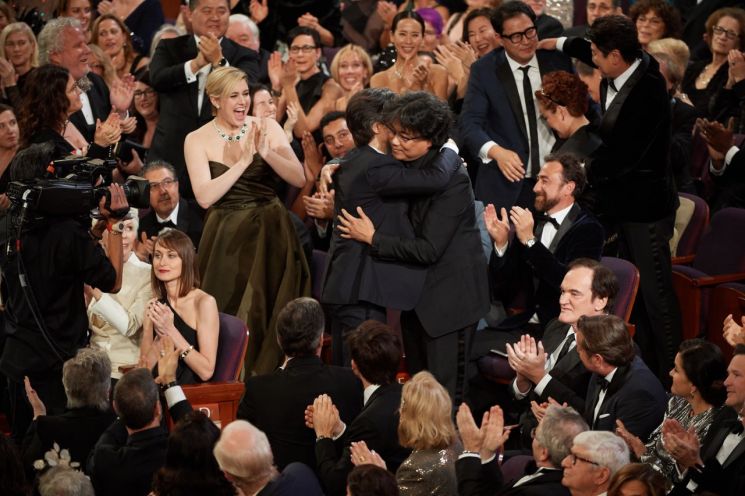
[Asia Economy Reporter Jonggil Lee] The landscape of Hollywood in the United States has changed. Director Bong Joon-ho (51)'s film "Parasite" broke the wall of conservative tradition by becoming the first foreign-language film to win the top honor at the Academy Awards (Oscars).
The Academy Awards had been the most American film festival. It was so from its inception. The Academy of Motion Picture Arts and Sciences was actually created by Louis B. Mayer (1884?1957), founder of Metro-Goldwyn-Mayer (MGM), to control labor unions. The grandiose name reminiscent of an academic institution was given with the intention of resolving labor disputes and promoting technical improvements across the film industry.
Every filmmaker wants to win an Academy Award. Therefore, Hollywood directors and producers are subtly influenced by political circumstances. Many Hollywood films carry certain messages or are cleverly produced to avoid political realities for this reason.
Professor Kim Hwajin of Seoul National University Law School wrote in her book "Looking at Films" that "Academy members with voting rights should be seen as highly political people, much like at the time of the Academy's founding."

Actors Ronald Reagan (1911?2004) and Arnold Schwarzenegger (73) were active politicians. John Wayne (1907?1979) and Charlton Heston (1923?2008) also drew attention with careers comparable to full-time politicians. Both supported Richard Nixon (1913?1994) and Reagan. Notably, Heston even served as president of the National Rifle Association (NRA).
The political nature of current filmmakers was clearly shown at the 2013 Academy Awards. Among the nine Best Picture nominees, five had political themes. "Django Unchained" and "Lincoln" addressed racial discrimination, "Les Mis?rables" focused on popular revolution, "Zero Dark Thirty" depicted the hunt for Osama bin Laden (1957?2011), and "Argo" portrayed the secret rescue operation during the Tehran embassy hostage crisis.
The Academy chose "Argo." The reason is clear. Hollywood is dominated by Jewish networks. Moreover, the U.S. treats soldiers who escape or are rescued from being prisoners of war as the highest heroes. The diplomats who escaped the embassy in "Argo" were heroes.
Recently, the focus has shifted to raising awareness about discrimination against women, African Americans, and foreigners. Coupled with anti-Trump sentiment, calls for reform have surged. The Academy is gradually implementing changes.

It awarded Best Picture to "Birdman" (directed by Alejandro Gonz?lez I??rritu, 2015) and "The Shape of Water" (directed by Guillermo del Toro, 2018), both directed by Mexican-born filmmakers. In 2016, "Spotlight," which emphasized the social responsibility of the press, and in the following year, "Moonlight," which dealt with sexual minorities, received the highest honors. Last year’s "Roma," which won Best Director and Best Foreign Language Film, also criticized the nationalist immigration policies of the Donald Trump administration.
The characteristics of these unconventional winners indicate that the Academy internally recognizes the need for change. "Parasite" clearly benefited from this reflection. It became the first foreign-language film to win Best Picture and the first film to win both Best Picture and Best International Feature Film simultaneously. Additionally, it was the second film to win Best Picture at the Academy Awards among Palme d'Or winners at the Cannes Film Festival.
This groundbreaking result could have a positive effect on Hollywood. The U.S. produces the most films, but the diversity of nationalities among films screened domestically is relatively low. Audiences tend to avoid subtitled films. Director Bong Joon-ho said, "The Oscars are not an international film festival but just a 'local (regional film award).'"
Hollywood seems to have realized this reality. Before this year’s ceremony, the "Best Foreign Language Film" category was renamed "Best International Feature Film." The award criteria changed from films made in non-English languages to feature films produced outside the U.S. The prerequisite that the film must be screened in the U.S. was also removed. Bong Joon-ho said, "I think the changed name symbolizes something," and "I support the direction the Oscars are taking."

By embracing "Parasite," the Academy also regained its most important relevance. The criticism that Best Picture should be awarded to non-English films has existed for a long time, but it was not a strong demand. However, local media and critics have showered "Parasite" with praise over the past few months. The Academy, which prioritizes box office success, would never miss such an opportunity.
This result also signals a change in the power dynamics between mainstream and independent film sectors within Hollywood. In 1999, the Best Picture Oscar went to John Madden (71)'s "Shakespeare in Love," not Steven Spielberg (74)'s "Saving Private Ryan." "Shakespeare in Love" was distributed by Harvey Weinstein (68)'s Miramax. "Parasite" was distributed by Neon, led by Tom Quinn, who gained experience under Weinstein. Spielberg was a producer of "1917," which competed against "Parasite."
Researcher Noh Gwang-woo of Korea University’s Information and Culture Research Institute said, "It’s a d?j? vu of 1999," and "This is how a new power dynamic between mainstream and independent film sectors is forming in the American film industry."
© The Asia Business Daily(www.asiae.co.kr). All rights reserved.
![User Who Sold Erroneously Deposited Bitcoins to Repay Debt and Fund Entertainment... What Did the Supreme Court Decide in 2021? [Legal Issue Check]](https://cwcontent.asiae.co.kr/asiaresize/183/2026020910431234020_1770601391.png)


















