2012 Former Lawmaker Jo Myeong-cheol Elected as Saenuri Party Proportional Representative
Former North Korean Embassy Officer in London Tae Young-ho Challenges for First Constituency Seat
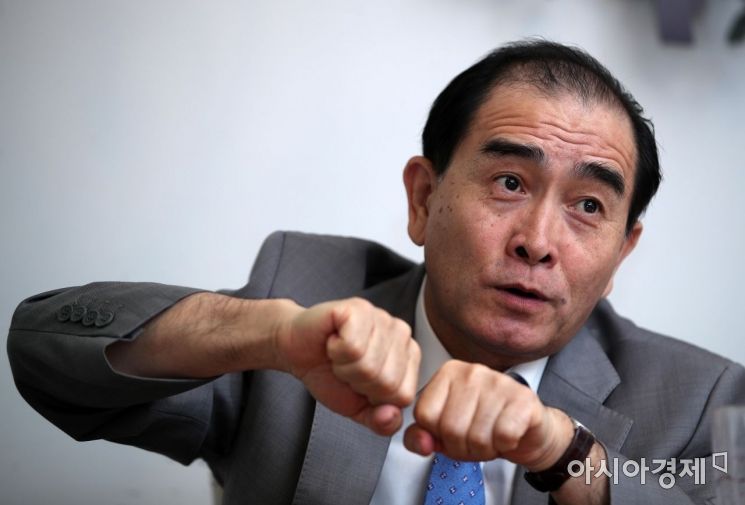
Former North Korean Embassy Charg? d'Affaires in the UK, Tae Yong-ho, has decided to run in the upcoming April 15 general election, bringing renewed attention to the history of North Korean defectors (talbukmin) challenging for seats in the National Assembly. Although there have been several attempts, only one defector has been elected through proportional representation. Tae, running under the Liberty Korea Party banner, has declared his candidacy in a Seoul district. If elected, he will become the first defector-origin district member of the National Assembly.
The first defector candidacy for the National Assembly was in 2008. Yoon Seung-gil registered as a preliminary candidate for the Grand National Party's proportional representation in the 18th general election. Yoon, who entered South Korea in 2000, declared his intention to restore freedom and human rights for North Korean residents. However, he was not selected as a final candidate and thus did not receive a parliamentary seat.
Lee Ae-ran, known as the "first female defector PhD," also ran in the 18th general election in 2008. She was placed fourth on the proportional representation list of the National Homeland Security Party. This was the first time in South Korea's 60-year party history that a defector-origin candidate was nominated for proportional representation. However, Lee failed to secure enough valid votes to be elected.
The first defector-origin National Assembly member was elected in the 19th general election in 2012. It was former lawmaker Cho Myung-chul, a North Korean elite who defected to South Korea in 1994. Born in North Korea in 1959, Cho attended Namsan High School, which was known for educating children of party officials in Pyongyang, and graduated from Kim Il-sung University with a degree in automatic control engineering. At age 28 in 1987, he became a professor in the university's economics department. While serving as an exchange professor at Nankai University in Tianjin, China, he suddenly defected to South Korea in 1994.
He later served as the head of the government-run Unification Education Institute. Cho was placed fourth on the Saenuri Party's proportional representation list, a position almost guaranteeing election, earning him the title of the first defector-origin National Assembly member.
Prior to recruiting Tae, the Liberty Korea Party also brought in Ji Sung-ho, a defector human rights activist from Hoeryong and CEO of NAUH, last month. Ji is likely to run as a proportional representation candidate. This means the second and third defector-origin National Assembly members could both emerge in this election.
 Former North Korean Embassy Minister Tae Yong-ho is answering reporters' questions after announcing his entry into the Liberty Korea Party and candidacy for the April 15 general election district at the National Assembly on the 11th.
 At a press conference held at the National Assembly that day, former Charg? d'Affaires Tae stated, "If I am elected as a member of the National Assembly of the Republic of Korea, especially as a district member, all the elites in North Korea who play a pivotal role in maintaining the regime, my former colleagues working as diplomats around the world, and especially the good-hearted North Korean residents yearning for freedom will have not just hope but certainty."
He added, "The moment North Korean residents and elites confirm that someone like Tae Yong-ho, who spent his life as a North Korean diplomat, can serve as a representative directly elected by the people of the Republic of Korea in a constitutional institution, the true unification we desire will take a significant step closer."
Meanwhile, the number of defector voters in the 21st general election is expected to exceed at least 25,000. As of the end of last year, the number of defectors who have entered South Korea was 33,523. During the 20th general election, the defector population was about 28,800, with approximately 25,500 registered voters. Defectors who settle in South Korea after escaping North Korea are granted voting rights following a government joint investigation that takes one to three months.
© The Asia Business Daily(www.asiae.co.kr). All rights reserved.
![User Who Sold Erroneously Deposited Bitcoins to Repay Debt and Fund Entertainment... What Did the Supreme Court Decide in 2021? [Legal Issue Check]](https://cwcontent.asiae.co.kr/asiaresize/183/2026020910431234020_1770601391.png)
















