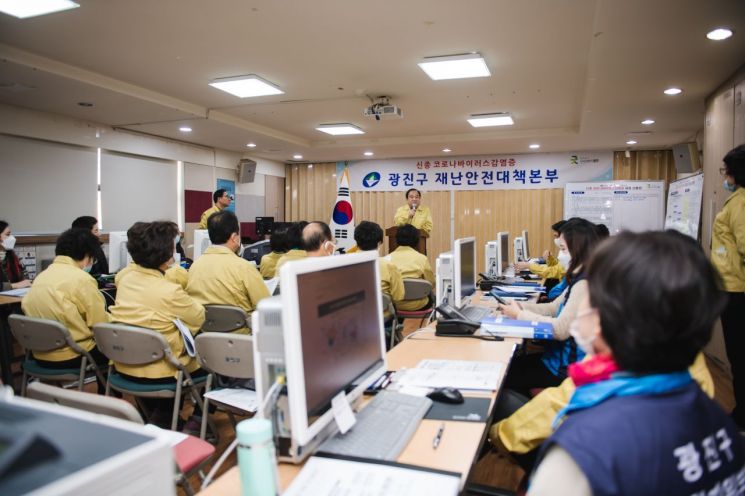
[Asia Economy Reporter Jong-il Park] On the morning of the 10th, the Gwangjin District Council postponed the originally scheduled 231st extraordinary session and attended a countermeasure briefing held at the Gwangjin District Disaster and Safety Countermeasures Headquarters Situation Room in response to the spread of the novel coronavirus infection.
This meeting was urgently convened to receive reports on the district's infection prevention response and management status and to discuss preventive measures, as the number of confirmed cases in Korea increased to 27 as of February 10, and the novel coronavirus rapidly spread.
The council members urged the district to make every effort in prevention and took time to deliver encouragement gifts to the district employees who were exhausted from their heavy workload.
During the briefing, the Director of the Safety and Environment Bureau and the Head of the Public Health Center reported on Gwangjin District’s response status, explained the district’s major efforts to block community infection, the response procedures for suspected patients, and the current management status to the council members, emphasizing that they are doing their best to minimize infection damage to residents.
Following this, Chairman Goyang-seok said, “On behalf of the residents, I express my gratitude as the district, led by Mayor Kim Seon-gap, is proactively operating the Disaster and Safety Countermeasures Headquarters and responding swiftly and actively to the novel coronavirus infection.” He added, “Along with the executive branch, the Gwangjin District Council members have gathered here today to consider the proactive role the council should play.”
He also stated, “As district council members who meet many residents on the front lines and represent their voices, I will take the lead in ensuring that accurate knowledge and response measures are clearly understood through today’s meeting so that correct information is delivered to the residents.”
Among the Gwangjin District council members present, Councilor Park Soon-bok proposed inquiries about the “safety of disinfectants used in each neighborhood’s disinfection activities and guidance on the correct use of disinfectants,” as well as suggestions for “improving the treatment of disinfection workers such as the Saemaeul Disinfection Volunteer Corps” and “prioritizing the allocation of disinfectants to areas densely populated by Chinese residents.”
Councilor Moon Kyung-sook inquired about the “disinfection status of food culture streets and traditional markets” and requested “continuous priority support of disinfection supplies such as masks and hand sanitizers for multi-use facilities.”
Chairman Goyang-seok emphasized that “it is urgent to prepare measures to revive the local commercial districts that have been depressed due to the novel coronavirus,” noting that misinformation about the infectious disease is spreading fear and anxiety, making it even harder for small business owners. He said, “Thorough response to infectious diseases and proper publicity are more important than anything else.”
Councilor Jang Kyung-hee pointed out that since the responsible institutions differ among educational institutions such as daycare centers, kindergartens, and universities, the response systems are inconsistent, causing confusion among residents on the front lines. She urged “close cooperation among institutions to implement consistent policies.”
Councilor Kim Hoe-geun inquired about the district’s “operation status of screening clinics” and the “epidemiological investigation system when suspected patients occur.” He also asked about the “virus blocking effect of general masks as well as medical masks” and what “topics are mainly covered during telephone consultations when virus infection is suspected,” which many residents are curious about.
Finally, Councilor Jang Gil-cheon proposed ways for “professional organizations in each neighborhood to participate in disinfection activities along with the Saemaeul Disinfection Volunteer Corps,” striving to improve the treatment of disinfection workers. He also suggested reviewing the “temporary suspension of operations of educational institutions densely populated by Chinese residents” for the safety of residents.
Gwangjin District is operating a 24-hour emergency disinfection system and screening clinics around the clock to prevent the spread of the infection. It is conducting preventive activities focused on multi-use facilities to block community infection and promoting preventive guidelines through various media, thereby establishing a response system.
Gwangjin District Council members are participating in emergency disinfection activities focusing on vulnerable areas by neighborhood, areas densely populated by Chinese residents, and multi-use facilities in each electoral district. They are also conducting sterilization and disinfection work throughout the council building, which many residents visit, making every effort to prevent the novel coronavirus.
© The Asia Business Daily(www.asiae.co.kr). All rights reserved.
![User Who Sold Erroneously Deposited Bitcoins to Repay Debt and Fund Entertainment... What Did the Supreme Court Decide in 2021? [Legal Issue Check]](https://cwcontent.asiae.co.kr/asiaresize/183/2026020910431234020_1770601391.png)