Japanese Manga Sparks Controversy by Naming Villain 'Maruta'
Domestic Fans Launch Hashtag Campaign and Petition to Ban Airing
Japanese Netizens Claim "Koreans Are Nitpicking"
Original Creator Says "No Intent... Will Change Name"
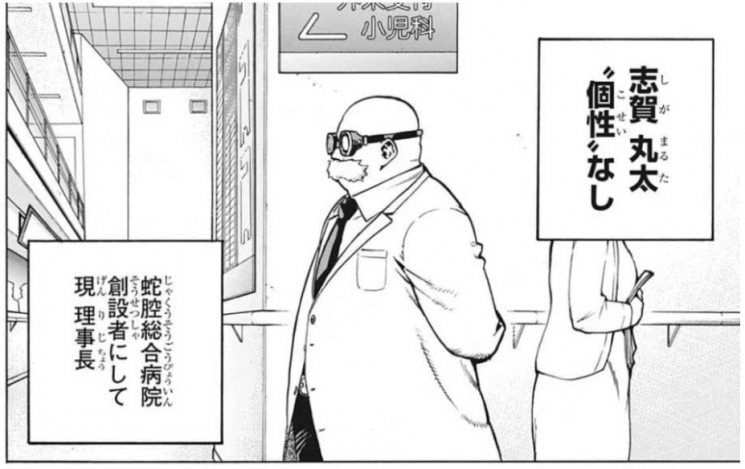 Chapter 259 of the manga "My Hero Academia," released through the Japanese manga magazine "Weekly Shonen Jump" published on the 3rd / Photo by Online Community Capture
[Asia Economy Reporter Kim Ga-yeon] A recent Japanese manga has sparked controversy due to depictions reminiscent of human experiments conducted by the Japanese military during World War II. Domestic fans who subscribed to the manga expressed disappointment and urged the original author to apologize through search word campaigns, while some fans defended the work as an over-interpretation, leading to ongoing debates.
The 259th chapter of the manga My Hero Academia was released on the 3rd in the Japanese manga magazine Weekly Shonen Jump.
Immediately after the magazine's release, controversy arose in South Korea over the name of a character in the manga. The villain, who kidnaps children and modifies their bodies to create monsters called "Brain Monsters," was named "Shiga Maruta" (志賀丸太).
The term "Maruta" was used by the Japanese military's Unit 731 during World War II to refer to human test subjects and literally means "log" in Japanese. Unit 731 is known to have conducted biological experiments on about 600 people annually since 1940. At least 3,000 victims died from these experiments, including Koreans, Chinese, Russians, and Mongolians.
My Hero Academia has been serialized in Shonen Jump since 2014. So far, 25 volumes have been published, selling over 25 million copies, and it has been adapted into a TV anime, gaining significant popularity. It is also widely popular in South Korea, where it is known as "Hiroaka," so the impact is expected to be considerable.
Fans have used social media to launch search word campaigns with hashtags like "Apologize Horikoshi Maruta" and "#APOLOGIZE_HORIKOSHI," demanding an apology from the original author.
Some have argued, "Isn't this a misunderstanding of the author's intent?"
Some fans claimed, "Naming the villain 'Maruta' could be seen as a criticism and reflection on past human experiments," "The word 'Maruta' itself means 'log,' so it is not problematic," and "The author might not have known."
In response to these claims, one netizen said, "If the author truly did not know the historical facts about 'Maruta,' would they have given a doctor who performs biological experiments a name meaning 'log'?" and added, "The use of the name 'Maruta' itself is intentional."
Another netizen, who had loved the work enough to buy manga books and merchandise, said, "It hurts my heart that this situation has arisen," but also stated, "Using the term 'Maruta' clearly mocks the victims." They added, "I will no longer consume this work."
On the 4th, a petition was posted on the Blue House (Cheong Wa Dae) national petition board calling for a ban on the domestic broadcast of the manga.
The petitioner emphasized, "It has been revealed for the first time that a character conducting cruel biological experiments in a manga currently serialized in Japan's Shonen Jump is named 'Shiga Maruta.' Not only Chinese but also Koreans were subjected to these cruel biological experiments. Thousands of people were victims of biological dissection, which remains a painful history."
They continued, "I no longer want My Hero Academia, which uses the name Maruta, to be broadcast in Korea. I oppose the domestic airing of My Hero Academia and urge a ban on its broadcast."
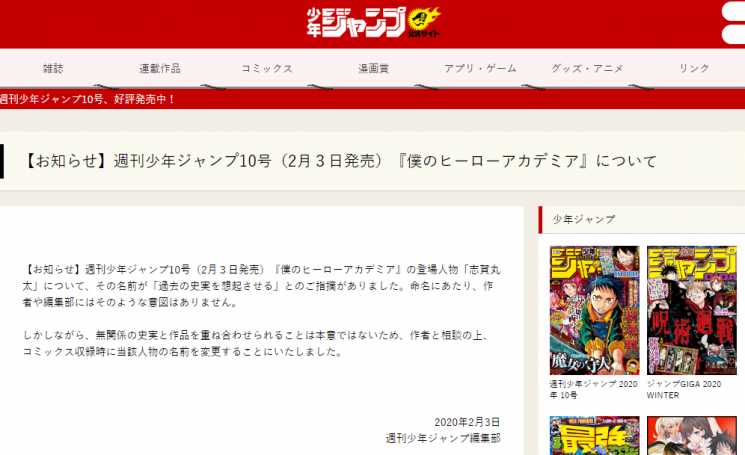 The official website of the manga publisher Shueisha clarified the controversy surrounding 'Maruta' in a notice on the 3rd. Photo by Shueisha official website screenshot
Meanwhile, Japanese netizens responded to the controversy by stating it is "an infringement on freedom of expression."
According to Yahoo Japan, one netizen said, "There is no need to easily succumb to things where it is unclear what is true or false," adding, "I wonder if it really did not evoke such associations, but the word itself is commonly used in daily life." They continued, "If it was used as slang and not an official term, then this is just nitpicking like the Rising Sun flag issue," and concluded, "They should not have given in."
Another netizen said, "I don't think the character's name needs to be changed," adding, "It is the name the author thought of, so it is best to leave it as is. If you don't like it, don't watch it."
Other netizens reacted with comments such as, "Then should the expression 'log cabin' also be banned now?", "This is nitpicking," "What kind of creativity is this?" and "This sets a bad precedent."
As the controversy spread, the original author Kohei Horikoshi posted on Twitter on the 3rd, stating, "I have received many opinions that the name 'Shiga Maruta' in this week's manga reminds people of historical events," and added, "I did not intend to include such meaning when naming the character. I take the criticism seriously and will change the name going forward."
The manga publisher Shueisha, which publishes Weekly Shonen Jump, also issued an official statement on its website that day, saying, "There have been criticisms that the name 'Shiga Maruta' in My Hero Academia reminds people of past history," and clarified, "Neither the author nor the editorial department had such intentions."
They added, "However, since it is undesirable for unrelated facts and the work to be mentioned together, after consulting with the author, it was decided to change the character's name in the comic book editions."
© The Asia Business Daily(www.asiae.co.kr). All rights reserved.


















