Acquisition Tax Rate Adjusted to 600M-900M KRW Range from This Year
Acquisition Tax Soars for Homes Over 750M KRW
Increased Burden on Middle Class Below Seoul Median Price
[Asia Economy Reporter Moon Jiwon] Since the government adjusted the housing acquisition tax rates starting this year, concerns have been raised that the transaction tax burden on the middle class is increasing. While house prices continue to rise, the tax base remains based on standards from 10 years ago, causing the acquisition tax rate adjustments aimed at high-priced housing transactions to squeeze only genuine buyers.
This issue has arisen since the government subdivided the acquisition tax rates for houses priced between 600 million and 900 million KRW starting from the 1st of last month. Houses priced below 600 million KRW maintain a 1% rate, and those above 900 million KRW maintain a 3% rate, but for houses priced between 600 million and 900 million KRW, the acquisition tax rate is segmented from a minimum of 1% to a maximum of 3% depending on the specific house price.
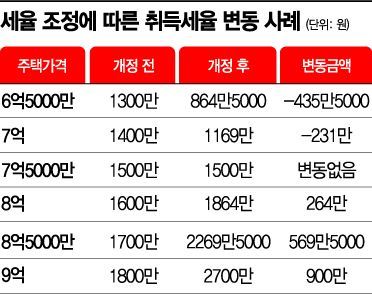
Accordingly, until last year, the acquisition tax for houses priced between 600 million and 900 million KRW was uniformly 2% of the acquisition price, but from this year, the tax rate increases by 0.0066 percentage points for every 1 million KRW increase in purchase price within this range. In this case, for a reference price of 750 million KRW, amounts below this are subject to a 1-2% tax rate, reducing the acquisition tax burden, whereas houses priced above this amount are subject to a 2-3% tax rate, increasing the burden.
For example, if the purchase price is 800 million KRW, the acquisition tax rises from 16 million KRW to 18.64 million KRW, an increase of 2.64 million KRW; if the purchase price is 900 million KRW, it jumps from 18 million KRW to 27 million KRW, an increase of 9 million KRW. If an apartment larger than 85㎡ is purchased for 900 million KRW in Seoul this year, the total acquisition-related taxes, including the special rural tax and local education tax, amount to 30.6 million KRW.
The problem is that since the December 16 real estate measures, the rise in house prices in Seoul has concentrated on houses priced between 600 million and 900 million KRW. Considering that the median price of apartments in Seoul calculated by KB Kookmin Bank has exceeded 900 million KRW at 912.16 million KRW, the tax reform has rather increased the transaction tax burden on genuine buyers.
The median price refers to the price located exactly in the middle when house prices are arranged in simple order. The fact that the median price has exceeded 900 million KRW means that more than half of the apartments in Seoul are priced higher than this amount. Even in the survey by the Korea Real Estate Board, which tends to provide relatively conservative statistics, the median price of apartments in Seoul has risen to 839.2 million KRW.
According to an analysis by Asia Economy using the Ministry of Land, Infrastructure and Transport's real transaction price disclosure system, last month there were a total of 285 transactions nationwide for houses priced between 750 million and 900 million KRW, of which 112 cases (39.2%) occurred in Seoul. The transaction areas were concentrated in Seongbuk, Dongdaemun, Gangseo, Nowon, and Gangdong districts. These are mostly areas with active transactions by genuine buyers and are far from the Gangnam area targeted by the government.
These areas are also places where house prices surged due to the balloon effect following the government's December 16 measures. For example, the 84㎡ exclusive apartment in Hwagok-dong, Gangseo-gu, Hwagok Prugio, was traded below 750 million KRW until early December last year but now forms a market price around 780 million KRW, about 30 million KRW higher. The adjustment of acquisition tax rates has thus increased the tax burden.
Kwon Il, head of the research team at Real Estate Info, said, "Since the median price of apartments in Seoul has already exceeded 900 million KRW and not all people owning houses priced between 700 million and 900 million KRW in Seoul are wealthy, it is true that the increase in transaction tax has increased the burden on these (middle-class) people."
This is also criticized for contradicting the government's policy direction of "strengthening holding taxes while lowering transaction taxes" to stabilize the real estate market. Although the overall acquisition tax burden may decrease somewhat due to this acquisition tax rate revision, the transaction tax burden on genuine buyers has also increased.
An industry insider pointed out, "Due to the recent rapid rise in house prices, the past standard that houses over 900 million KRW are considered high-priced has lost its meaning," and added, "There is a need to reset the tax base reference point reflecting the current reality."
© The Asia Business Daily(www.asiae.co.kr). All rights reserved.












