[Asia Economy Reporter Lee Chun-hee] Korea Land and Housing Corporation (LH) is set to actively promote the 'Public Participation Type Street Housing Maintenance Project,' which grants special benefits such as expanded recognized area and increased floor area ratio for street housing maintenance projects when public entities participate as public implementers in existing maintenance projects, thereby securing public interest.
According to industry sources on the 3rd, the Ministry of Land, Infrastructure and Transport, LH, and the Seoul Metropolitan Government have decided to actively promote the public participation type street housing maintenance project starting this month, holding two project briefing sessions in April and May.
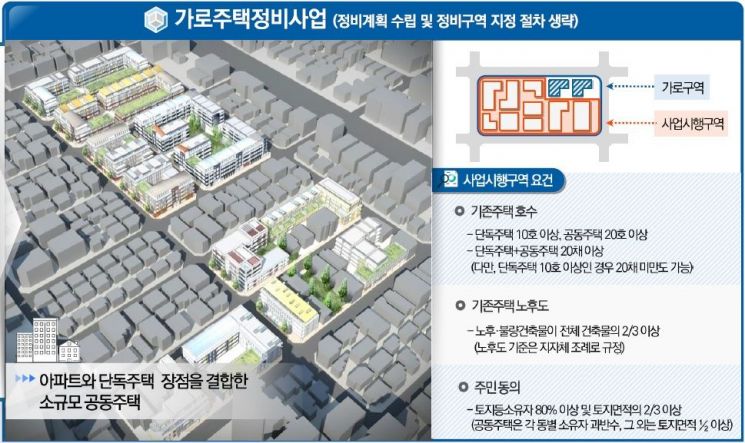
The street housing maintenance project is a reconstruction project carried out on small-scale land plots surrounded by roads. Introduced in August 2012 as an alternative to large-scale maintenance projects, LH reports that there are currently 97 associations within Seoul city. However, many projects have faced difficulties due to lack of profitability and other reasons. In response, the government announced regulatory relaxations through the December 16 real estate measures last year, allowing expansion of project feasibility if public entities such as LH participate to secure public interest in street housing maintenance projects.
If public participation occurs or if more than 10% of public rental housing is supplied, the recognized project area can be increased from the current maximum of 10,000㎡ to 20,000㎡, and the floor area ratio can be raised up to the legal limit. The related amendment to the Enforcement Decree of the 'Special Act on Vacant Houses and Small-scale Housing Maintenance' was also announced for legislative notice last month.
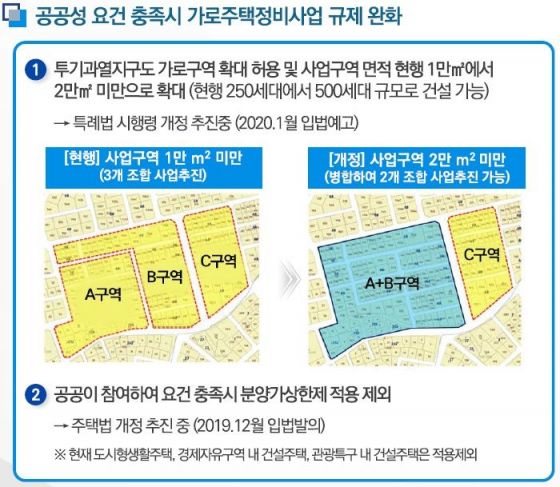
According to a simulation case presented by LH, a project site in Gwangjin-gu currently being pursued as a low-rise small-scale apartment complex with a floor area ratio of 200% and up to 7 floors, each under 10,000㎡, has a supply scale of only about 266 units. However, if promoted as a public participation type, the floor area ratio can be increased to 250%, allowing construction up to 15 floors, and the supply scale can increase to approximately 350 units.
In this case, the number of general sale units increases from 116 to 130, resulting in reduced contributions for association members. Additionally, the number of Happy Housing units increases by 70, expanding the supply of rental housing.
LH plans to hold briefing sessions this month targeting areas where street housing maintenance projects are currently underway. In May, additional briefing sessions will be held to discover new candidate sites for project promotion within Seoul. After the briefing sessions, projects will proceed through a public offering and agreement signing between LH and residents. According to LH, there are currently 9,750 locations in Seoul that meet the street housing maintenance district requirements, of which 2,065 are realistically feasible for project promotion after excluding maintenance districts and commercial areas.
Meanwhile, for the newly promoted street housing maintenance projects, the LH’s sole public implementation method is likely to become the main approach rather than the existing joint implementation method with associations. This is because it does not require separate association formation or legal consent requirements such as general meetings, enabling faster project promotion.
An LH official stated, "We will take the lead in promoting public participation street housing maintenance projects in downtown Seoul and contribute to expanding housing supply in urban areas by spreading the projects throughout low-rise residential areas in the metropolitan area through institutional improvements and private cooperation."
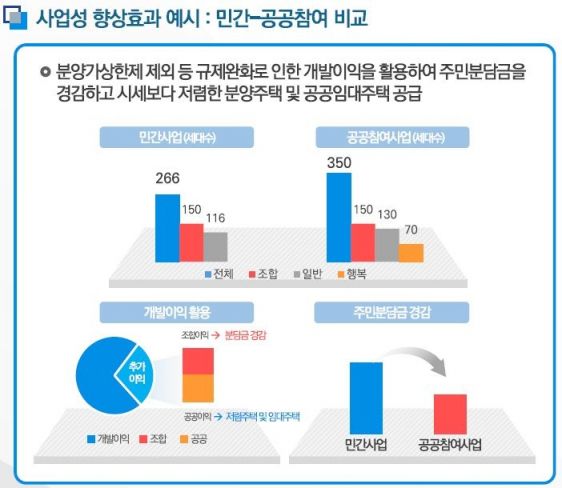 ▲ An example of an analysis of business improvement effects targeting a street housing maintenance project site in Gwangjin-gu (Provided by LH)
© The Asia Business Daily(www.asiae.co.kr). All rights reserved.
![Clutching a Stolen Dior Bag, Saying "I Hate Being Poor but Real"... The Grotesque Con of a "Human Knockoff" [Slate]](https://cwcontent.asiae.co.kr/asiaresize/183/2026021902243444107_1771435474.jpg)













