[Asia Economy Reporter Kim Daeseop] The Ministry of SMEs and Startups announced on the 31st that it will invest a total of 492.5 billion KRW in the Smart Manufacturing Innovation Support Project this year.
This year's budget for the Smart Manufacturing Innovation Support Project is the largest ever, increasing the project cost by 1.4 times compared to last year's 342.8 billion KRW. The support direction has also shifted from expanding the base of smart factories to advancing them.
The main projects for this smart manufacturing innovation support include ▲smart factory construction and advancement ▲manufacturing data infrastructure construction ▲robot-utilized manufacturing innovation support ▲consulting such as smart meister ▲field demand-oriented smart factory technology development, divided into 11 categories.
First, to build and advance smart factories, 415 billion KRW will be invested this year to distribute 5,600 smart factories. The goal is to distribute 30,000 smart factories by 2022. From this year, small and medium-sized enterprises (SMEs) and mid-sized companies that build and advance smart factories with their own technical personnel will also be included in the support targets.
Additionally, the 'Win-Win Smart Factory Project,' where large companies support SMEs with smart factories, will add an advancement support track. SMEs and mid-sized companies using the win-win project to advance smart factories can receive up to 180 million KRW (90 million KRW from the government and 90 million KRW from large companies, etc.) in support.
In particular, from the end of this year, SMEs and mid-sized companies are expected to be able to utilize advanced smart factory services such as diagnosing manufacturing process failures in advance through data accumulation and analysis, just like large companies.
To this end, the Ministry of SMEs and Startups will establish one manufacturing data platform and two data centers (selected through public competition, 1.5 billion KRW per center) by the end of this year. The data centers will support the collection and utilization of manufacturing data produced in smart factories, and the data platform will provide advanced data analysis and utilization services by linking with regional data centers.
Efforts will also be actively made to secure manufacturing competitiveness through robot introduction. SMEs and mid-sized companies wishing to improve processes using robots can apply for the 'Robot-Utilized Manufacturing Innovation Support' project. The ministry will support about 30 companies with a total of 8.5 billion KRW this year. The support condition is up to 300 million KRW per company (within 50% of the total project cost), and companies wishing to introduce robots should form a consortium with robot suppliers to apply.
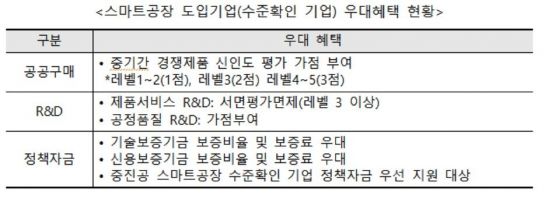
Support will also be provided for smart factory level verification. Companies that have built smart factories independently without participating in the smart factory distribution and expansion project since 2014, or companies that have advanced smart factories without government support among participating companies, will receive full support for smart factory level verification costs (800,000 KRW, 1,190 companies). Additionally, a budget of 3 billion KRW has been allocated to the 'Smart Capability Enhancement' project to support SMEs in receiving professional consulting related to smart factories.
Furthermore, 11.7 billion KRW will be provided to support field demand-oriented smart factory technology development. Support will also be provided for smart sensor leading project technology development (4.66 billion KRW) and process and quality technology development (29.6 billion KRW).
A ministry official said, "As of the end of last year, a total of 12,660 smart factories have been distributed," adding, "On average, adopting companies have increased productivity by 30%, improved quality by 43.5%, reduced costs by 15.9%, and increased on-time delivery rates by 15.5%, enhancing their competitiveness." He further explained, "Employment per company has increased by three people, and industrial accidents have decreased by 17.9%, indicating that many good jobs are also being created."
© The Asia Business Daily(www.asiae.co.kr). All rights reserved.

















