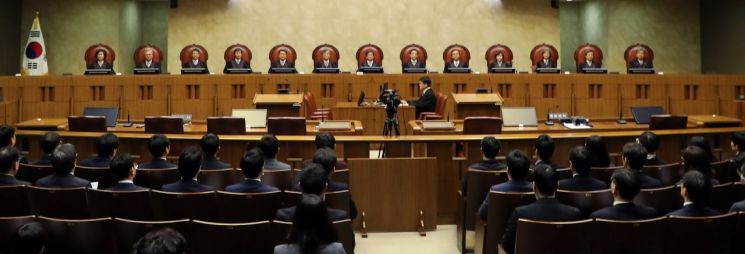
[Asia Economy Reporter Kim Hyung-min] The Supreme Court's full bench has narrowly recognized the charge of 'abuse of authority' against former Presidential Chief of Staff Kim Ki-chun and former Senior Secretary for Political Affairs Cho Yoon-sun, who were indicted in the so-called 'blacklist' case during the Park Geun-hye administration, where certain cultural and artistic figures were excluded from support, and has sent the case back for a retrial in the second trial.
On the 30th, the Supreme Court's full bench ruled that there were legal errors and insufficient examination in the second trial's judgment on the appeal case involving Kim and others for abuse of authority and obstruction of the exercise of rights, and sent the case back to the Seoul High Court with a verdict of not guilty.
This appears to be a judgment to narrow the scope of the abuse of authority crime, which has been a contentious issue. The abuse of authority crime, stipulated in Article 123 of the Criminal Act, is established when a public official abuses their authority to make a person perform an act they are not obliged to do or obstructs a person's exercise of rights. The Supreme Court emphasized the need for a stricter judgment regarding the 'act not obliged.' Accordingly, it stated that the acts committed by former Chief of Staff Kim and others should be individually judged as to whether they were 'acts not obliged' and judged differently for each. The full bench's ruling is that the second trial did not do so.
The full bench first stated, "The defendants' instruction to Ministry of Culture, Sports and Tourism officials to exclude support through employees of the Arts Council Korea, the Korean Film Council, and the Korea Publishing Culture Industry Promotion Agency constitutes an abuse of authority in collusion with former President Park Geun-hye, abusing the authority of the President, Chief of Staff, Senior Secretary for Political Affairs, Senior Secretary for Education and Culture, and the Minister of Culture, Sports and Tourism."
Accordingly, "Regarding the acts performed by employees of the Arts Council Korea, the Korean Film Council, and the Korea Publishing Culture Industry Promotion Agency that exceeded the scope of duties prescribed by law or violated legal obligations, the original court's guilty judgment recognizing these as 'making a person perform an act not obliged' is not mistaken," it said.
However, "Regarding the acts of sending various lists and reporting the progress of reviews during the ongoing public contest projects, the original court's guilty judgment recognizing these as 'making a person perform an act not obliged' contains legal errors and insufficient examination," it said. "The court should have examined whether the acts of sending each list and reporting the progress of reviews differ from previous acts and judged whether they constitute 'making a person perform an act not obliged' by reviewing violations of laws and regulations."
The original court's judgment on the charges of coercion and violation of the National Assembly Act on Testimony, Evidence, and Inspection was upheld, confirming the guilty verdict.
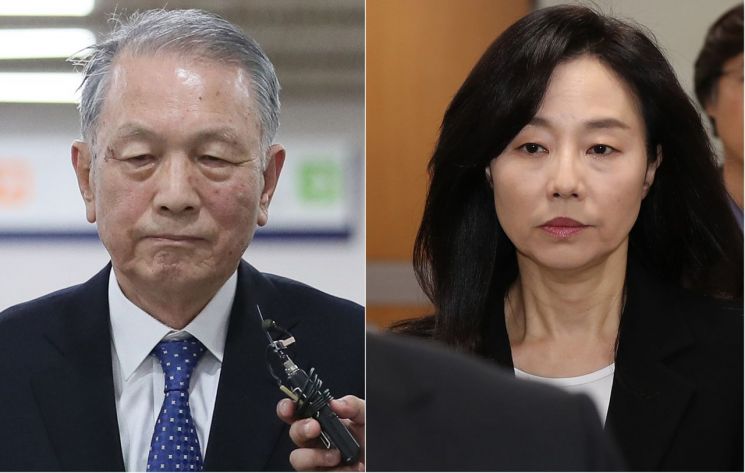
Former Chief of Staff Kim was prosecuted for creating and ordering the execution of a 'blacklist' excluding certain individuals and organizations from support during the Park Geun-hye administration to senior Blue House officials. He was also charged with conspiring with former Minister of Culture, Sports and Tourism Kim Jong-deok and others to force senior department officials to resign. Former Minister Cho was accused of selecting blacklist targets for exclusion from literary fund support and notifying the Senior Secretary for Education and Culture while serving as Senior Secretary for Political Affairs.
Both the first and second trials recognized the abuse of authority charges against former Chief of Staff Kim and others. The first trial sentenced Kim to three years in prison and Cho to one year in prison with a two-year probation. The second trial found Kim guilty of coercion, which was acquitted in the first trial, and increased his sentence to four years in prison. Cho was also sentenced to two years in prison.
© The Asia Business Daily(www.asiae.co.kr). All rights reserved.


















