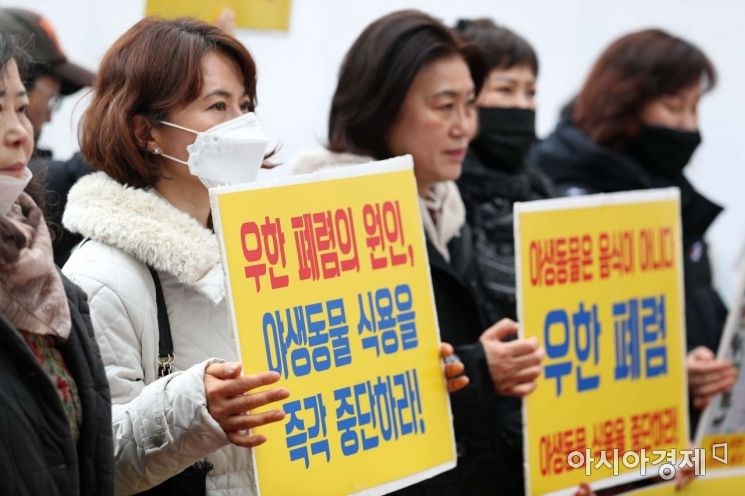
 Animal protection organizations, including the Korea Animal Protection Alliance, held a press conference on the 29th near the Chinese Embassy in Jung-gu, Seoul, condemning China's wild animal consumption culture, which is considered a cause of the novel coronavirus infection (Wuhan pneumonia). Photo by Moon Honam munonam@
[Asia Economy Reporter Choi Dae-yeol] It has been ten days since the first confirmed case of the novel coronavirus infection (Wuhan pneumonia) was reported in South Korea. Previously, on the 19th, a Chinese woman (35 years old) who arrived at Incheon Airport was detected during on-site quarantine, and was confirmed as a patient on the following day, the 20th. Subsequently, three more confirmed cases were reported sequentially. Considering that the maximum incubation period of the coronavirus is two weeks and that test results for those who had close contact with confirmed patients or were diagnosed with pneumonia after recently visiting China need to be monitored, health authorities remain on high alert.
According to the Central Disease Control Headquarters of the Korea Centers for Disease Control and Prevention on the 30th, a total of four confirmed cases have been identified in South Korea so far. Four days after the first confirmed Chinese patient, a Korean man (55 years old) was confirmed as the second patient on the 24th. During the Lunar New Year holiday period, the third (male, 54) and fourth (male, 55, both Korean) confirmed cases were added on the 26th and 27th, respectively.
No additional confirmed cases have been reported in the two days following the identification of the last patient. However, by expanding the case definitions for suspected patients and those with symptoms under investigation, the number of individuals under investigation increased to 187 (including the 4 confirmed patients) as of the previous day. From the 28th, those who entered the country from China within the last two weeks and were diagnosed with pneumonia were also included in the investigation. Among the 187 individuals under investigation, 155 had tested negative and were released from isolation by the morning of the previous day, with the remaining results expected soon.
Secondary infections, where individuals who have not traveled to China become infected through contact with confirmed patients, have not yet been confirmed domestically. All four confirmed patients either lived in or had visited Wuhan, China. However, the number of people who had contact with these confirmed patients after their arrival or return to South Korea reached 387, so our health authorities cannot rule out the possibility of secondary infections. Some countries, including Japan, have reported cases of their nationals infected without traveling to China.
Although the number of Chinese nationals entering South Korea has somewhat decreased since the Chinese government locked down Wuhan City, tens of thousands of people still enter daily from other regions within China. Recently, China has been confirming over 1,000 new cases daily, showing a rapid increase.
Jung Eun-kyung, Director of the Korea Centers for Disease Control and Prevention, said at a briefing the previous day, "It is difficult to determine whether more patients will occur in our country before the outbreak in the initial affected area overseas ends," adding, "Many experts say that the peak (epidemic period) has not yet come, and some papers suggest it could be in March. Our authorities have no choice but to closely monitor the situation." She added, "It is difficult to offer optimistic remarks."
© The Asia Business Daily(www.asiae.co.kr). All rights reserved.
![Clutching a Stolen Dior Bag, Saying "I Hate Being Poor but Real"... The Grotesque Con of a "Human Knockoff" [Slate]](https://cwcontent.asiae.co.kr/asiaresize/183/2026021902243444107_1771435474.jpg)
















