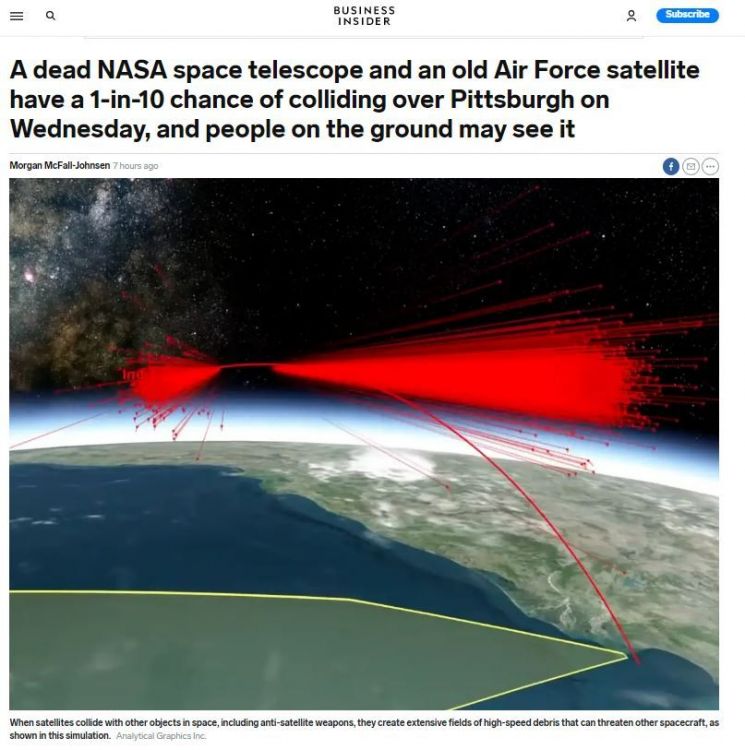
 Business Insider in the United States reported on the 28th (local time) that there is a high possibility of a collision between two US-affiliated satellites.
[Asia Economy Reporter Junho Hwang] It has been observed that two American satellites are at risk of collision. If the two satellites collide, it is expected that a massive cloud of debris will form. This debris cloud could become a significant obstacle to future human space exploration by destroying other satellites.
High Possibility of Collision Between Two Defunct Satellites
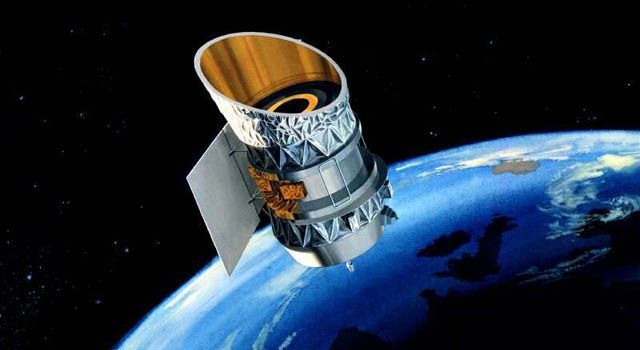
Foreign media such as Business Insider reported on the 28th (local time) that NASA, along with the Netherlands, the United Kingdom, and others, launched the infrared astronomy satellite IRAS, and the US Air Force launched GGSE-4, which are likely to collide around 6:39 PM Eastern Time on the 29th at an altitude of 900 km over Pittsburgh, Pennsylvania.
The report was based on radar observations from LeoLabs, a research organization monitoring space debris. LeoLabs tweeted that "IRAS, launched in 1983 and currently drifting in space due to fuel depletion, and GGSE-4, launched in 1967 for gravity experiments and now non-operational, could come within 15 to 30 meters of each other." The collision probability was estimated between 0.1% and 1%. In this regard, the nonprofit space research organization The Aerospace Corporation also estimated the collision probability at about 10%.
Although the probability range of 0.1% to 10% suggests a low chance of actual collision, NASA changes the International Space Station's position if the collision probability with objects in space exceeds 0.001%, indicating that this is a level of probability that requires close attention.
What About the Impact of the Debris Cloud?
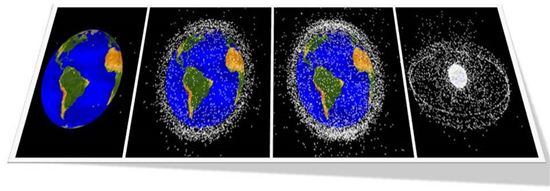 ▲Space debris orbiting the Earth is increasing rapidly. [Photo by NASA]
If a collision occurs, it is expected that the collision site could be visible to the naked eye, creating a spectacle similar to a meteor shower.
However, it is not just a simple space show. The debris cloud generated by the collision could adversely affect human space exploration. The debris cloud could damage currently operating satellites and space stations, and it could collide with satellites launched by humans in the future.
IRAS, which has an increased collision risk, carries a space telescope measuring 3.6 meters in length and 3.2 meters in width. Additionally, the two satellites are moving at a speed of 14.7 km per second, so a collision is expected to generate a massive debris field.
Roger Thomson, Senior Engineering Specialist at The Aerospace Corporation, told the media, "Because the collision energy is large, the debris is likely to spread into other orbits." He estimated that a 1 cm wide object colliding head-on at this speed could break into approximately 290,000 pieces of debris.
© The Asia Business Daily(www.asiae.co.kr). All rights reserved.


















