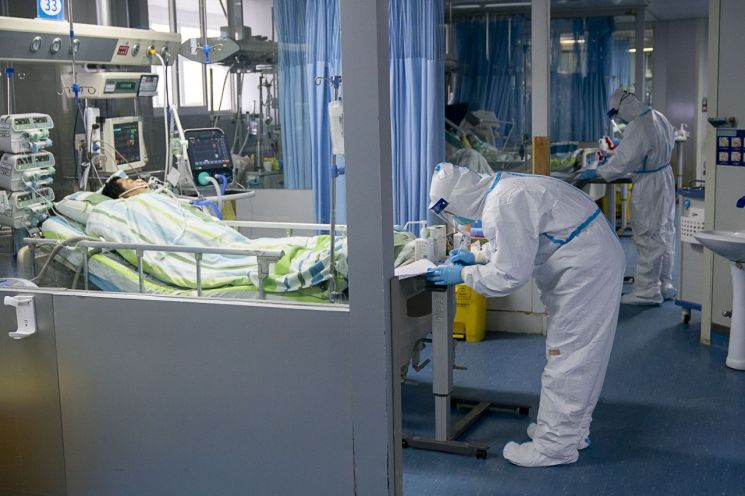
 On the 24th, medical staff wearing protective suits are caring for confirmed patients of the novel coronavirus infection (Wuhan pneumonia) in the intensive care unit of Zhongnan Hospital of Wuhan University, Hubei Province, China.
 [Asia Economy Reporter Choi Dae-yeol] The costs for testing or isolating and treating confirmed patients of the novel coronavirus infection (Wuhan pneumonia) are covered by health insurance and the government (central government and local governments). Although there may be a significant amount of out-of-pocket expenses beyond what health insurance covers, it is judged that additional damage could be substantial if proper treatment is not provided.
According to the Ministry of Health and Welfare's guidelines on medical expense support for novel infectious disease syndromes dated the 29th, based on the Infectious Disease Control and Prevention Act, the medical expenses for patients infected with the novel coronavirus are jointly borne by the National Health Insurance Corporation, the state, and local governments. The government regards diagnosis and treatment of infectious diseases as a right of the people and covers the associated costs. The support targets confirmed patients, suspected patients, and symptomatic individuals under investigation. The coverage period is from the time of isolation hospitalization until the isolation is lifted.
The support amount covers all expenses related to hospitalization treatment, investigation, and examination, but only if they are related to the novel coronavirus. Patients with Wuhan pneumonia requiring isolation hospitalization or treatment (including suspected patients and symptomatic individuals under investigation) who are admitted to nationally designated isolation hospitals following public health center guidance and are discharged after isolation are reimbursed for health insurance-covered items or medical aid co-payments by the National Health Insurance Corporation.
Other patient out-of-pocket expenses or non-covered items are supported through payments from the Korea Centers for Disease Control and Prevention or city/provincial public health centers. This includes costs such as infectious disease diagnostic testing fees and meal expenses during hospitalization. In the case of the novel coronavirus, genetic testing fees exceed 100,000 KRW per person, and using a negative pressure isolation room for isolation observation and treatment can cost several million KRW. If symptoms worsen, additional fees for various medical equipment usage are incurred.
© The Asia Business Daily(www.asiae.co.kr). All rights reserved.

















