China·Corona Fear Spreads
South Korea's Export Dependence on China at 25.12% in 2019
Trade Volume and Dependence Higher Than in 2003, Likely Causing Greater Negative Impact
"If the Situation Prolongs, Active Measures Such as Supplementary Budget Allocation Needed," Voices Raised
[Asia Economy Reporters Kim Hyunjung, Jang Sehee, Moon Chaeseok] As the novel coronavirus infection (Wuhan pneumonia) originating in the Wuhan region of China rapidly spreads worldwide, concerns are emerging that South Korea's economy, whose largest trading partner is China, will suffer a considerable impact. There is a forecast that the momentum of economic recovery could weaken, with exports, which had begun to rise this year, turning negative again. Experts diagnose that active government response is necessary, given that trade volume with China and export dependence have significantly increased compared to 2003 when Severe Acute Respiratory Syndrome (SARS) broke out.
According to experts on the 29th, the extension of China's Lunar New Year holiday due to the spread of the novel coronavirus has reduced local working days and sharply contracted domestic demand, increasing the likelihood of deterioration in South Korea's export indicators for the first quarter of this year. There are also concerns that if this situation continues until April or May, the economic damage could extend into the second quarter.
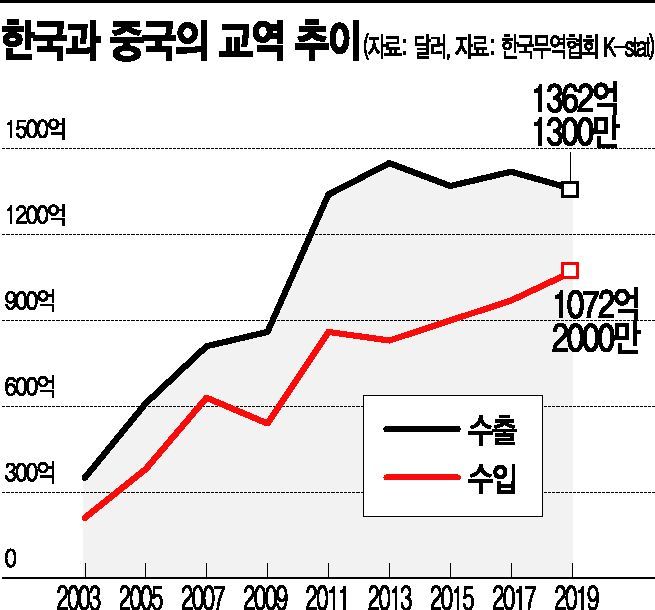
China is South Korea's largest trading partner, with bilateral trade volume (exports and imports) reaching $243.4 billion (approximately 286 trillion won) last year. Compared to 2003, when SARS caused China's GDP growth rate to drop by 1 percentage point and trade volume was $57 billion, this represents an increase of about 330%. During the same period, South Korea's export dependence on China rose from 18.12% to 25.12%. On the 28th (local time), Plenum, a U.S.-based China research institute, projected that China's first-quarter GDP growth rate could fall to the 4% range due to disease control policies. Domestic experts believe that if China's economy weakens to this extent or the situation prolongs, negative effects on South Korea's economy will be inevitable.
Joo Won, head of economic research at Hyundai Research Institute, explained, "If the infection spread is contained in the short term, the impact will be limited to short-term effects such as a sharp decline in Chinese tourists and worsened consumer sentiment due to anxiety. However, if China's domestic market weakens, South Korea's exports will be hit." He added, "Exports, which have just turned positive, could return to negative. Considering base effects and trade time lags, indicators are likely to worsen 2 to 3 months from now."
Professor Shin Sedon of Sookmyung Women's University’s Department of Economics said, "If China's growth rate falls to the 5% range or below, exports will be significantly affected." He added, "With the real economy weak and interest rates low, the fundamentals are shaky, and the outbreak of the novel coronavirus raises concerns about South Korea's inherent vulnerabilities." Professor Kim Soyoung of Seoul National University's Department of Economics also assessed, "Even a 0.1 to 0.2 percentage point drop in China's growth rate could impact our overall economy."
Some have raised the possibility of supplementary budget (추경) formulation, but the government has drawn a line, saying that discussions are premature. During the 2015 Middle East Respiratory Syndrome (MERS) outbreak in South Korea, the government prepared a related supplementary budget of about 11 trillion won. Joo emphasized, "If the situation worsens and the economy weakens compared to now, the most necessary measure would be to prepare a supplementary budget." In response, a Ministry of Economy and Finance official said, "Mentioning a supplementary budget is too hasty," explaining, "In 2003, besides SARS, there were many unexpected variables such as the credit card crisis and SK Global accounting fraud, which contributed to the decline in economic growth." The official added, "It is still difficult to assess the impact of the novel coronavirus," and "We need to observe the overall trend until around May."
© The Asia Business Daily(www.asiae.co.kr). All rights reserved.

















