Fake News and Rumors About 'Wuhan Pneumonia' Spread Rampantly
"There Is a Cure for Wuhan Pneumonia" False Information Circulates Wildly
Dissemination of Fake News Punishable by Up to 7 Years Imprisonment or Fines Up to 50 Million Won
Concealing Wuhan Pneumonia Symptoms or Falsifying Health Questionnaires Also Subject to Punishment
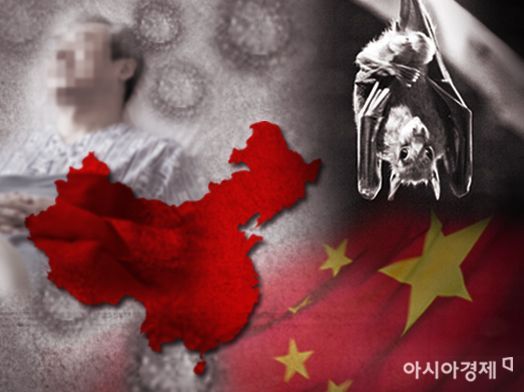
[Asia Economy Reporters Seungyoon Song and Jeongyun Lee] Office worker Lee Youngjin (29) recently received a message in a KakaoTalk group chat related to the novel coronavirus infection (Wuhan pneumonia). The message claimed that an SKT employee working at the SK Seorin Building in Jongno-gu, Seoul, was the fourth confirmed case and that the entire Seorin Building was being disinfected. Lee, who often visits the nearby area, was engulfed in anxiety just in case.
However, this message was eventually confirmed to be fake news. According to the Korea Centers for Disease Control and Prevention, the fourth confirmed case stayed only in Pyeongtaek after returning from Wuhan, China, and never visited Seoul. An SKT official also stated, "The fourth confirmed case has no connection whatsoever with SKT."
As confirmed cases of Wuhan pneumonia continue to be reported domestically, fake news is spreading indiscriminately, especially on internet communities and social networking services (SNS). Various rumors exploiting the fear of Wuhan pneumonia are also being used as a means of making money, intertwined with the competition for views on YouTube and SNS.
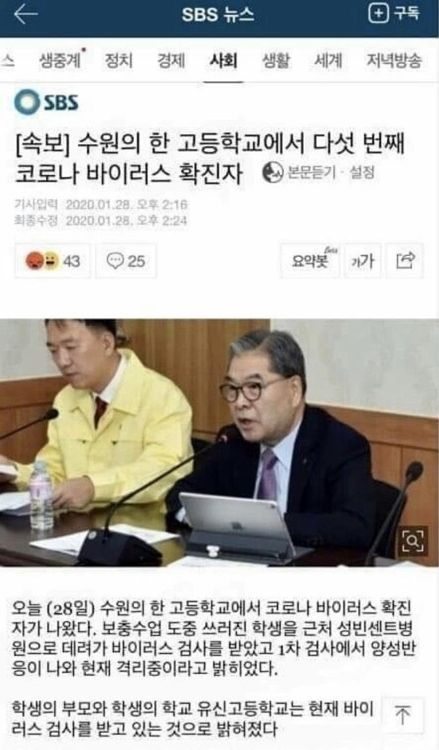
Unverified rumors such as "A Chinese person collapsed at Konkuk University Station" are being circulated, along with more specific rumors related to confirmed cases, such as "The third confirmed case collapsed at Goyang Starfield" and "Used the jjimjilbang inside Starfield." Rumors fabricated in the form of actual news are spreading recklessly, further increasing citizens' anxiety.
Incorrect information about Wuhan pneumonia is also being distributed indiscriminately. Although there is currently no vaccine or treatment for Wuhan pneumonia, promotional content claiming the existence of treatments is openly posted on YouTube. Some claim that moxibustion or drinking homemade beverages can overcome Wuhan pneumonia. Professor Lee Jaegab of Hallym University’s Department of Infectious Diseases said, "These treatments can be regarded as fake treatments that have not undergone verification such as clinical trials," adding, "If you have symptoms related to Wuhan pneumonia, you should seek measures through the Korea Centers for Disease Control and Prevention."
Such acts of spreading fake news are all serious crimes. Under current law, distributing or redistributing fake news can be punished under criminal law and the Information and Communications Network Act for defamation, obstruction of business, and violations of the Telecommunications Business Act. If charged with defamation under the Information and Communications Network Act, one could face up to seven years in prison or a fine of up to 50 million won. There have been cases where individuals were punished for spreading fake news during infectious disease outbreaks such as SARS and MERS.
Local governments and health authorities plan to respond strictly to prevent the spread of fake news. The National Police Agency is also preparing measures against fake news related to the novel coronavirus under the Cyber Safety Bureau.
The Korea Communications Standards Commission also intends to actively block misinformation about Wuhan pneumonia. A commission official explained, "To prevent the distribution of information that causes social confusion, we are deleting posts on online sites or requesting portals to strengthen monitoring," adding, "However, since it is difficult to monitor content on messengers like KakaoTalk, individual efforts to refrain from spreading such information are necessary."
Meanwhile, those who have symptoms related to Wuhan pneumonia or have visited high-risk areas but hide this information or lie to medical staff are subject to criminal punishment. The same applies to those who submit false health status questionnaires upon entry.
According to the Infectious Disease Prevention and Control Act, when the infectious disease crisis alert level is at "caution" or higher, one must not make false statements regarding the possibility of infection to medical personnel. The government has currently raised the infectious disease crisis alert from the caution level to the third level, "alert." Violations can result in imprisonment of up to one year or a fine of up to 10 million won. Refusing to cooperate with epidemiological investigations conducted by the government when infectious disease symptoms are suspected can also lead to imprisonment of up to two years or a fine of up to 20 million won.
© The Asia Business Daily(www.asiae.co.kr). All rights reserved.
![User Who Sold Erroneously Deposited Bitcoins to Repay Debt and Fund Entertainment... What Did the Supreme Court Decide in 2021? [Legal Issue Check]](https://cwcontent.asiae.co.kr/asiaresize/183/2026020910431234020_1770601391.png)
















