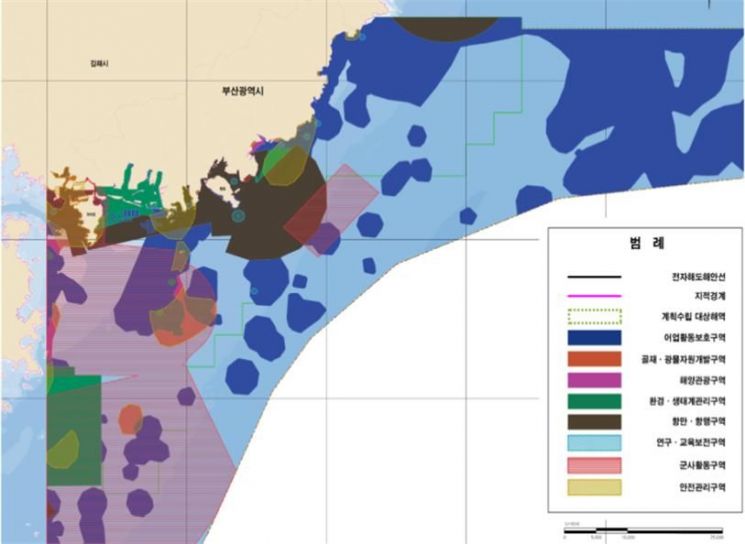
[Sejong=Asia Economy Reporter Joo Sang-don] The Ministry of Oceans and Fisheries and Busan City announced on the 29th the first marine spatial management plan for Busan and the adjacent Exclusive Economic Zone (EEZ) of Busan since the enforcement of the Marine Spatial Planning and Management Act.
Until now, the use and development of marine space on a first-come, first-served basis caused social issues such as conflicts among users and concerns over unregulated marine spatial development. In response, the government has established a foundation for integrated marine spatial management through the enactment and enforcement of the Marine Spatial Planning Act and the establishment of the Basic Marine Spatial Plan under the national agenda of 'Integrated Management and Planned Use of Marine Space.'
The spatial scope of the Busan area marine spatial management plan covers a total of 5,526.44㎢, including 2,361.54㎢ of territorial waters and 3,164.90㎢ of the Exclusive Economic Zone.
Within the territorial waters, military activity zones account for the largest proportion at 40.53%. Marine use zones are designated in the order of fishery activity protection zones (29.71%), port/navigation zones (17.36%), and safety management zones (10.52%).
In the Exclusive Economic Zone, only fishery activity protection zones (40.73%), military activity zones (18.16%), and port/navigation zones (1.07%) are designated, leaving 43.51% as undesignated waters.
Currently, there is a plan to establish an offshore wind power complex in front of Haeundae-gu and Gijang-gun in Busan, but due to insufficient local acceptance of offshore wind power during the opinion-gathering process such as regional councils and public hearings, energy development zones were not designated in this plan.
Even if marine use zones are designated, other activities are not prohibited nor are separate regulations imposed. For example, marine spaces designated as fishery activity protection zones are managed to maximize support for fishery activities, but activities that do not interfere with fishery activities are fully allowed. However, according to Article 11 of the Marine Spatial Planning Act, when administrative agencies establish and implement plans for the use, development, and conservation of marine space, the designated marine use zones must be considered in advance.
Song Myung-dal, Director of Marine Environment Policy at the Ministry of Oceans and Fisheries, said, "The establishment of the marine spatial management plan is significant as it is the first time that all activities occurring in our seas have been gathered and their uses set from an integrated perspective," adding, "We expect the marine spatial management plan to serve as a guideline for not only administrative agencies but also the general public in using the sea."
© The Asia Business Daily(www.asiae.co.kr). All rights reserved.

















