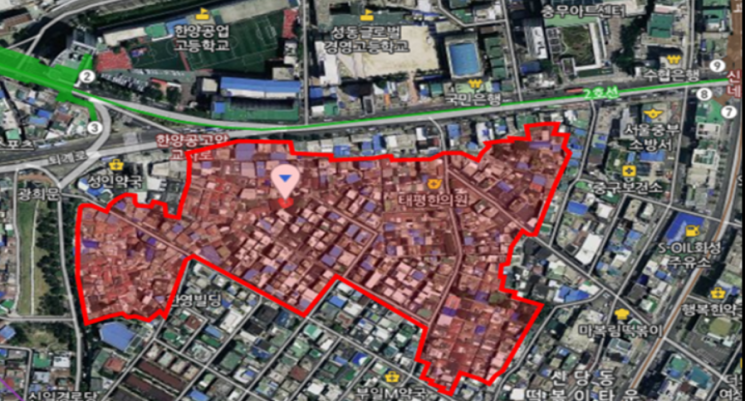
[Asia Economy Reporter Yuri Kim] Sindang 10 District in Sindang-dong, Jung-gu, Seoul, which was deregulated from the maintenance zone in 2015, is reinitiating its redevelopment project.
According to the maintenance industry on the 29th, recently Jung-gu Office is conducting a preliminary feasibility study on the former Sindang 10 District housing redevelopment project. The project covers an area of 51,750㎡ around 236 Sindang-dong, Jung-gu.
In the 2025 Seoul Metropolitan City Urban and Residential Environment Maintenance Basic Plan, a preliminary feasibility review procedure is set before designating a new maintenance zone to confirm the possibility of project promotion. This is to minimize delays in project promotion and conflicts among residents after zone designation. The preliminary feasibility study includes a rough business analysis and calculation of individual estimated contributions to assist residents' decision-making before zone designation. Jung-gu Office plans to complete the preliminary feasibility study and collect residents' opinions within the second half of this year.
The Sindang 10 District was originally a project to build 750 apartment units on 43,039㎡ around 236 Sindang-dong, Jung-gu, designated as a maintenance zone in 2006. Although the establishment of the association and project implementation approval were obtained, the project stalled due to internal conflicts while preparing for the management disposition plan approval. The association was dissolved after the Seoul High Court ruled in favor of the Emergency Measures Committee in 2008 in a lawsuit nullifying the association establishment, and the area was eventually deregulated from the maintenance zone in 2015.
The project re-promotion began in 2018. The location is excellent as a downtown station area near Dongdaemun History & Culture Park Station, a transfer station for subway lines 2, 4, and 5, and Sindang Station on lines 2 and 6. With redevelopment accelerating in nearby Sindang 8 and 9 Districts, residents' expectations for development are rising again. A Jung-gu Office official explained, "If more than 50% support and less than 25% oppose the project, the district can establish a maintenance plan," adding, "Currently, a service contract for the preliminary feasibility study has been issued."
However, there are also forecasts that the project re-promotion will not be smooth. To apply for the designation of a maintenance zone in an area where the maintenance zone was deregulated, a 'Residential Maintenance Index' score of 70 or higher out of 100 points must be obtained according to the 2025 Basic Plan. Among these, the resident consent rate accounts for the largest portion with 40 points. This requires consent from at least two-thirds of landowners and owners of more than half of the parcel area. If scores are insufficient in factors such as aging (30 points), road extension rate (15 points), and household density (15 points), a higher resident consent rate may be required.
An industry insider said, "In areas that have been deregulated once, the business feasibility is somewhat guaranteed, but re-promotion is often difficult," adding, "Increasing the consent rate for project progress will be the key."
© The Asia Business Daily(www.asiae.co.kr). All rights reserved.
![User Who Sold Erroneously Deposited Bitcoins to Repay Debt and Fund Entertainment... What Did the Supreme Court Decide in 2021? [Legal Issue Check]](https://cwcontent.asiae.co.kr/asiaresize/183/2026020910431234020_1770601391.png)