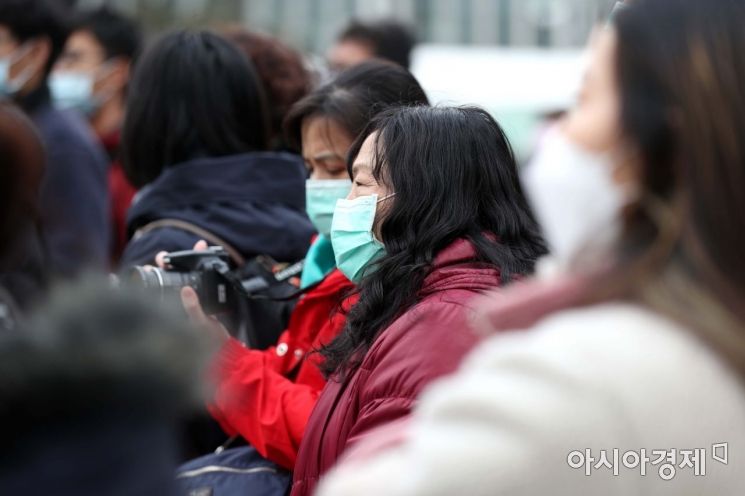
 On the 28th, as public anxiety grows over the spread of the novel coronavirus infection (Wuhan pneumonia), tourists are watching the royal guard changing ceremony at Deoksugung Palace in Jung-gu, Seoul.
 Photo by Moon Honam munonam@
[Asia Economy Reporter Lim Hye-sun] As fears of the 'Novel Coronavirus Infection (Wuhan Pneumonia)' spread, the distribution industry is on high alert. With Chinese authorities banning overseas group tours and the number of confirmed cases of the novel coronavirus increasing domestically, a reluctance to visit multi-use facilities such as department stores and duty-free shops is forming within the country. In response, the distribution industry is making every effort to prevent the spread of the novel coronavirus.
According to the distribution industry on the 28th, duty-free shops, which attract the largest number of Chinese tourists, have established response systems to prevent the spread of the novel coronavirus and ensure employee safety. Shilla and Lotte Duty Free have each formed emergency response committees chaired by President Han In-gyu (Head of Duty-Free Business Division) and CEO Lee Gap, respectively, and are operating a constant response system.
Shilla Duty Free installed thermal imaging cameras at employee entrances to check for fever symptoms and instructed workers to wear health masks.
Additionally, they have strengthened in-store disinfection conducted at least once a day and decided to carry out professional disinfection at least once a week.
Lotte Duty Free is also implementing Δmandatory mask-wearing for employees Δbiweekly disinfection of stores and delivery areas Δexpanded placement of hand sanitizers within stores (at information desks and cash registers) Δdistribution of masks to customers. Employees returning from China will be granted a 14-day leave followed by observation.
Department stores and large supermarkets have also applied strict preventive measures. Lotte Shopping has made it mandatory for all employees to wear hygiene masks and banned food sampling at high-risk stores frequently visited by foreigners. Hand sanitizers and wet tissues have been placed in all stores.
Shinsegae Department Store requires sales staff to wear masks and disinfects escalator handrails every hour. They also plan to place hand sanitizers at department store entrances and conduct disinfection in restrooms, elevator halls and interiors, and store entrances.
The convenience store industry has also introduced preventive measures. GS25, Seven Eleven, and CU have made hand sanitizing mandatory for all store employees and recommend mask-wearing. In the case of Seven Eleven, special supervision is being conducted to ensure mask-wearing among employees at about 40 stores located in areas with many tourists such as airports, Myeongdong, and Jamsil.
Cosmetics companies have also established response plans. AmorePacific will implement remote work for employees who have visited major outbreak areas of Wuhan Pneumonia during the Lunar New Year holiday period.
The reason the distribution industry is responding so swiftly is to prevent a 'second Middle East Respiratory Syndrome (MERS) incident.' During the MERS outbreak in 2015, distribution companies suffered severe sales damage. According to the Ministry of Trade, Industry and Energy, department store sales dropped by 11.9% and large supermarket sales by 10.2% in June 2015 compared to the previous year, immediately after the MERS outbreak.
© The Asia Business Daily(www.asiae.co.kr). All rights reserved.

















